–The Liberian Post’s Inaugural Government Performance Grading Report
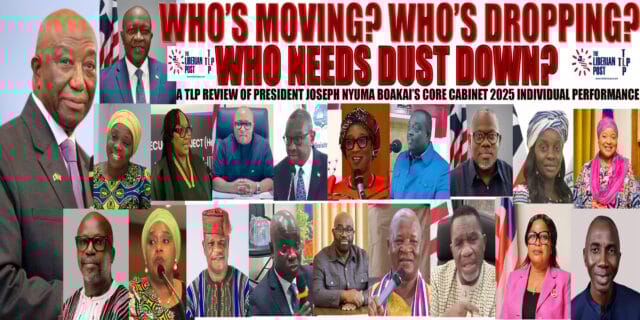
MONROVIA, Liberia – Today, The Liberian Post (TLP) unveils its inaugural Performance Assessment and Grading Report of the Unity Party–led Government under the stewardship of President Joseph Nyuma Boakai. Branded under the headline “Who’s Moving, Who’s Dropping, Who Needs Dust Down,” this evaluation launches a new annual tradition in which TLP rigorously examines the effectiveness, leadership, and accountability of the administration’s central decision-makers.
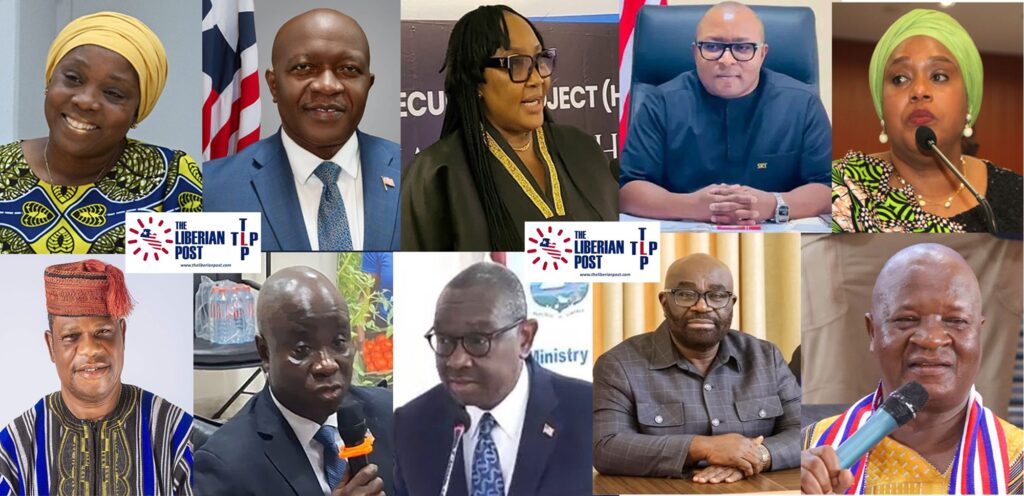
This first edition focuses exclusively on the nineteen Cabinet Ministers who form the core governance structure of the Boakai Administration. These officials drive national policy, oversee critical sectors, and collectively determine whether the government delivers on its commitments to the Liberian people.
Assessing performance across the period of January 2025 through December 2025 has been a demanding and methodical exercise. It required detailed analysis of policy decisions, sectoral outcomes, institutional reforms, administrative conduct, and the broader governance climate. The result is a comprehensive grading that reflects not only individual ministerial impact but also the overall capacity of the government to govern effectively.
The report concludes with an overarching grade for President Boakai himself — acknowledging that every minister serves at his will and pleasure, and that their collective performance ultimately mirrors the direction, discipline, and leadership he provides.
Brigadier General (Ret.) Geraldine Janet George, Minister of National Defense
Brief Background
Brigadier General (Retired) Geraldine Janet George is Liberia’s first woman to serve as Minister of National Defense. She joined the Armed Forces of Liberia in 2006, rose through key command and staff positions, and served as Deputy Chief of Staff before her appointment as minister.
2025 Performance Summary — Highs, Lows & Grade
Highs (2025)
- Institutional Governance & Policy Strengthening
Minister George has overseen a significant policy reform effort within the Ministry of National Defense, formalizing governance practices. On 3 July 2025, she signed eleven key policy documents covering accounting, procurement, risk management, internal audit, and other institutional control areas — measures aimed at modernizing the ministry’s internal systems and improving transparency. - Advancement of Gender Equality in Defense
In November 2025, she led a landmark inclusion initiative with UN Women focused on expanding women’s participation in peacekeeping and defense roles. The initiative includes recruitment campaigns, training programs, and policy reviews to support gender and social inclusion within the Armed Forces of Liberia. This reflects a strategic push toward structural change in a traditionally male-dominated sector. - Diplomatic and International Engagements
Throughout 2025, Minister George represented Liberia in key engagements with international partners, including defense and security meetings with foreign diplomats and allied military representatives (e.g., strategic bilateral coverage, such as visits involving foreign embassies to Liberia’s defense institutions).
Lows / Challenges (2025)
- Limited Public Record of Operational Outcomes
While institutional reforms and policy documents are important, there is limited publicly verifiable evidence in 2025 specifically linking the ministry’s activities to broader improvements in national security outcomes (e.g., measurable improvements in defense readiness, border security metrics, or operational performance). This makes it difficult to evaluate the impact of reforms beyond organizational policy and strategic planning. - Structural Constraints Persist in Defense Sector
Liberia’s defense sector continues to face longstanding structural challenges — resource constraints, training needs, and limited peacekeeping deployment gaps — which are not yet resolved. While these are not unique to Minister George’s tenure, they shape the context in which her accomplishments are measured.
Grade: B — Very Good Performance with Clear Progress but Partial Execution Evidence
Grade Rationale: Minister George has overseen notable institutional governance improvements and taken a visible leadership role in advancing gender inclusion and organizational policy frameworks. These are important steps that align with modernization goals for the Ministry of National Defense.
However, because quantifiable operational or security outcomes attributable to 2025 policies are not well documented in public sources, there is insufficient evidence to raise the grade to an A-level.
The B grade reflects strong leadership and positive reform agenda execution, balanced against limited publicly reported outcomes for operational defense performance in 2025.
Augustine Kpehe Ngafuan — Minister of Finance & Development Planning
Highs
- Publicly emphasized progress on Liberia’s Millennium Challenge Corporation (MCC) scorecard and cited meeting key indicators (passing 12 of 22 indicators; meeting “hard hurdles” such as control of corruption and political rights), which bolstered Liberia’s eligibility for compact funding conversations and signaled improved macro-policy stewardship. Because of his tenacity and oversight under the full supervision of President Joseph Nyuma Boakai, Ngafuan finally secured the second Compact for Liberia.
- Took a visible role in donor and multilateral engagement, helping present Liberia as improving on fiscal governance—important for investor confidence and budget support negotiations.
- Ngafuan shuttled between Washington and Monrovia leading a team of professionals and experts to plead Liberia’s case with the MCC folks.
- The Finance Minister is noted for “firsts”. For the first time in Liberia’s history, he has taken the country’s budget to billion. During his first stint as Finance Minister more than 10 years ago, through his efforts and managerial skills under the supervision of former President Ellen Johnson Sirleaf, Liberia’s foreign debt in billions of dollars was wiped clean. He’s associated with “billions”.
- He is good at crisis management. When USAID pulled out, naysayers predicted doom for the economy. More than US$300 million in aid was ended. He kept the economy steady, stable and on the right trajectory: civil servants take pay on time; there have been no shortfall in the budget; etc.
Lows
- Despite positive messaging on scorecards, Liberia continued to face fiscal pressure and public concern over budget allocation and service delivery; some civil-society reporting noted ongoing governance gaps (asset-declaration suspensions applied broadly across the public sector in 2025). This constrained the perceived immediacy of gains.
Grade: A+
Rationale: Demonstrable progress on the MCC indicators and active external diplomacy are strong achievements in 2025; however, fiscal constraints and the broader anti-corruption enforcement actions suggest work remains on domestic governance and transparency.
Sara Beysolow Nyanti — Minister of Foreign Affairs
Highs
- Led a visible diplomatic recovery in 2025: high-level engagements with ECOWAS and the U.S., and instrumental roles in talks about U.S. investment in Liberia’s critical-minerals sector. Reporting credits her with helping secure international confidence that contributed to Liberia’s strong standing (including the country’s UN Security Council non-permanent seat election for 2026–27).
- Implemented passport service reforms (decentralization and upgraded security processes) and represented Liberia in several high-impact multilateral meetings; civil society and media gave positive coverage of her diplomatic campaign in 2025.
Lows
- Diplomatic gains have not yet fully translated into rapid domestic investments (investment deals remain in negotiation phases), and public expectation management has been a challenge—some stakeholders expected faster on-the-ground projects. This is a common lag between diplomacy and investment realization.
Grade: A-
Rationale: Strong diplomacy and visible results in restoring Liberia’s international profile; the principal limitation is execution speed on converting diplomatic momentum into concrete, timely investment outcomes.
Dr. Louise Mapleh Kpoto — Minister of Health & Social Welfare
Highs
- Continued rollout of health-system improvements begun earlier (PSA oxygen plants, hospital construction pipelines, stronger immunization and vaccine integration work, and partnerships on infectious-disease units). WHO/AFRO and sector reporting highlight these technical gains as material improvements for service capacity.
- Active donor coordination and public messaging around rebuilding trust with international health partners, which contributed to renewed external assistance discussions in 2025.
Lows
- Despite infrastructure projects, service delivery gaps persist in rural areas and human resource shortages remain a recurring constraint; timelines for new facilities and equipment delivery have slipped in places. Local reporting flagged uneven implementation across counties.
Grade: B+
Rationale: Clear technical progress and improved donor relations; execution and equity of service delivery need further improvement to justify a higher rating.
Roland Lafayette Giddings — Minister of Public Works
Highs
- Continued emphasis on infrastructure repairs and contracts to improve ports, roads, and public buildings—public communications and government releases show multiple project starts and procurement activity in 2025 (consistent with the government’s ARREST agenda).
Lows
- Infrastructure project delivery faced frequent criticisms: delays, procurement scrutiny, and public frustration over slow visible progress in some counties. Additionally, the broader asset-declaration and suspension actions affecting officials undermined public confidence in procurement transparency. (Reporting on large-scale projects in Liberia in 2025 highlighted governance and delivery risk as recurring themes.)
Grade: B-
Rationale: Programmatic intent and project starts are positive, but delivery and transparency concerns reduce the effective performance grade.
Ministry of Commerce & Industry — Minister: Hon. Magdalene Ellen Dagoseh.
Highs (2025)
- Leadership & institutional reset: Magdalene E. Dagoseh officially assumed the ministry in December 2024 and has led the ministry’s public outreach throughout 2025, signaling continuity after the departure of the previous minister.
- Strategic planning: The ministry under Dagoseh began validation of a new Five-Year Strategic Plan, an important step toward clarifying priorities for trade, MSME support, and industrial policy.
- SME & trade engagement: The minister has been visible at national MSME conferences and trade-promotion events, highlighting work on improving market access, SME finance, and private-sector linkages (including the Liberia Investment, Finance and Trade — LIFT — project).
- External relations: Dagoseh has engaged bilateral and multilateral partners (e.g., recent meetings with the Chinese Embassy), indicating active diplomacy to attract trade and investment support.
Lows / Challenges (2025)
- Structural constraints remain: Liberia’s economy remains highly import dependent and vulnerable to price shocks (e.g., rice, fuel), and progress in reducing these structural vulnerabilities was limited in 2025; the ministry’s strategic planning is necessary but still early in implementation.
- Delivery vs. design: Much of 2025 under Dagoseh appears focused on planning, stakeholder consultation, and promotional activity rather than on clear, measurable delivery outcomes (e.g., rapid improvements in trade facilitation metrics, tariff reforms, or large investment closures). Implementation milestones will be the true test.
Grade (2025): B
Rationale: Minister Dagoseh has provided steady, visible leadership, advanced strategic planning, and engaged key stakeholders (positive early-stage performance). However, 2025 was primarily a preparation and engagement year; measurable delivery on reform and structural changes remains to be seen. Until implementation yields demonstrable results, a B is a balanced, evidence-based grade.
Minister of State for Presidential Affairs
- Current Minister (since September 2025): Hon. Samuel A. Stevquoah.
- Predecessor (deceased August 2025): Hon. Sylvester M. Grigsby.
Brief note / context
- President Boakai nominated Samuel A. Stevquoah to serve as Minister of State for Presidential Affairs on 7 September 2025, following the death of Sylvester M. Grigsby in August 2025. The Executive Mansion press release and multiple national outlets reported the appointment.
Provisional 2025 “Highs / Lows / Grade” for Hon. Samuel A. Stevquoah (September–December 2025)
- Highs
- Provided rapid continuity at the presidential chief-of-staff level after a period of transition, helping stabilize cabinet coordination during the remainder of 2025.
- Publicly involved in commission/administrative activities immediately after appointment, signaling executive intent to keep the ARREST agenda on track.
- Lows / Limitations
- Short time in office during 2025 (appointment in September) limits the observable policy or delivery record for that year. No substantial, independently verifiable achievements or failures attributable solely to him are yet on public record for 2025. He made a flop during his confirmation hearing when he told senators that he doesn’t know about the construction of the condos in President Boakai’s hometown of Foya, Lofa County.
- Grade (2025, provisional): B- (Incomplete Data) — appointment ensured continuity and prevented a leadership gap, but it is too early to judge programmatic results.
Cllr. Cooper Kruah — Minister of Labor
Highs
- Continued engagement on labor standards, workplace regulations and dialogue with unions and employers; official statements and media coverage show the ministry engaged on employment policy and workplace safety matters in 2025.
Lows
- High youth unemployment and informal sector vulnerabilities persisted; systemic problems in matching education/training to labor market demand limited visible impact from ministry initiatives over a single year. These are structural and slow-moving problems.
- Was found mixing politics with policy when Senator Abraham Dillon called him out for his handling of work permit.
Grade: C+
Rationale: Policy engagement is necessary and ongoing, but outcomes against unemployment and informal employment were limited in 2025.
Francis Sakila Nyumalin — Minister of Internal Affairs
Highs
- Continued decentralization efforts, county-level administrative management, and coordination of local governance programs; official notes and cabinet pages show routine activity in managing county administrations.
- Credited for organizing the first‑ever National Assembly of Chiefs and Tribal Governors Conference. The traditional leaders praised him for his leadership and coordination of the state’s internal affairs.
Lows
- Local governance capacity gaps and some public reports of uneven delivery of services at the county level persisted. The asset-declaration enforcement and related suspensions also created operational interruptions for some county administrators in 2025. Some have accused him of excesses citing his ‘family relations’ to the President.
Grade: B-
Rationale: Necessary administrative work was done, but tangible improvements in county service delivery remained uneven.
Jerolinmek Matthew Piah — Minister of Information, Culture & Tourism
Highs
- Actively managed government communications, cultural outreach and tourism promotion; public media shows visible presence in national communications and cultural events. Some civil society acknowledgement of improved outreach and transparency in ministerial communication during the year.
- In May of 2025 became the first Minister of MICAT to take attempt to take the government’s communication arm to the people, through a program he launched— “Kapa Kulono”, which is a Kpelle language for “Come, Let’s Talk”.
Lows
- Public trust and perception remain fragile due to larger governance controversies during 2025; the ministry’s communication efforts sometimes struggled to get ahead of rapidly evolving negative headlines (e.g., public protests, parliament fire in related national coverage). Some think that by this time, strategic media houses and or personalities should have been running with the latest development coming from the US MCC if the Ministry has been farsighted because nearly every intellectual knew that the big announcement was coming, surely. But the Ministry is always “second the motion”. Minister Piah and subordinates became very combative at times with opposition figures.
Grade: B–
Rationale: Professional communications and outreach were evident, but the ministry’s capacity to shape public perception was limited by systemic governance events outside its direct control.
Cllr. N. Oswald Tweh — Minister of Justice & Attorney-General
Highs
- Under his leadership, the Ministry of Justice, Liberia (MoJ) completed “Cycle II” of the “Responsible Citizens Justice Program (RCJP),” certifying 38 youths as “Justice Ambassadors.” This suggests a push for civic engagement, legal awareness, and reform-oriented outreach in the justice sector.
- The Ministry also completed construction / dedication of a perimeter fence at a rural prison (Bopolu Central Prison, Gbarpolu County), demonstrating efforts to improve prison infrastructure and security — an area often neglected in Liberia’s correctional system.
- The MoJ’s Gender & Social Inclusion Unit conducted internal gender-sensitivity training for staff, which suggests attention to institutional culture and human-rights compliance.
Lows / Challenges
- I found no publicly accessible, credible reporting for 2025 on major reforms like anti-corruption prosecutions, reduction in prison overcrowding, justice system efficiency, or landmark legal reforms. Without visible outcomes, it is hard to say whether institutional improvements beyond symbolic ones (programs, training, infrastructure) have occurred.
- Given broader national concerns around corruption and governance in 2025 (including mass suspensions of public officials for failing to declare assets), the justice system’s performance under Tweh may still be perceived as under pressure. I found no public record showing the MoJ took a leading, visible role to prosecute high-level corruption or restore public confidence at a large scale.
Grade: B- (Provisional)
Rationale: The efforts in civic-education outreach, gender training, and prison infrastructure are legitimate positives, but the absence of clear, high-impact justice reforms or transparency measures limits the rating.
Sekou M. Kromah — Minister of Posts & Telecommunications (Postmaster-General)
Highs
- He remains the nominal head of the Ministry of Posts and Telecommunications, Liberia (MOPT), which implies continuity in leadership for this sector.
- Maintenance of organizational structure (ministries, deputies, assistant ministers) under his leadership suggests institutional stability in the sector.
Lows / Challenges
- I found no credible 2025 reporting indicating major achievements under his tenure — no noticeable improvements in telecommunications infrastructure, expansion of postal services, digital communications reforms, or regulatory breakthroughs.
- Given the critical importance of telecoms for economic development, lack of visible public-facing progress represents a missed opportunity. There is no public record of new initiatives, regulatory reforms, or improvements in rural connectivity attributable to MOPT under his stewardship in 2025.
Grade: Incomplete Data / C
Rationale: With minimal public evidence of action or outcomes, it’s not possible to conclude that meaningful progress has been made — but also not enough to condemn underperformance. Until more data becomes available, the ministry remains at baseline.
J. Alexander Nuetah — Minister of Agriculture
Highs
- His academic and technical background — including a Ph.D. in agricultural economics — and previous experience in economic planning suggest a strong foundation for evidence-based agricultural policy.
- Under his leadership, the Ministry of Agriculture, Liberia is reportedly working toward implementing a new long-term strategic plan: the “LIBERIANS FEED YOURSELVES AGENDA” dubbed “National Agriculture Development Plan 2025–2029 (NADP)”. That plan, if realized, could reshape the agricultural sector’s value-chain — from production to marketing.
- The ministry maintained public communications and engagement with stakeholders and donors, which is important for mobilizing support, financing, and technical assistance.
Lows / Challenges
- I found no independent public evaluation from 2025 showing tangible output from the NADP yet — such as increased crop yields, exports, food-security improvements, or rural farmer uptake. Until such metrics are available, progress remains largely on paper and plans.
- Liberia’s structural agricultural challenges — weak infrastructure, limited access to finance for farmers, rural distribution inefficiencies — continue to pose risks. Without early implementation milestones, the promise of reform remains speculative.
Grade: B (Tentative)
Rationale: The minister appears to have set a credible long-term agenda and leveraged technical expertise; however, 2025 seems to be largely preparatory and strategic rather than delivery-oriented. Real impact remains to be demonstrated.
Wilmot J. M. Paye / R. Matenokay Tingban — Ministry of Lands, Mines & Energy
Because there was a leadership change in 2025, I treat them together.
Background: As of early 2025, Paye held the post; on October 27, 2025, President Boakai replaced him with Tingban.
Highs (Paye period / 2025 early)
- The ministry under Paye overseen ongoing resource-sector engagement; the government continued public discussion of mining and energy-sector reforms, which is critical given global demand for minerals and energy.
- Paye’s oversight likely helped maintain baseline operations in the sector, avoiding disruption during a politically sensitive period when mining and energy remain key to national growth prospects.

Lows (leading to his dismissal)
- According to a widely circulated 2025 report, the government replaced him citing governance concerns and to improve investor confidence amid major talks with foreign investors in Liberia’s critical-minerals sector.
- The leadership turnover in the last quarter of the year indicates that under Paye, the ministry did not sufficiently satisfy political or investor expectations; this suggests limited progress on reforms or transparency needed to unlock critical-mineral investment.
Under new Minister (Tingban, from October 2025) — Early Indicators
- Appointment of a new minister signals a renewed push to reposition the sector for foreign investment, especially in light of Liberia’s identified deposits of lithium, cobalt, manganese, and rare earths, which are attractive to global green-tech supply chains.
- For 2025 this reshuffle signals potential gains ahead; but as of December 2025 there is no public record yet of major new deals or sector transformation under Tingban.
Grade for 2025: C (Overall, for the Ministry of Lands, Mines & Energy)
Rationale: The mid-year change reflects poor performance under the prior minister. The new minister’s impact is still emergent. Until clear investment deals or reforms materialize, the ministry’s performance remains mediocre overall.
Dr. Jarso Maley Jallah — Minister of Education
Highs
- Only “high” I think worthy of mentioning is that in May of 2025 during one of the Finance Ministry’s “deep dives” sessions, Minister Dr. Jallah disclosed the construction of 100 schools around the country. The funding, in the tune of US$90 million, will be sourced and provided by the World Bank.
Status / Data Limitations
- While she is listed among the cabinet ministers under 2025 administration, I found no credible, substantial public documentation for 2025 that describes major reforms, policies, or measurable achievements under her leadership.
- Given the broad challenges facing Liberia’s education sector (funding, infrastructure, teacher training, rural access), the absence of public reporting in 2025 suggests there has been no major, reportable breakthrough this year.
Grade: Incomplete Data / C-
Rationale: Lack of visible action — whether productive or disastrous — makes evaluation difficult. Until independent assessments or public policy milestones appear, the ministry under Jallah remains opaque.
J. Cole Bangalu — Minister of Youth & Sports
Status / Data Limitations
- J. Cole Bangalu is listed as the minister for Youth & Sports in the 2025 cabinet roster.
- I found no public 2025 reporting on major youth-oriented programs, sports infrastructure development, youth employment initiatives, or national sports achievements directly tied to his tenure.
Grade: Incomplete Data / C
Rationale: Without publicly documented activity or outcomes, it’s impossible to assess whether the ministry made progress or failed to act.
Sirleaf Ralph Tyler — Minister of Transport
Status / Data Limitations
- He is listed as holding the Transport ministry in 2025.
- I found no credible reports in 2025 about major transport-infrastructure projects begun/completed, railway/roads/port upgrades, or policy reforms under his leadership. Given the long-term nature of transport projects, lack of public record likely means limited visible activity in 2025. In July of 2025, a serious controversy erupted and there were protests daily at the Ministry and on the grounds of the Capitol by workers of the Ministry. A controversial parallelled role was assigned to the Liberia Traffic Management (LTM). That confusion has not been resolved.
Grade: C (Baseline)
Rationale: In the absence of evidence for strong initiative or failure, the default baseline grade reflects neither achievement nor clear failure.
Gbeme Horace Kollie — Minister of Gender, Children & Social Protection
Status / Data Limitations
- Ms. Kollie is listed among the cabinet ministers for 2025.
- I found no public 2025 reports highlighting significant policy roll-outs, social-protection schemes, children/women-safeguarding initiatives, or impact assessments under her leadership.
Grade: Incomplete Data / C
Rationale: Without visible documented activity or metrics, evaluation is not feasible; the ministry remains functionally silent in public reporting for 2025.
Mamaka Bility — Minister of State without Portfolio
Status / Data Limitations
- The 2025 cabinet list includes her in this role.
- As is typical for “state without portfolio” positions, public duties and responsibilities are often diffuse — they may involve special assignments, inter-ministerial coordination, or ad-hoc diplomacy. I found no clear public record of specific initiatives or outcomes tied to her role in 2025.
Grade: Incomplete Data / C
Rationale: The nature of the portfolio — and absence of public reporting — preclude meaningful assessment.
Presidential Oversight Assessment
Since cabinet performance reflects the President’s hiring decisions, strategic direction, enforcement capacity, and ability to coordinate government, we evaluate President Boakai on:
Strengths (Highs)
- Strong appointments in high-diplomacy and macroeconomic portfolios, leading to MCC progress, improved scorecards, and increased international confidence.
- Visible governance efforts (e.g., enforcement of asset declaration), showing political will.
- Stability in the core leadership team and strong momentum in foreign affairs and finance.
Weaknesses (Lows)
- Underperformance in essential domestic ministries (Education, Transport, Youth & Sports, Gender, LME early period).
- Uneven delivery and slow improvements in social-service and infrastructure-heavy sectors.
- Mid-year disruption from mass suspensions, which—although driven by anti-corruption objectives—affected continuity and operational capacity across government.
5. Final Grade for President Boakai (2025)
Overall Grade: B
Interpretation:
A solid, above-average performance, driven by strong diplomacy, improved international credibility, and governance reform intentions — but slowed by uneven execution and weak performance in several key domestic ministries.
Not a failing year, not an exceptional year — but a stabilizing and reform-oriented year with room for stronger delivery in 2026.