–Policy Analyst Challenges Former Finance Minister’s CDC Anniversary Remarks, Citing Road Project Timeline and Fresh Financing Agreements to Defend Unity Party’s Infrastructure Record
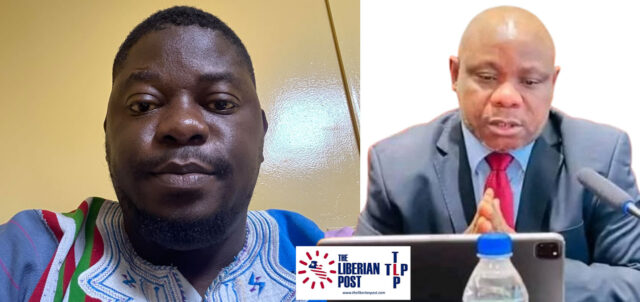
MONROVIA – A sharp war of words has erupted over Liberia’s infrastructure record after policy analyst S. Emmanuel Lloyd launched a detailed rebuttal to claims made by former Finance Minister Samuel D. Tweah, Jr. during the Congress for Democratic Change (CDC)’s 22nd anniversary celebration in Zwedru, Grand Gedeh County.
Tweah had credited the former CDC-led administration with initiating and financing major national infrastructure projects, including the Ganta–Zwedru Highway, the southeastern road corridor and key electricity projects, while criticizing the current Unity Party administration for failing to mobilize comparable investments.
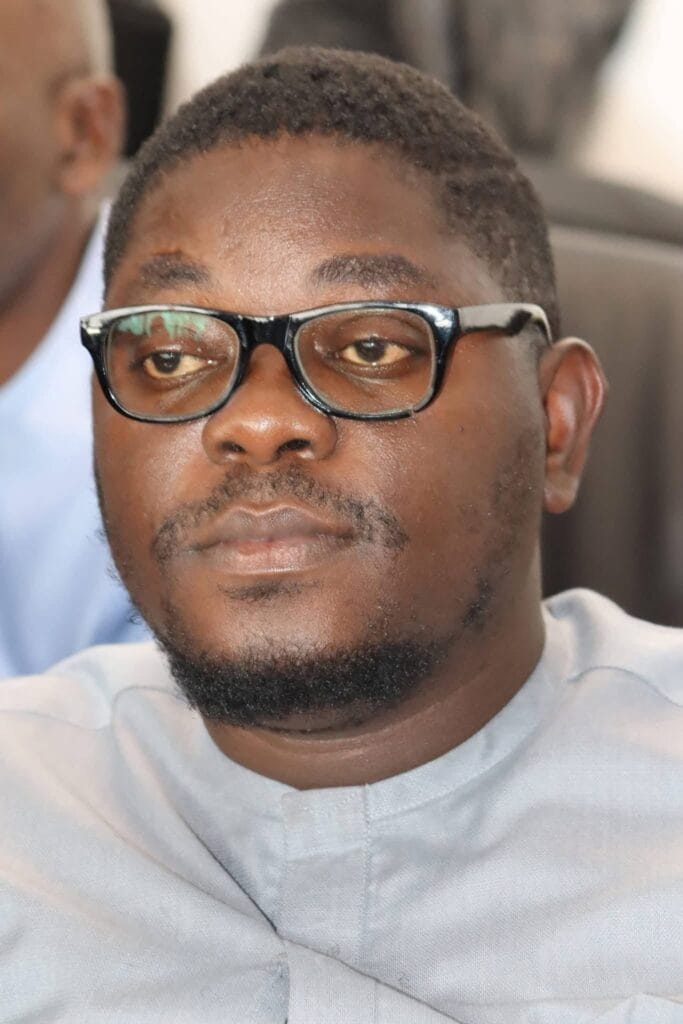
But in a lengthy response titled “Infrastructure Is Built on Implementation, Not Rhetoric,” Lloyd accused the former Finance Minister of presenting what he described as an incomplete and misleading account of Liberia’s development history.
According to Lloyd, the true measure of any government’s infrastructure record lies not in the number of financing agreements it signs, but in its ability to satisfy implementation conditions and deliver completed projects.
The latest exchange comes few months after Lloyd publicly disputed another claim made by Tweah regarding the introduction of Liberia’s Value Added Tax (VAT). In that rebuttal, Lloyd argued that VAT was conceived, legislated and substantially prepared under the previous Unity Party administration before eventually taking effect years later under the CDC government.
The new response broadens the debate, shifting the focus from tax policy to one of Liberia’s most politically sensitive issues—road infrastructure.
Who Really Started the Ganta–Zwedru Highway?
At the center of Lloyd’s rebuttal is the 225-kilometer Ganta–Zwedru Highway, one of Liberia’s largest ongoing road projects.
Contrary to Tweah’s assertions, Lloyd argued that the project became financially viable after the Unity Party administration secured and signed a US$250 million financing agreement with the World Bank under the Liberia Road Asset Management Project (LIBRAMP) in October 2011.
According to him, by March 2016 approximately 325 kilometers of asphalt pavement had already been completed between Monrovia and Ganta, leaving the remaining stretch between Ganta and Zwedru to be completed by the succeeding administration.
Lloyd said that when President Joseph Nyuma Boakai’s administration assumed office in January 2024, only about 24 kilometers of pavement had been completed from Ganta toward Cocopa.
“The biggest question,” Lloyd argued, “is why the CDC government did not complete the remaining corridor after six years in office.”
Signing Agreements Is Only the Beginning
Lloyd insisted that financing agreements alone do not build roads.
He explained that externally financed infrastructure projects must satisfy several critical conditions before construction can proceed.
Among them, he said, are the completion of Resettlement Action Plans (RAPs) to compensate affected property owners, timely payment of counterpart funding, fulfillment of debt servicing obligations to maintain donor confidence and strict compliance with donor financial management rules.
“You can sign as many agreements as you wish,” Lloyd wrote.
“If those effectiveness conditions are not satisfied, implementation will inevitably be delayed.”
According to him, several infrastructure projects experienced implementation challenges between 2018 and 2023 because of delays in meeting those requirements.
Road Projects Span Successive Governments
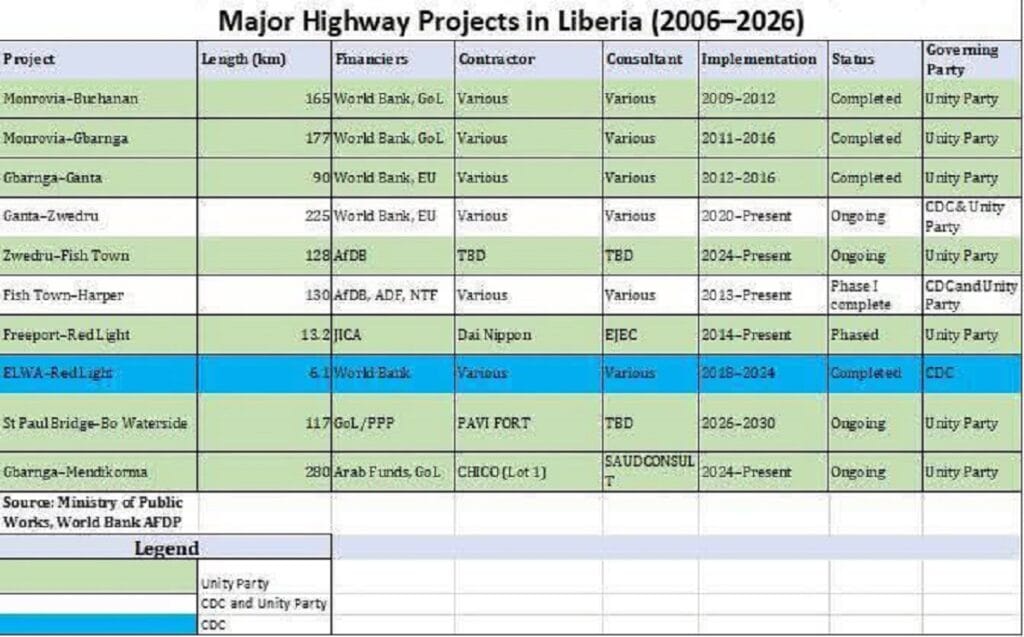
To reinforce his argument, Lloyd published a comparative timeline of Liberia’s major highway projects covering the period 2006–2026.
The chart, which Lloyd compiled using information he said was drawn from the Ministry of Public Works, the World Bank and the African Development Bank, argues that many of Liberia’s flagship highway projects have naturally spanned multiple political administrations.
According to the timeline, major corridors such as the Monrovia–Buchanan, Monrovia–Gbarnga and Gbarnga–Ganta highways were financed and completed during the Unity Party administration.
The chart further suggests that projects including the Ganta–Zwedru Highway, Fish Town–Harper Road, St. Paul Bridge–Bo Waterside Highway and the Gbarnga–Mendikorma Road have either crossed successive administrations or are currently being implemented under the Boakai administration.
The timeline also identifies the ELWA–Red Light Road as a project completed during the CDC administration.
Infrastructure specialists have long observed that large road projects typically require years of preparation—including feasibility studies, environmental and social assessments, financing negotiations, land acquisition, procurement and construction—making it common for projects to extend across multiple governments rather than being completed within a single presidential term.
Lloyd argued that this reality makes it difficult for any administration to claim exclusive ownership of projects that evolve over many years.
Ngafuan’s Agreements
Lloyd also challenged suggestions that Tweah was a superior negotiator of development financing.
Using a touch of irony, he argued that if public recognition were based solely on signing financing agreements, current Finance and Development Planning Minister Augustine Kpehe Ngafuan would deserve even greater acclaim.
He pointed to financing agreements associated with Ngafuan over the years, including projects supporting the Monrovia–Buchanan Highway, Monrovia–Ganta Road, Fishtown–Harper Corridor, Freeport–Red Light Road, the St. Paul Bridge–Bo Waterside Highway, and the recently signed US$30 million BADEA financing agreement supporting the Salayea–Voinjama Road.
“But on a more serious note,” Lloyd remarked, “real goal-getters don’t concern themselves with these petty things about who signs agreements. What matters most is implementing the agreements that have been signed.”
Electricity Financing Continues Under Boakai
Lloyd also disputed Tweah’s suggestion that financing for Liberia’s energy expansion had already been secured before the Unity Party returned to office.
He pointed to three financing agreements totaling US$125 million, signed on June 5, 2026, between the Government of Liberia and the World Bank.
According to Lloyd, the package includes:
- US$57 million in additional financing for the RESPITE Project, supporting improvements at the Mount Coffee Hydropower Plant, expansion of Liberia’s solar park from 20 megawatts to 30 megawatts, and installation of battery storage systems.
- US$50 million for the West Africa Regional Digital Integration Program (WARDIP 2) to strengthen broadband connectivity, cybersecurity and digital innovation.
- US$18 million in additional financing for the South Eastern Corridor Road Asset Management Project (SECRAMP) supporting the completion of the Ganta–Tappita Road Corridor.
Lloyd argued that the agreements demonstrate that the Boakai administration continues to mobilize substantial external financing for both infrastructure and energy development.
‘Projects Belong to the Liberian People’
Lloyd further argued that governments should avoid treating national infrastructure as political trophies.
Instead, he maintained that every administration has a responsibility to complete projects inherited from its predecessor because they are ultimately financed with public resources.
“The debate over Liberia’s road infrastructure should be grounded in facts rather than political rhetoric,” he concluded.
“Development projects of this magnitude are not measured by the number of agreements signed or groundbreaking ceremonies held. They are measured by actual implementation, timely execution and the tangible benefits delivered to the Liberian people.”
He added that the timeline of Liberia’s major highway projects demonstrates a broader lesson—that roads are national investments rather than partisan achievements.
Successive governments, he argued, inherit projects from previous administrations and bear responsibility for seeing them through to completion, just as future governments will inherit projects launched by the current administration.
Lloyd’s latest intervention adds another chapter to the increasingly public policy debate between officials and supporters of the former CDC administration and the ruling Unity Party as both sides continue to contest the narrative surrounding Liberia’s economic management and infrastructure development.
Editor’s Note: The highway timeline referenced in this story was compiled and published by policy analyst S. Emmanuel Lloyd, who cites the Ministry of Public Works, the World Bank and the African Development Bank as source material. The chart reflects Lloyd’s presentation and interpretation of the chronology of Liberia’s major highway projects.
For breaking news, in-depth analysis, and exclusive reports from Liberia and around the world, follow The Liberian Post on Facebook (https://web.facebook.com/profile.php?id=61576017166570) and X, formerly Twitter (https://x.com/LiberianPost). Visit us anytime at www.theliberianpost.com — Liberia’s credible voice, reporting with accuracy, depth, and integrity.