–Nation’s Oldest University Opens Doctoral Programs in Education and Public & International Affairs, Signaling New Era for Research, Innovation, and National Leadership Development
MONROVIA – In what education experts are likely to regard as one of the most significant milestones in Liberia’s higher education history, the University of Liberia (UL) has officially opened applications for a new suite of Doctor of Philosophy (PhD) programs, marking a transformative step in the institution’s 164-year journey from a modest college to a comprehensive national university.
The new doctoral programs, announced through a series of public notices released by the university’s Graduate School and the newly renamed IBB Graduate School of Public and International Affairs, are expected to commence in September 2026, positioning the University of Liberia to produce its own generation of doctoral-level scholars, researchers, policymakers and academic leaders.
For decades, thousands of Liberian academics seeking doctoral education have been compelled to travel abroad—often to Ghana, Nigeria, Sierra Leone, Europe, or the United States—because the country’s flagship public university lacked locally accredited PhD programs in many critical disciplines.
The launch is therefore being viewed as far more than an expansion of academic offerings; it represents a strategic investment in Liberia’s human capital and research capacity at a time when the country is seeking to strengthen public institutions, improve governance and compete in an increasingly knowledge-driven global economy.
A Historic Expansion
According to information released by the university, doctoral studies will initially be offered in three education disciplines:
- Educational Administration;
- Educational Measurement and Evaluation; and
- Curriculum Studies and Instruction.
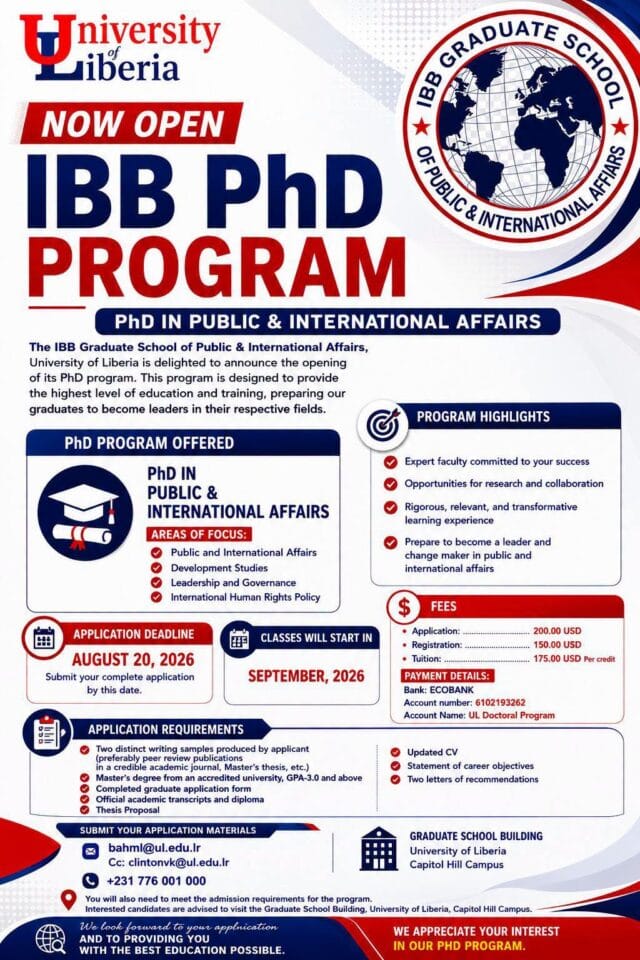
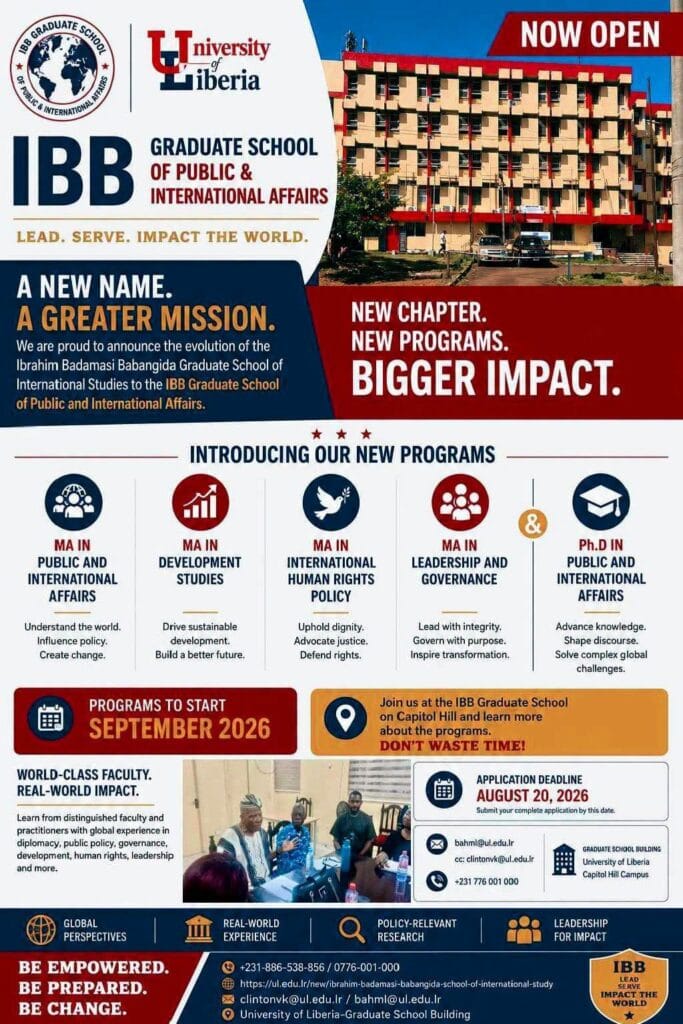
The university has also opened applications for a PhD in Public and International Affairs under the IBB Graduate School of Public and International Affairs, formerly known as the Ibrahim Badamasi Babangida Graduate School of International Studies.
The rebranding reflects what university officials describe as a broader institutional vision that expands beyond traditional international studies into public policy, governance, development, diplomacy and global affairs.
The graduate school has also announced new master’s degree programs in:
- Public and International Affairs;
- Development Studies;
- International Human Rights Policy; and
- Leadership and Governance.
University promotional materials describe the expansion as “A New Name. A Greater Mission. New Chapter. New Programs. Bigger Impact.”
An Institution Long Ready for Doctoral Education
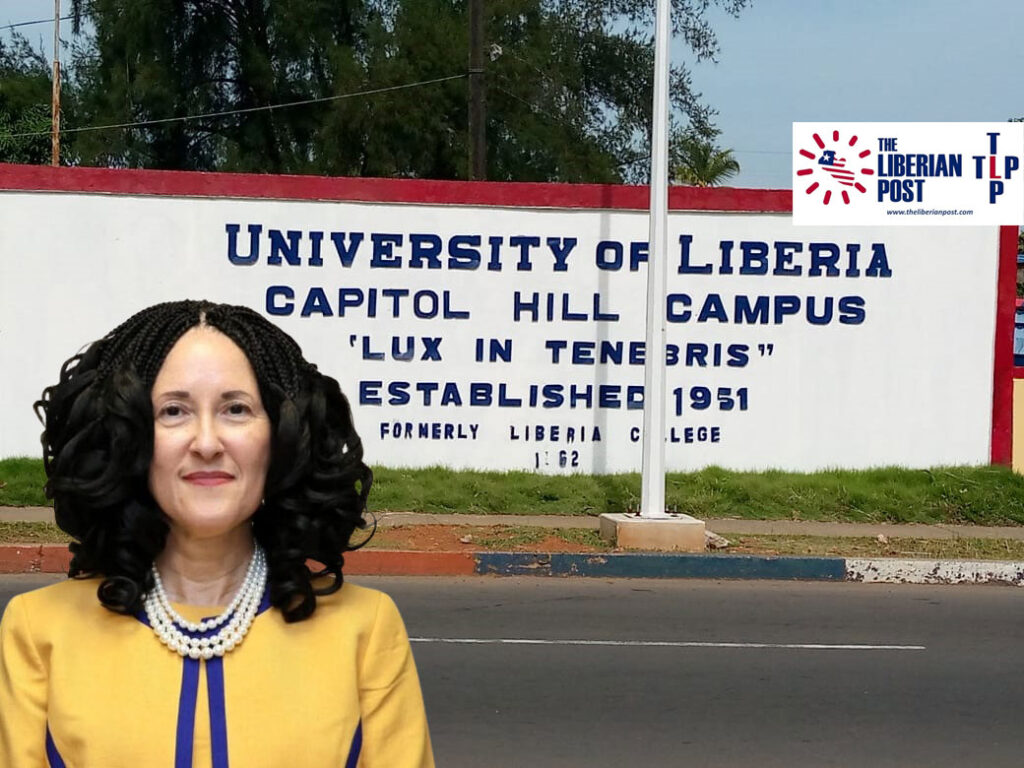
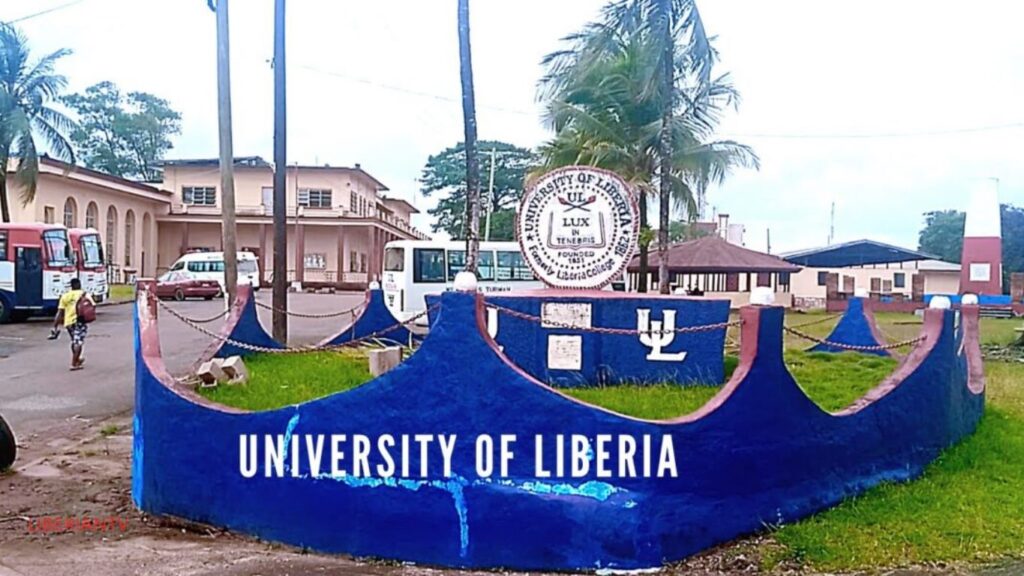
Founded in 1862 as Liberia College, the University of Liberia is the country’s oldest institution of higher learning and among the oldest universities in sub-Saharan Africa.
Throughout much of its history, UL has produced generations of Liberia’s presidents, cabinet ministers, judges, legislators, diplomats, educators, lawyers, economists, physicians and public servants.
Yet despite its historic stature and enormous contribution to nation-building, the university has long operated without a comprehensive doctoral program capable of producing homegrown PhD graduates across key academic disciplines.
Many observers have argued that this gap has forced Liberia to depend heavily on foreign universities for advanced research training, while simultaneously limiting opportunities for many qualified professionals unable to pursue expensive overseas studies.
The introduction of doctoral programs therefore addresses what many within Liberia’s academic community have regarded as one of the country’s longest-standing higher education challenges.
Strengthening National Research Capacity
The new programs are designed not only to award advanced academic qualifications but also to strengthen Liberia’s capacity for policy research, educational reform and evidence-based decision-making.
The PhD in Educational Administration aims to prepare leaders capable of managing and transforming educational institutions.
The Educational Measurement and Evaluation program will emphasize assessment systems, data analysis and educational policy evaluation—areas increasingly important for improving learning outcomes and accountability within Liberia’s education sector.
Meanwhile, Curriculum Studies and Instruction will focus on modern teaching methodologies, curriculum development and classroom innovation.
The doctoral program in Public and International Affairs will provide advanced training in governance, development policy, international relations and human rights, with an emphasis on producing scholars capable of addressing Liberia’s complex domestic and global challenges.
University officials say the programs will feature experienced faculty, opportunities for collaborative research and rigorous academic training intended to produce graduates capable of influencing policy and leading institutional reform.

Applications Now Open
Applications for the education doctoral programs will close on July 17, 2026, while applications for the PhD in Public and International Affairs remain open until August 20, 2026.
Classes for all programs are scheduled to begin in September 2026.
According to the university, applicants must satisfy established graduate admission requirements, including academic transcripts, recommendation letters, statements of purpose and other supporting documentation.
Candidates for the Public and International Affairs doctoral program will also be required to submit writing samples, a curriculum vitae and a research proposal as part of the admissions process.
A Turning Point for Higher Education
The launch comes at a time when Liberia is placing renewed emphasis on strengthening higher education, research and innovation as pillars of national development.
Recent reforms across several of the country’s tertiary institutions—including academic expansion at Cuttington University, renewed investments at Booker Washington Institute, and ongoing efforts to modernize the University of Liberia—reflect a broader recognition that sustainable national development depends on producing highly skilled professionals capable of driving innovation and solving increasingly complex challenges.
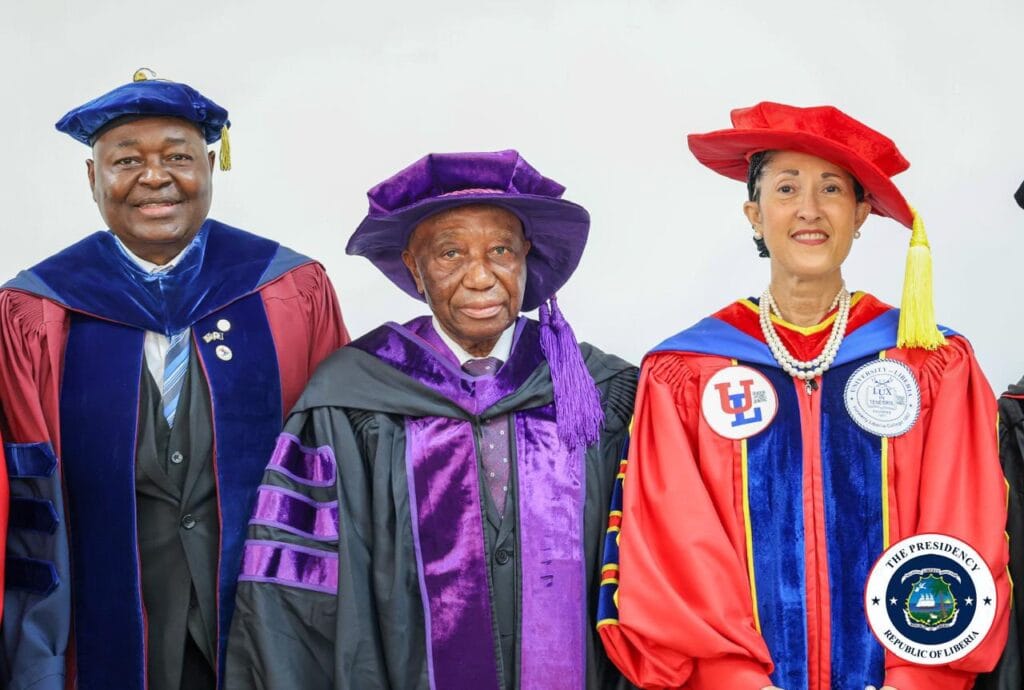
For Liberia’s flagship public university, the introduction of doctoral education marks more than a new academic offering.
It signals the beginning of a new chapter in which the University of Liberia is seeking to evolve from being primarily a teaching institution into a center for advanced scholarship, policy research and intellectual leadership.
If successfully implemented, the initiative could reduce Liberia’s dependence on foreign universities for doctoral training, strengthen local research institutions and help cultivate the next generation of scholars whose work will influence education, governance, public policy and national development for decades to come.
For an institution that has educated much of Liberia’s leadership for more than a century and a half, many educators believe the arrival of doctoral education is not simply another milestone—it is one that has been long anticipated and, perhaps, long overdue.
For breaking news, in-depth analysis, and exclusive reports from Liberia and around the world, follow The Liberian Post on Facebook (https://web.facebook.com/profile.php?id=61576017166570) and X, formerly Twitter (https://x.com/LiberianPost).