–Ambassador Lewis Brown Calls for Halt to Long-Range Strikes, Protection of Shipping and a Return to Negotiations
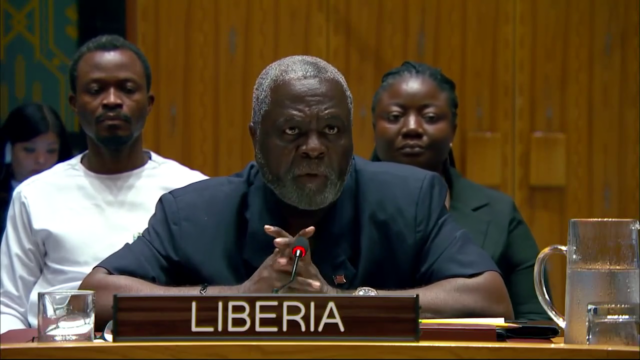
NEW YORK, United States — Liberia has called for an immediate and unconditional ceasefire in Ukraine, warning the United Nations Security Council that the continuing war is escalating with renewed intensity and exacting an increasingly devastating toll on civilians.
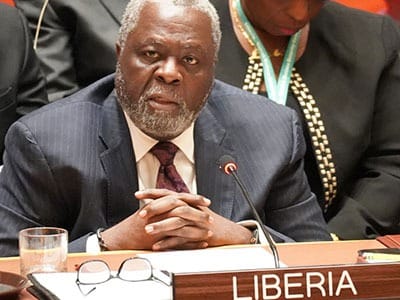
Speaking at the Security Council’s 10,212th meeting on Monday, August 24, Liberia’s Permanent Representative to the United Nations, Ambassador Lewis Garseedah Brown II, urged the parties to take immediate steps to reduce civilian suffering while working toward a comprehensive political settlement.
Brown said July was the deadliest month for civilians in Ukraine since March 2022, with at least 437 people killed and more than 2,600 injured, while child casualties reached their highest level since April 2022.
“Every month this year has been worse than the one before,” Brown told the Council, warning that the figures demonstrate that the conflict is not winding down.
“This is not a war signaling any indication of winding down. It is a war escalating with new, if not renewed, intensity,” he said.
According to Brown, long-range weapons have accounted for a significant share of civilian casualties, with much of the destruction occurring far from the front lines.
Liberian-Flagged Ships Caught in War
Brown used Liberia’s prominent position in the global maritime industry to underscore the conflict’s international consequences.
He noted that more than 300 million gross tons of shipping—roughly one in six ocean-going vessels—operate under the Liberian flag, making Liberia the world’s largest flag state by tonnage.
“Ordinarily, that is a source of national pride. This afternoon, it is a source of national grief,” Brown said.
He told the Council that a strike on a Liberian-flagged merchant vessel in the Black Sea in July killed its master, while another Liberian-flagged vessel anchored at Odesa was struck three times in August.
He also reported that another Liberian-flagged bulk carrier approaching a Russian port was set ablaze, forcing its crew to evacuate.
Brown stressed that the crews aboard the affected vessels are civilians from different countries, including the Philippines, Syria, India, Ukraine and Egypt.
“They are not combatants,” he said. “They are crew moving goods to countries with no part in this war.”
The ambassador said the attacks demonstrate that the consequences of the war extend beyond Ukraine and Russia, affecting international shipping, global food supplies and countries far removed from the battlefield.
“A flag, as you all know, is not a decoration painted on a stern. It is a state’s promise that the men and women beneath it will be saved and will not be alone,” Brown declared.
“Liberia intends to keep that promise and urges this Council to help us ensure it.”
Call for Protection of Shipping and Ports
Brown called on all parties to comply with UN Security Council Resolution 2417, which addresses the impact of armed conflict on hunger and food insecurity.
He urged the parties to treat ships, seafarers and ports as civilians under international law and warned against allowing food supplies to become casualties of the conflict.
“Liberia calls on all parties to honor Resolution 2417 and to treat shipping, seafarers and ports as what they are in law. Civilians,” he said.
He also reaffirmed Liberia’s position that sovereignty, territorial integrity and political independence must be respected and that civilians must be protected.
“These are not any continent’s exclusive principles,” Brown said. “They are, in truth, the terms on which all states, big or small, must continue to exist if our world will know peace.”
Three Steps Toward De-escalation
While reiterating Liberia’s call for an immediate and unconditional ceasefire, Brown proposed several practical measures that could reduce civilian suffering while broader negotiations continue.
First, he called for a moratorium on long-range strikes against populated areas and on attacks against shipping and ports, arguing that such a measure would target areas where the civilian toll is concentrated and could save lives quickly.
“It will save the most lives soonest,” he said, describing the proposal as relatively easy to verify and requiring less trust between the parties.
Second, Brown urged the Security Council to pursue areas where agreement remains possible, including humanitarian corridors, medical evacuations, prisoner exchanges, the return of children and the safety of the Zaporizhzhia nuclear power plant.
He argued that the Council should not wait for complete agreement among the parties before pursuing limited humanitarian arrangements.
Third, Liberia called for support for every credible peace initiative, regardless of who initiated it.
“Liberia does not care who ends this war. We care simply that it ends,” Brown said.
Brown Draws on Liberia’s Own War Experience
Brown grounded Liberia’s position in the country’s own experience with prolonged conflict.
He reminded the Security Council that Liberia itself had spent years on the Council’s agenda during its civil war and therefore understood what it meant for a country to become “a matter for discussion.”
He said Liberia’s war ultimately ended not simply because one side exhausted its military capacity, but through negotiations among bitterly opposed parties in Accra, Ghana, in 2003.
“Everything that made peace possible in 2003 in Accra, Ghana, existed years before. The only thing that changed in the interval was the number of graves,” Brown said.
He argued that the same reality applies to Ukraine: the conflict will ultimately require a negotiated settlement.
“Ultimately, this war will end at a table,” he said. “This is not blind optimism. It is real calculus.”
The ambassador warned, however, that the longer the parties wait, the greater the human cost will become.
“The only open question is how many names will be inscribed on gravestones before the parties sit down to negotiate peace and security for all,” he said.
‘This Council Was Built to End Wars’
Brown concluded with a pointed appeal to the Security Council to move beyond documenting the consequences of the conflict and take stronger action to stop the violence.
“The world has become dangerously efficient at counting the dead and dangerously comfortable with failing to stop the dying,” he said.
“This Council was built to end wars, not to curate them.”
He said the ultimate measure of the Council’s work should not be the accuracy of casualty figures but whether it can help prevent those numbers from continuing to rise.
Brown ended by drawing attention to the human decisions being made every night because of the war.
“Tonight, a master under the Liberian flag will be deciding whether it is safe to sail,” he said. “Tonight, a family in Kharkiv will be struggling to decide whether the corridor is safer than the basement.”
“Neither is waiting for our next report or our next debate.”
For more news, analysis and updates, follow The Liberian Post on Facebook (https://web.facebook.com/profile.php?id=61576017166570) and X, formerly Twitter (https://x.com/LiberianPost).