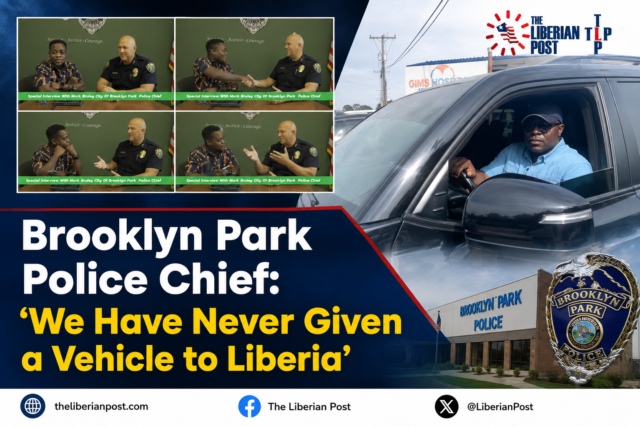
–Mark Bruley Confirms Equipment Donations to LNP, But Says No Police Vehicle Has Ever Been Sent From Brooklyn Park to Liberia
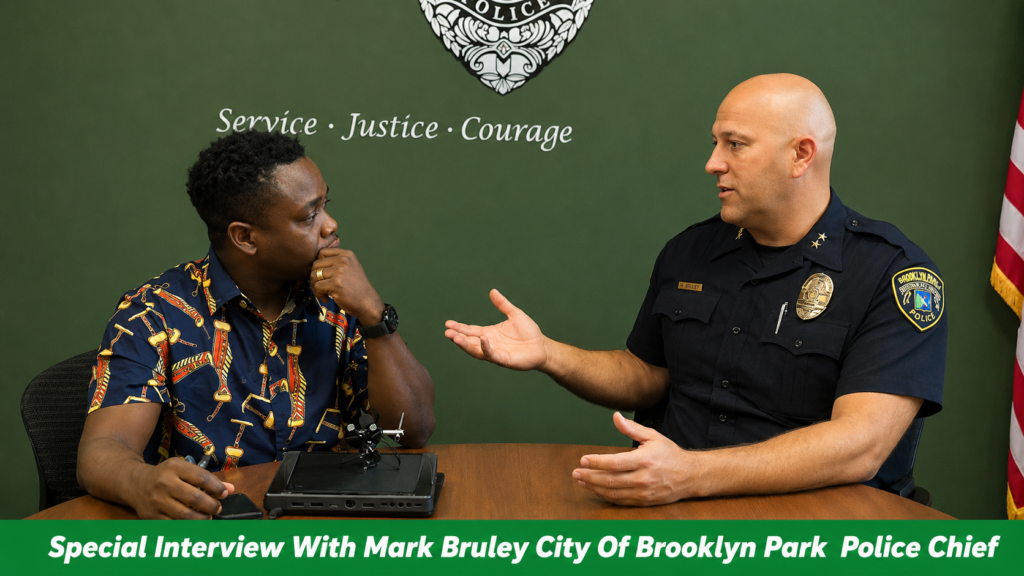
MONROVIA, LIBERIA — The debate over the origin of several vehicles reportedly acquired for the Liberia National Police has taken a new turn after Brooklyn Park Police Chief Mark Bruley categorically said his department has never donated or sent a police vehicle to Liberia, while confirming that the Minnesota police department has donated other used and outdated police equipment to Liberian law-enforcement authorities.
Bruley made the clarification during an interview with Liberian-US-based journalist Cyrus McGee, in which he discussed his department’s longstanding relationship with Liberia and directly addressed growing public claims that retired or refurbished Brooklyn Park police vehicles had been acquired by the LNP.
The chief’s comments are significant because allegations surrounding police vehicles have become part of a wider controversy over the leadership of Liberia National Police Inspector General Gregory O. W. Coleman, with critics calling for him to resign or temporarily step aside from the ongoing investigation into Liberia’s massive narcotics case. Those calls, however, are based on allegations that remain disputed and unproven.
‘I’ve Never Given a Vehicle’
Asked directly about the reports linking Brooklyn Park police vehicles to the LNP, Bruley said the relationship between his department and Coleman is genuine, but insisted that it has never included the donation of a vehicle.
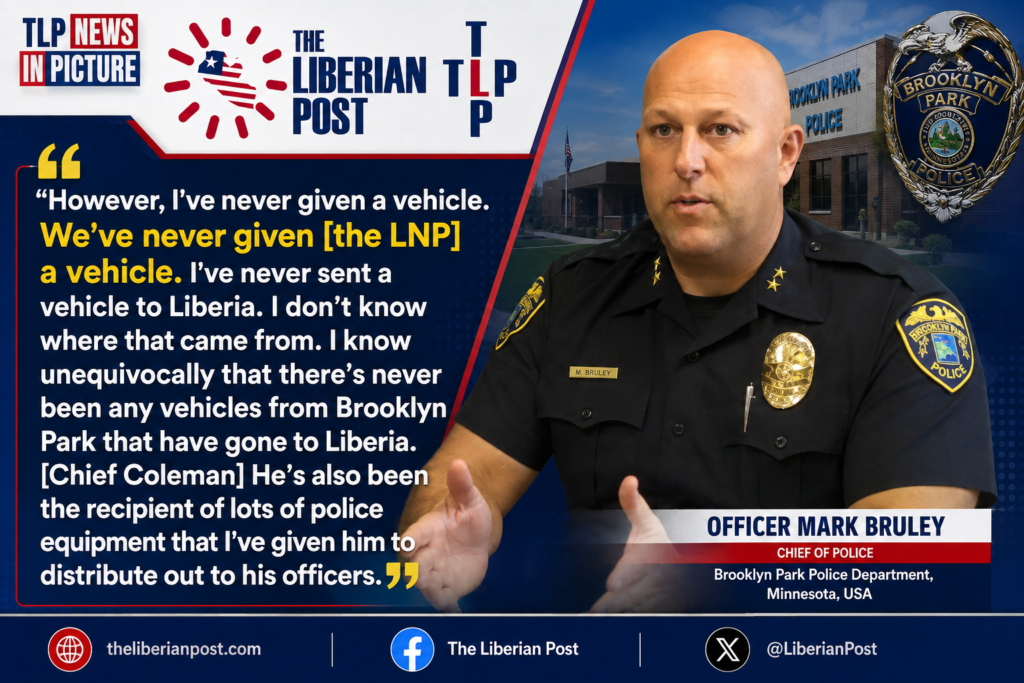
“However, I’ve never given a vehicle. We’ve never given [the LNP] a vehicle.”
Bruley went further, saying he had never sent a vehicle from Brooklyn Park to Liberia and that he first learned of the claim from members of the Liberian community who contacted him.
“I’ve never sent a vehicle to Liberia. I don’t know where that came from.”
He repeated the denial when McGee pressed him on whether there had ever been discussions about Brooklyn Park helping Liberia with police vehicles.
“No, none. None, never.”
And in perhaps his strongest formulation, Bruley said:
“I know unequivocally that there’s never been any vehicles from Brooklyn Park that have gone to Liberia.”
That statement directly addresses one of the claims circulating in Liberia and places the Brooklyn Park Police Department’s position on record.
Equipment Was Donated—But Not Vehicles
Bruley’s denial of vehicle donations does not mean there has been no police equipment relationship between Brooklyn Park and Liberia.
Quite the contrary.
The chief confirmed that his department has supplied the Liberian National Police with equipment that Brooklyn Park had phased out because it was outdated or had been replaced by newer technology.
Among the items he identified were radar devices, body armor, squad-car lights and uniforms.
“He’s also been the recipient of lots of police equipment that I’ve given him to distribute out to his officers.”
Bruley explained that some of the equipment was no longer suitable for use by Brooklyn Park because newer technology had replaced it, but remained functional enough to be useful to Liberian police officers.
He cited radar equipment as an example.
Brooklyn Park had moved to newer radar technology that could reach farther and provide greater accuracy, but the older units could still serve a practical purpose in Liberia.
The department also provided body armor, older squad-car lights and uniforms.
Brooklyn Park Council Approved Equipment Donations
The chief’s account is supported by publicly available records from the City of Brooklyn Park.
In 2025, the city’s council authorized the donation of used and outdated equipment to the Liberian National Police. The council record specifically identifies a resolution authorizing the donation, while minutes from a council discussion indicate that representatives from Liberia would collect the equipment and that the Liberian police chief would be responsible for shipping it to Liberia.
Bruley told McGee that such donations go through the city’s approval process.
“City Council approves these items, itemized items, approves them to go to Liberia.”
This is consistent with an earlier documented relationship between Brooklyn Park and Liberian law enforcement.
In 2019, the city approved a donation of used police uniforms to Margibi County, whose capital, Kakata, has a sister-city relationship with Brooklyn Park. The uniforms were described as previously worn and no longer suitable for reissue by the department.
And in April 2024, Bruley wrote to another Minnesota police chief requesting retired body cameras and accessories specifically for donation to the Liberian National Police, identifying Coleman as the intended recipient.
The evidence therefore establishes a documented equipment relationship between Brooklyn Park police and Liberian law enforcement.
But the available evidence does not establish a Brooklyn Park police vehicle donation.
How Brooklyn Park Disposes of Police Vehicles
The interview also shed light on what happens to retired police vehicles in Brooklyn Park.
Bruley said vehicle acquisition and disposal are not handled directly by the police chief or police department.
Instead, the city’s Public Works division manages the vehicles.
According to Bruley, when police vehicles are retired, they are generally sent to Public Works, where they are either auctioned or, in some cases, reallocated to other city departments after police equipment is removed.
“Most of them go to a police auction, and they’re sold in the auction.”
Bruley said he does not personally know which auction platform is used because Public Works handles that process.
That distinction is important to the current Liberian controversy.
The Brooklyn Park Police Department’s position is that its police department did not send vehicles to Liberia. It does not necessarily establish that a vehicle once owned by Brooklyn Park—or another Minnesota agency—could never have reached Liberia through an independent auction or private purchase.
Indeed, Bruley himself explained that retired vehicles ordinarily leave the police department’s control through the city’s vehicle-disposal process.
Vehicle Claims Fuel Pressure on Coleman
The Brooklyn Park controversy has emerged against the backdrop of a much larger dispute over police fleet management and the ongoing investigation into Liberia’s narcotics crisis.
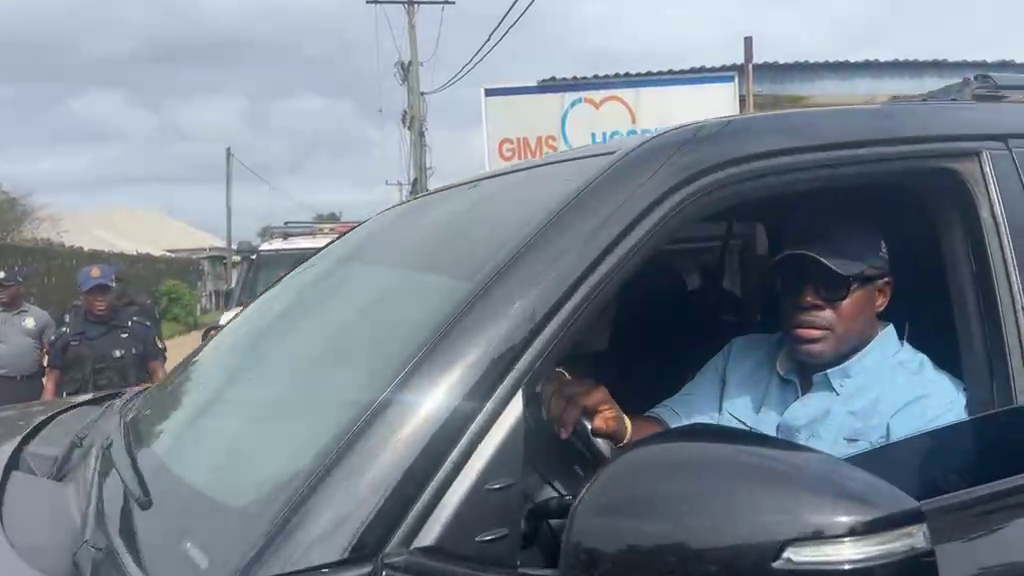
Liberian activist Martin K. N. Kollie has alleged that three black SUVs, reportedly worth more than US$150,000 collectively, were acquired outside normal government procurement channels and that money was provided to Coleman for their purchase. He also alleged that the vehicles were purchased in Minnesota by Jose Quintin Russell, whom he identified as associated with Coleman. Those claims remain allegations and have not been established as facts.
The allegations have fueled calls for Coleman to resign or step aside while the drug investigation continues.
But another important part of the debate is now emerging: the claim that the vehicles came from the Brooklyn Park Police Department appears to be directly contradicted by its chief.
Verity News reported earlier this week that Brooklyn Park police had denied donating or knowing of any of their old vehicles being sold to Liberia.
Konneh Calls for Paper Trail
The vehicle controversy has also reached the Liberian Senate.
At the Press Union of Liberia’s Edward Wilmot Blyden Intellectual Discourse on Wednesday, Gbarpolu County Senator Amara Konneh urged authorities to publish the documentary trail surrounding vehicles acquired and assigned to the LNP.
Konneh said the government should release relevant Public Procurement and Concessions Commission (PPCC) approvals, General Services Agency asset records and Ministry of Finance payment vouchers to establish how the vehicles were procured and paid for.
His argument is that documentary evidence—not competing social-media claims—can settle the controversy.
“The one good solution in this matter is for the task force to publish in one press package” the relevant procurement and financial documents, Konneh said.
The Senator has emphasized that he is not declaring the allegations true, but warned that perception can become damaging in a major international drug investigation.
“In a drug case such as this, perception is dangerous for a successful outcome.”
Bruley Defends Relationship With Coleman
Despite the controversy, Bruley said the allegations have not damaged his relationship with Coleman.
He confirmed that Coleman has visited Brooklyn Park several times and that their discussions have covered policing strategies, funding, training, youth crime and approaches to public safety.
“I still think our relationship with Chief Coleman is great.”
Bruley said the relationship goes beyond equipment.
He and Coleman have exchanged ideas about how police departments respond to challenges and how agencies can secure resources and improve policing.
The relationship, he explained, has existed for years and has involved other Liberian police officials as well.
A Relationship That Predates Current Controversy
The Brooklyn Park-Liberia police relationship is therefore not a creation of the current drug investigation.
Public records show that Brooklyn Park has been supporting Liberian law enforcement with used equipment for years, including uniforms and, more recently, retired police technology and protective equipment.
Bruley said the relationship was facilitated in part by former Brooklyn Park Councilmember Winford Russell, while other Liberian police leaders have also visited the department over the years.
The chief said he has even been invited to Liberia and would like to visit.
“I’d love to, to be honest with you.”
What The Interview Establishes—and What It Does Not
The interview provides an important piece of evidence in a controversy that has increasingly become tangled in allegations, counter-allegations and social-media claims.
What Bruley clearly establishes is that Brooklyn Park Police has donated police equipment to the Liberia National Police, including radar units, body armor, lights and uniforms, through an approved process.
What he emphatically denies is that Brooklyn Park Police has donated or sent a police vehicle to Liberia.
What remains unresolved, however, is the separate question of whether any of the vehicles currently being scrutinized in Liberia were acquired through an auction, private seller, another municipality or another source in Minnesota or elsewhere in the United States.
That question cannot be answered by Bruley’s denial alone.
It requires the very paper trail now being demanded by Senator Konneh: purchase records, invoices, ownership documents, customs records, procurement approvals, payment records and asset-registration documents.
Until those records are produced and independently examined, the public debate over the vehicles—and what they may or may not have to do with the broader narcotics investigation—will remain clouded by competing claims.
For now, however, the Brooklyn Park Police chief has put his department’s position beyond ambiguity:
“There’s never been any vehicles from Brooklyn Park that have gone to Liberia.”
That statement is likely to become a significant reference point as Liberia’s authorities face growing demands to establish, with documents rather than declarations, the origin and ownership of the vehicles at the center of the controversy.
For breaking news, in-depth analysis, and exclusive reports from Liberia and around the world, follow The Liberian Post on Facebook (https://web.facebook.com/profile.php?id=61576017166570) and X, formerly Twitter (https://x.com/LiberianPost).