


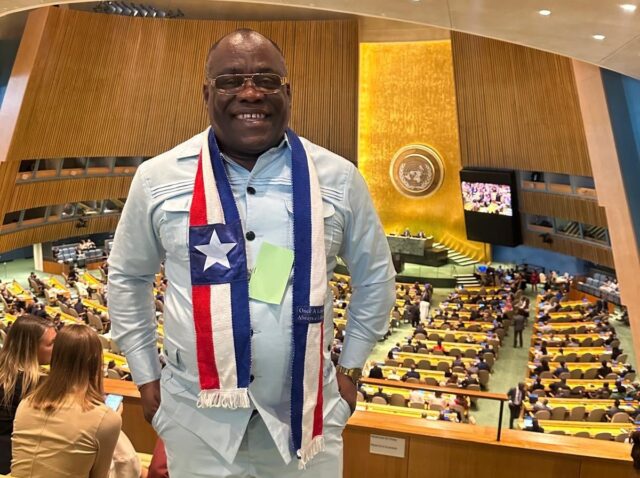
– Group Pushes Phased Path to Out‑of‑Country Voting
MONROVIA, Liberia – A leading Liberian diaspora organization is appealing to the National Elections Commission (NEC) to open Diaspora Voters Registration Centers at embassies and consulates ahead of the 2029 elections, describing the move as a practical first step toward full out‑of‑country voting for Liberians in the diaspora in the near future.
The All‑Liberian Conference on Dual Citizenship (ALCOD), which was instrumental in securing the 2022 dual‑citizenship law, says the current system effectively prices out most diaspora Liberians from voting and undermines the spirit of that hard‑won reform.
“Since the passage of the dual citizenship law advocated by ALCOD, Liberians in the diaspora can fully participate in national elections in Liberia,” the group said in a statement. “However, they will first have to come to Liberia and register to vote, return to their respective countries, and later return to Liberia to participate in the actual voting process. This is a huge financial burden on diaspora Liberians.”
The burden is even heavier when elections go to a second round, requiring yet another trip.
Thousands of Dollars Just to Be Counted
In the 2023 general elections, ALCOD cites the experiences of three Liberians as typical of the problem.
- Madam Theresa Johnson, a Liberian based in the United States and a supporter of the Unity Party, spent at least US$6,000 to travel to Liberia, registered, returned to the U.S., and then flew back to vote in Liberia.
- Another Liberian, popularly known as “Uncle T,” a stalwart of the former ruling Coalition for Democratic Change (CDC), spent roughly the same amount for the same purpose.
- Mrs. Mary Jackson, another US-based Liberian and a member of the Alternative National Congress (ANC), spent a little over US$5,000 for the same purpose.
Combined, the three spent about US$17,000 and more simply to participate in one election—not counting the extra costs of lodging, supporting relatives, and covering local expenses while in Liberia.
“These three are just among the hundreds of Liberians who spend thousands of dollars to take part in national elections,” ALCOD noted. “When they don’t have to travel multiple times to fulfill one aspect of the election processes, some of the thousands of dollars saved can be used on campaign.”
A Phased Approach: Register in the Diaspora , Vote in Liberia
The NEC has repeatedly said that full out‑of‑country voting—where ballots are cast and counted in the diaspora—would be logistically and financially challenging. In response, ALCOD is pushing a phased model instead of an all‑or‑nothing demands.
Under the group’s proposal:
- Diaspora Voters Registration Centers would be established at Liberian embassies, consulates, and designated missions around the world.
- NEC and Ministry of Foreign Affairs staff would be deployed to those locations to conduct biometric voter registration, using a process similar to the current passport system to guarantee voter integrity.
- Liberians in the diaspora would register at those centers and then travel to Liberia to vote in the national elections.
“ALCOD’s proposal tries to respond to [NEC’s] concerns by separating registration (to be done in the diaspora) from balloting (still done in Liberia),” the group explained, calling it “a relatively modest, data‑gathering pilot rather than a full‑scale overseas election.”
The group believes this pilot could also generate significant revenue for the Ministry of Foreign Affairs through the sale of passports used as identification for registration. It is estimated that the process would generate around US$10 million for the Liberian Government.
Diaspora Raises Issue with President Boakai in France:
The push for diaspora voting is not confined to the United States. During President Joseph Nyuma Boakai’s recent visit to France, Liberians in the Paris diaspora reportedly raised the issue directly with the President and his delegation at a town‑hall style engagement.
Participants urged the administration to prioritize legislative and technical work toward out‑of‑country voting, arguing that Liberians in the diaspora are deeply involved in the country’s politics and economy sectors but having challenges to exercise equal voting rights.
According to local media reports, President Boakai acknowledged the contribution of Liberians overseas and promised that his government would “study the issue,” while stressing that any reform must align with the Constitution and the capacity of the NEC. A concrete timeline has not yet been announced.
Legal and Logistical Hurdles
Under current law and practice, voting in Liberian elections is strictly in‑country. The Constitution, in Article 80, ties voting to constituencies within Liberia’s territory, and the New Elections Law does not provide a framework for absentee or external voting.
In previous election cycles, the NEC has flagged several obstacles to immediate diaspora voting:
- Legal gaps – the need for explicit constitutional or statutory authorization;
- Logistical complexity – running secure polls in multiple foreign jurisdictions;
- Cost – deploying staff, materials, and technology overseas.
By focusing first on registration in the diaspora while keeping the act of voting inside Liberia, ALCOD says it is offering a realistic compromise that allows the country to begin integrating its diaspora into the electoral system without overwhelming NEC’s capacity.
Finance Political Parties Without Challenge But Face Hurdles in Voting for Leaders
ALCOD also highlights a long‑standing frustration: diaspora Liberians are major financial backers of political parties and candidates but have limited formal power to determine who governs.
“Financially, diaspora Liberians are the financial sources for almost all political parties in Liberia,” the group noted, pointing to the role Liberians abroad played in the 2023 elections through social media mobilization, talk shows, financial contributions, and multiple travels to vote.
For many in the diaspora, this raises a basic question of fairness: should a community that consistently supports families, campaigns and the broader economy remain largely absent from the voters’ roll?
Who Is ALCOD and What Comes Next?
The All‑Liberian Conference on Dual Citizenship is a coalition of diaspora organizations and activists that campaigned for more than a decade to reform Liberia’s restrictive nationality laws. Its advocacy helped secure the 2022 amendments recognizing dual citizenship for Liberians by birth.
With that milestone achieved, ALCOD says it is now focused on the “unfinished business of political rights.”
“Let it be noted that ALCOD’s ultimate goal is out‑of‑country voting and removing the restrictions in the dual citizenship law” the group reiterated. “Diaspora Voters Registration Centers in the Diaspora can be a pilot program to give a picture of full out‑of‑country voting.”
An ALCOD delegation is expected in Liberia “very soon” to hold a town hall meeting on out‑of‑country voting, removing the restrictions in the Dual Citizenship law, to meet separately with NEC, the Foreign Ministry, political parties, civil society and other stakeholders to build consensus around the pilot and push for the necessary legal and policy changes.
With pressure mounting from organized diaspora communities—from Paris to Washington D.C.—Liberia’s political establishment will increasingly be forced to answer a simple question: Will those who helped finance the country’s future and political parties be allowed to fully shape it at the ballot box?






To the theliberianpost.com Admin!
Comments are closed.