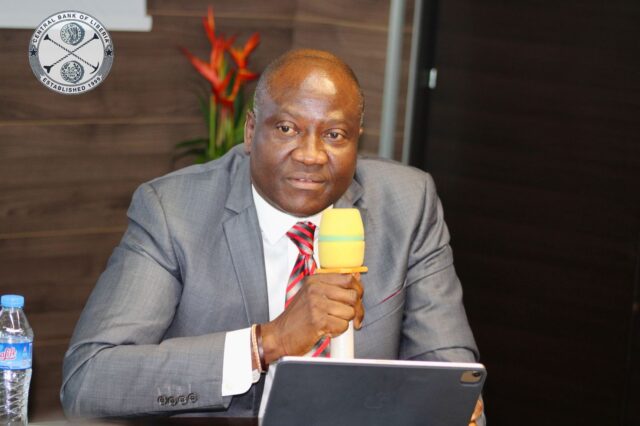
MONROVIA, Liberia — The Monetary Policy Committee (MPC) of the Central Bank of Liberia (CBL) has kept its Monetary Policy Rate (VPR) unchanged at 16.25% for the first quarter of 2026, pointing to continued moderation in inflation and broadly stable macroeconomic conditions at home and abroad.
Announcing its decision after the MPC’s regular quarterly meeting on January 28, 2026, the CBL said the rate hold “reflects confidence in the continued moderation of inflation and sustenance of macroeconomic stability.” Headline inflation averaged 4.4% in Q4 2025 (down from 5.9% in Q3), with end‑period inflation at 4.0%, buoyed by a stable exchange rate, lower food and fuel prices, and subdued non‑food inflation amid improved supply conditions.
The Bank expects a mild, temporary uptick in Q1 2026 due to lagged festive‑season effects and FX demand for inventory restocking, but projects inflation to remain within the single‑digit target band, averaging 4.8% (±2 percentage points), underpinned by expected exchange‑rate stability, higher remittance inflows, and favorable terms of trade.
Growth Revised Up; Domestic Backdrop Resilient
The MPC said economic activity was on track to achieve real GDP growth of 5.1% for 2025—revised up from an earlier 4.6% projection—supported by stable macro fundamentals, sustained fiscal spending, strong private‑sector output (particularly mining), and resilient consumption demand. Growth momentum is expected to remain positive in early 2026, driven by further expansion in mining, ongoing public investment, and resilient domestic demand.
Global and Regional Context
The CBL cited the IMF’s January 2026 World Economic Outlook, which estimates global growth at 3.3% in 2025, with a similar projection for 2026. Global headline inflation is estimated to have eased to 4.1% in 2025 (and is projected at 3.8% in 2026), though the MPC flagged downside risks from geopolitics, rising protectionism, sovereign debt vulnerabilities—especially in Sub‑Saharan Africa—and potential policy and market adjustments. The MPC welcomed a projected moderation in Sub‑Saharan Africa’s inflation to 10.9% in 2026 from an estimated 13.3% in 2025.
Banking Sector Remains Strong, But Asset Quality Still a Concern
Liberia’s banking system remained well‑capitalized and liquid in Q4 2025. The Capital Adequacy Ratio (CAR) stood at 37.9% (vs. a 10% regulatory minimum) and the liquidity ratio at 50.1% (vs. a 15% minimum). Total capital rose by 3.9%. Total deposits and assets increased by 3.9% and 5.4%, respectively.
The Non‑Performing Loans (NPL) ratio declined from 19.7% (Dec. 2024) to 12.58%—still 2.58 percentage points above the regulatory threshold—underscoring ongoing asset‑quality challenges. Total loans and advances fell marginally by 0.6%, reflecting heightened risk aversion, balance‑sheet repairs, and cautious lending, though private‑sector credit grew by 3.8% quarter‑on‑quarter. The MPC reaffirmed that full implementation of the NPL Resolution Framework should help strengthen asset quality and support credit growth, and said it stands ready to deploy macroprudential tools as needed.
Money and Financial Markets
Broad money (M2) expanded by 17.0% in Q4 to L$289.2 billion, driven by growth in net foreign assets and net domestic assets; domestic credit rose 4.0%. The CBL noted further improvement in monetary‑policy transmission as the interbank rate aligned more closely with the Standing Deposit Facility (SDF) rate, signaling stronger market responsiveness.

CBL bill redemptions exceeded issuances in Q4, but liquidity impact was limited as excess liquidity was absorbed via the SDF. Post‑festive liquidity pressures were deemed transitory and unlikely to fuel significant inflation. Interbank market activity remained sustained, comprising six FX swaps (US$13.0 million), five U.S. dollar placements (US$3.23 million), and four Liberian‑dollar placements (L$518.65 million). The average interbank rate was 9.14%, within the corridor floor.
Government debt service during the quarter included interest payments of L$488.42 million and US$6.61 million; rollovers of L$5.85 billion and US$53.81 million; and new issuances amounting to US$10.0 million.
Fiscal Stance Expansionary; Coordination Emphasized
Fiscal operations in Q4 resulted in net liquidity injections in both domestic and foreign currency, dominated by U.S. dollars, which supported exchange‑rate stability. The fiscal stance remained expansionary, with a positive fiscal impulse of 3.0% of GDP (up from 2.3% in Q3), mainly from capital and priority social spending. The MPC underscored sustained coordination between fiscal and monetary authorities to preserve stability and consolidate gains.
External and Exchange‑rate Developments
Despite a trade deficit of 1.0% of GDP due to high import payments, gross international reserves rose 3.8% to US$575.5 million, while net international reserves exceeded the IMF‑agreed 2025 target of US$266 million. Months of import cover, however, dipped to 2.3 from 2.6 in Q3, reflecting higher import payments.
Net personal remittances increased by 1.7%, reaching 4.1% of GDP, bolstering exchange‑rate stability. The Liberian dollar appreciated in Q4 by 0.9% (end‑period) and 7.8% (average), reflecting higher government U.S.‑dollar spending, rising remittances, and a relatively tight monetary stance. The MPC acknowledged temporary depreciation pressures in early 2026 from elevated FX demand for post‑festive restocking but expects the prevailing disinflationary and stability trends to hold.
Outlook and Policy Stance
The CBL said the domestic macroeconomic environment remains resilient and broadly stable, supported by prudent monetary policy, strengthened fiscal discipline, increased private‑sector investment, and improved market confidence. The MPC will continue to closely monitor inflation and financial‑stability risks and stands ready to act to safeguard systemic stability.
Follow The Liberian Post on Facebook and X (formerly twitter)