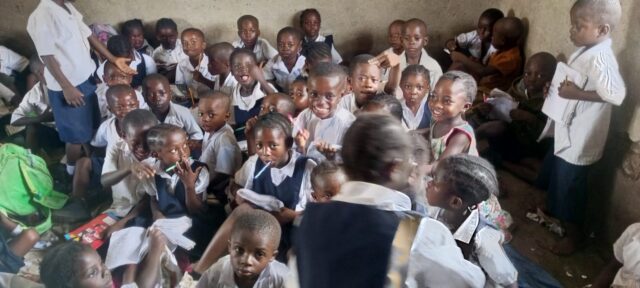
Buah Geeken, Grand Kru County – Scenes reminiscent of modern-day neglect unfolded this week at the Sally B. Toogbabu Elementary and Junior High School in Buah Geeken, Grand Kru County, where students — including kindergartners — are forced to sit on tarpaulins spread across bare classroom floors due to the lack of chairs and desks.
A visit by a journalist on Thursday revealed deplorable learning conditions at the government-run school, with sections of the building visibly crumbling and posing serious risks to the safety of students and teachers alike.
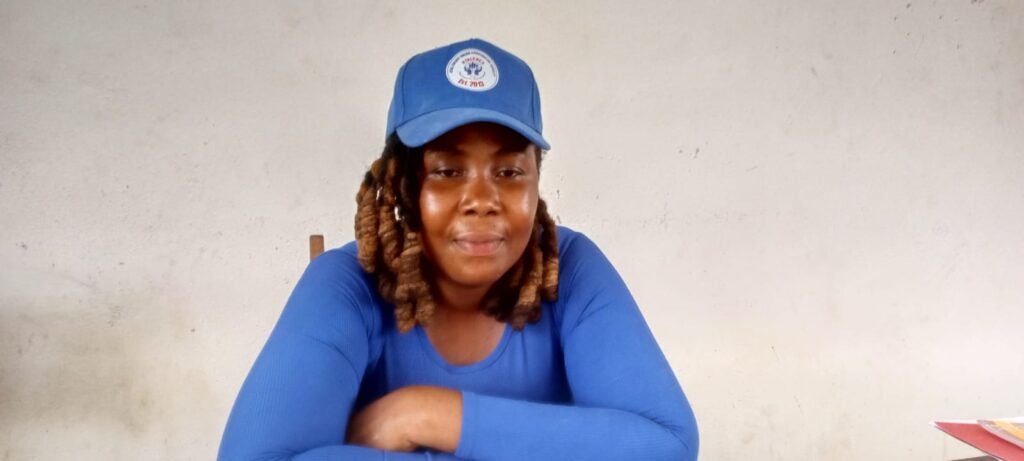
Speaking to reporters, the school’s principal, Madam Beaty Williams, confirmed the distressing situation and said she has already reported it to the District Education Officer (DEO).
“We have informed the DEO about the challenges facing the school, and we’re hoping for swift action,” Madam Williams said.
The revelation comes at a time when the government, under President Joseph Nyuma Boakai, is championing the “One Child, One Chair” initiative — a flagship effort by the Ministry of Education aimed at ensuring every primary school child has access to basic classroom furniture.
In his most recent State of the Nation Address (SONA), President Boakai reaffirmed his administration’s commitment to restoring dignity to the education system, declaring that “every Liberian child deserves access to quality and dignified education.”
However, the conditions at Sally B. Toogbabu School stand in stark contrast to that vision.
According to a 2021 Education Fact Sheet, Liberia has over 5,400 public schools, many of which continue to face acute shortages of chairs, textbooks, and learning materials. In rural and remote communities, students are often seen sitting on wooden planks, bricks, or the floor during class sessions.
The issue is not new. In October 2021, the previous administration under former President George Weah launched a national effort to distribute 24,000 armchairs to public schools. But the initiative had limited impact in hard-to-reach areas like Grand Kru, where logistical challenges and poor infrastructure remain barriers.
Principal Williams further lamented the school’s poor sanitation conditions, revealing that even the few available bathrooms are shared with nearby residents.
“Community dwellers are also using the school bathrooms, making the campus polluted,” she said.
“We are planning to construct additional bathrooms in the future to ease the burden on our students.”
Sally B. Toogbabu Elementary and Junior High School currently enrolls about 300 students, many of whom walk long distances to attend classes despite the harsh learning conditions.
Madam Williams is appealing to the Government of Liberia and the Ministry of Education to prioritize the school in its upcoming infrastructure rehabilitation and logistics distribution programs.
“Our children deserve better — chairs to sit on, safe classrooms, and clean facilities. Without that, we are denying them a fair chance at education,” she pleaded.
The situation at Sally B. Toogbabu has sparked concerns among education advocates who warn that without urgent intervention, the government’s commitment to equitable and quality education may remain an unfulfilled promise — especially in Liberia’s rural southeast.