MONROVIA, Liberia — Former President Ellen Johnson Sirleaf has renewed calls for sweeping land reform, stricter accountability, and decisive action on urban decay, warning that unresolved land disputes and abandoned properties continue to undermine Liberia’s development and social cohesion.
Speaking on Changing Minds, Changing Attitudes on the Liberia Broadcasting System, Sirleaf argued that land mismanagement remains one of Liberia’s most dangerous and emotionally charged challenges, fueling conflict, corruption, and inequality.
She expressed strong support for a moratorium on the sale of public land, describing unchecked land transactions as a major source of injustice and instability.
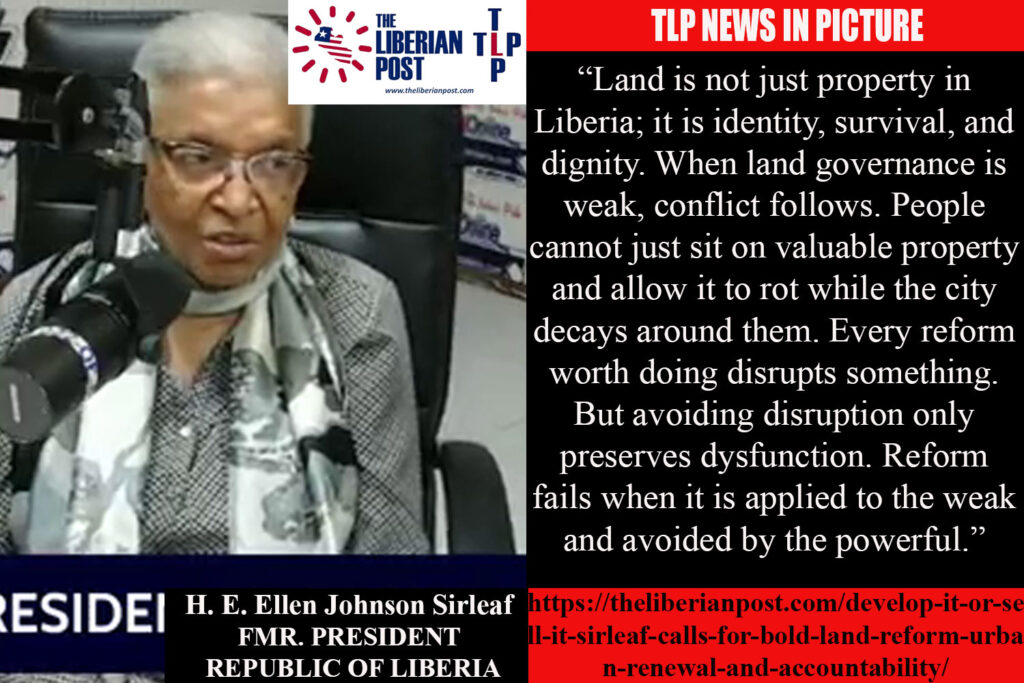
“Land is not just property in Liberia; it is identity, survival, and dignity,” Sirleaf said. “When land governance is weak, conflict follows.”
Sirleaf noted that land disputes dominate court dockets and community tensions, calling for a more structured and enforceable framework to resolve claims. While she acknowledged proposals for a specialized land court, she suggested that strengthening existing judicial institutions could be a more practical and immediate solution.
Beyond land ownership, Sirleaf turned attention to the visible decay of Liberia’s capital, criticizing the proliferation of abandoned and derelict buildings in prime areas of Monrovia.
“People cannot just sit on valuable property and allow it to rot while the city decays around them,” she said, urging authorities to require owners to either develop, maintain, or sell neglected properties.

She argued that urban neglect discourages investment, weakens national pride, and reinforces perceptions of disorder, particularly for foreign visitors and investors.
Sirleaf emphasized that meaningful reform often requires difficult choices, acknowledging that strong enforcement of land and property laws may provoke resistance but remains necessary for national progress.
“Every reform worth doing disrupts something,” she said. “But avoiding disruption only preserves dysfunction.”
On governance more broadly, Sirleaf stressed that accountability must be institutional rather than personal, calling for systems that outlast political administrations. She urged public officials to understand leadership as stewardship, not entitlement.

She also linked land reform and urban renewal to youth empowerment, noting that unresolved land disputes limit housing development, job creation, and access to capital for young people.
Sirleaf’s remarks echoed ongoing national debates about public land sales, squatter settlements, and urban planning, issues that have intensified alongside rapid population growth and weak enforcement capacity.
While she praised recent reform efforts by the current administration, Sirleaf warned against selective enforcement and urged leaders to apply rules consistently, regardless of political affiliation or social status.

“Reform fails when it is applied to the weak and avoided by the powerful,” she said.
She concluded by urging Liberians to embrace a mindset shift that prioritizes national interest over personal gain, arguing that laws alone cannot transform society without changes in attitude and civic responsibility.
“Liberia will only change when we decide that rules matter and that the future is bigger than individual convenience,” Sirleaf said.
Her comments reinforced her continued role as a moral and policy voice in national discourse, offering critique not as opposition, but as counsel rooted in experience.
Follow The Liberian Post on Facebook and X (formerly twitter)