The opening of the March Term of Court by the Supreme Court of Liberia this week was more than a ceremonial constitutional event. It was a moment of national reflection on the health of Liberia’s democratic institutions and a reminder that the rule of law remains the bedrock upon which the country’s future must be built.
When Chief Justice Yamie Quiqui Gbeisay stood before the nation’s leaders at the Temple of Justice and declared that “when the law is rejected or neglected, the state itself is neglected,” he was not merely speaking to lawyers and judges. He was issuing a warning to the entire nation.
At a time when public discourse is increasingly heated, institutions often come under pressure, and the credibility of the justice system is constantly tested, Liberia must recommit itself to a simple but powerful principle: no society can thrive without respect for the law.

The Judiciary at the Center of Democracy
The judiciary occupies a unique place in Liberia’s democratic architecture. It is the branch of government entrusted with interpreting the Constitution, resolving disputes, and ensuring that justice is administered fairly and impartially.
Yet the Chief Justice’s remarks also highlighted a troubling reality: the judiciary remains one of the most under-resourced branches of government. With less than three percent of the national budget allocated to it, the institution responsible for safeguarding the rule of law continues to operate under significant constraints.
This raises an important national question: Can Liberia truly strengthen the rule of law without adequately investing in the institutions that uphold it?
A justice system without sufficient resources risks delays, inefficiencies, and diminished public confidence. Strengthening the judiciary must therefore be seen not as a favor to judges but as an investment in Liberia’s democratic stability.

A Welcome Commitment from Government
Encouragingly, the opening ceremony also demonstrated a spirit of cooperation among the three branches of government.
Attorney General and Justice Minister Natu Oswald Tweh reaffirmed the Executive Branch’s commitment to supporting judicial reforms and strengthening collaboration with the courts.
His assurance that the government will work to ensure the judiciary is staffed by “competent, qualified, morally upright and independent men and women” reflects an important recognition that justice institutions must remain credible and professional.
Such cooperation is essential. When the branches of government work at cross purposes, the rule of law suffers. But when they respect each other’s roles and collaborate within constitutional boundaries, democratic governance is strengthened.

The Role of the Legal Profession
The responsibility for strengthening Liberia’s justice system does not rest solely with the government.
The legal profession itself must remain vigilant in upholding the highest standards of integrity and professionalism. The President of the Liberia National Bar Association, Cllr. F. Juah Lawson, rightly reminded lawyers that they are not only advocates for clients but also officers of the court and guardians of justice.
This dual responsibility carries profound implications. Lawyers shape how justice is practiced and perceived. Their conduct can either reinforce public confidence in the legal system or undermine it.
A strong Bar that promotes ethical practice and professional discipline is therefore indispensable to a functioning justice system.
Civility in Public Discourse
One of the most important themes of the Chief Justice’s address was the call for civility in public discourse.
Liberia’s Constitution guarantees freedom of expression, but it also demands responsibility in the exercise of that freedom. Public debate is essential in a democracy, but when criticism degenerates into insults, misinformation, or attacks on institutions, the consequences can be damaging.
Respect for the judiciary—and for all institutions of governance—is not about shielding officials from criticism. It is about preserving the integrity of the institutions that hold society together.
Justice as a Foundation for Development
Beyond the courtroom, the rule of law has far-reaching implications for Liberia’s national development.
Investors look for stable legal systems before committing capital. Citizens rely on courts to resolve disputes fairly. Communities depend on the justice system to maintain order and protect rights.
In short, a credible justice system is not merely a legal necessity—it is an economic and social imperative.
The message from the Supreme Court’s March Term opening was therefore clear: Liberia must strengthen its justice institutions if it hopes to build a stable and prosperous future.

A Moment for National Renewal
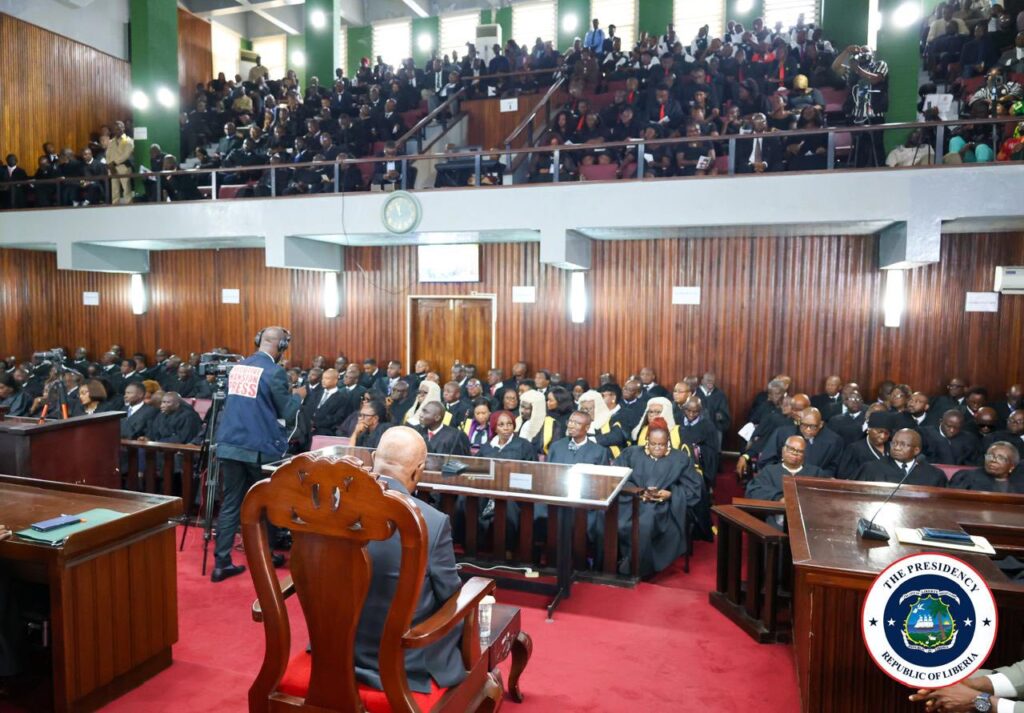
The presence of President Joseph Nyuma Boakai, lawmakers, legal professionals, and international partners at the opening ceremony signaled that the importance of the judiciary is widely recognized.
But recognition alone is not enough.
Liberia must now translate words into action—through increased support for the judiciary, stronger professional standards within the legal community, and a renewed commitment by all citizens to respect the rule of law.
The Chief Justice’s warning should not be ignored.
When the law is neglected, the state itself is endangered. But when the law is respected, upheld, and strengthened, the nation stands on firm ground.
Follow The Liberian Post on Facebook and X (formerly twitter)