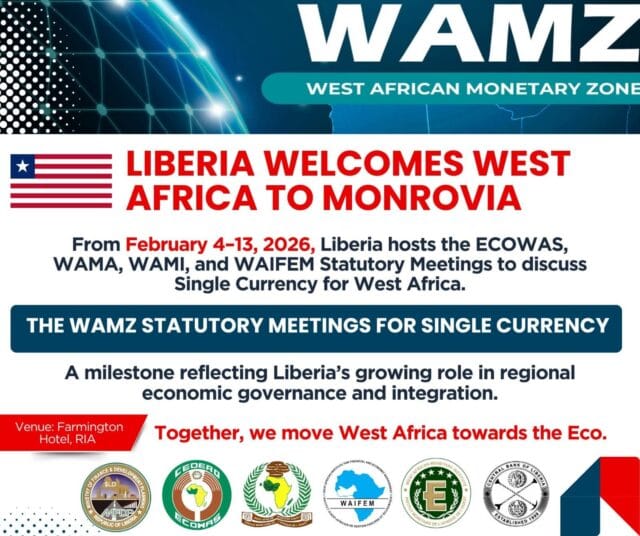
MONROVIA, Liberia — From February 4 to 13, 2026, Liberia will assume a central role in West Africa’s economic integration agenda as it hosts the Joint Statutory Meetings of Economic Community of West African States (ECOWAS) institutions focused on monetary cooperation and the long-anticipated single currency for the region.
The high-level meetings will bring together the West African Monetary Agency (WAMA), the West African Monetary Institute (WAMI), and the West African Institute for Financial and Economic Management (WAIFEM), alongside senior officials from ECOWAS member states. Discussions will center on advancing technical, institutional, and policy frameworks required for the introduction of a common currency under the West African Monetary Zone (WAMZ) arrangement.
Scheduled to take place at the Farmington Hotel, near Roberts International Airport, the meetings are expected to attract central bank governors, finance ministry officials, economists, and regional policymakers. Key agenda items include macroeconomic convergence criteria, fiscal discipline, monetary policy coordination, payment systems integration, and capacity building for national institutions.

For Liberia, hosting the meetings represents more than a logistical milestone. It signals the country’s growing credibility and re-emergence as a trusted convener of regional policy dialogue following years of post-conflict recovery and institutional reform. Government officials view the event as affirmation of Liberia’s commitment to regional cooperation, sound economic governance, and collective solutions to shared development challenges.
The push for a single West African currency—often referred to as the “Eco”—has been a longstanding objective of ECOWAS, aimed at facilitating intra-regional trade, reducing transaction costs, strengthening monetary stability, and enhancing the region’s bargaining power in the global economy. While timelines have shifted over the years due to economic shocks, fiscal disparities, and structural differences among member states, momentum has gradually rebuilt through sustained technical engagement by WAMA, WAMI, and WAIFEM.
Regional observers note that convening the statutory meetings in Monrovia at this juncture reflects renewed political will within the WAMZ to address lingering obstacles and chart a realistic pathway toward monetary union. Outcomes from the meetings are expected to shape recommendations to ECOWAS policymakers and finance ministers ahead of future heads-of-state deliberations.
As West Africa confronts global economic uncertainty, inflationary pressures, and currency volatility, the Monrovia meetings underscore a shared regional resolve: to deepen integration, strengthen financial cooperation, and move collectively toward a more unified and resilient economic future.