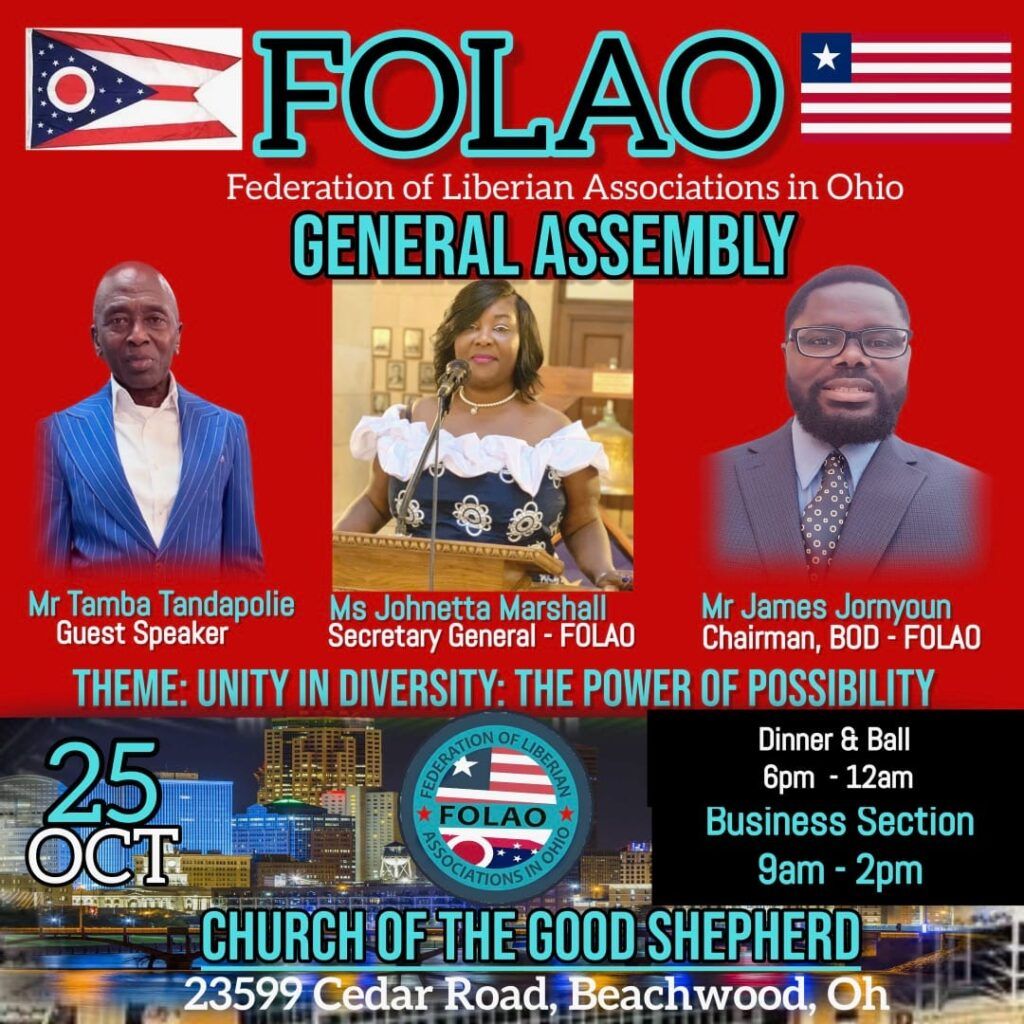
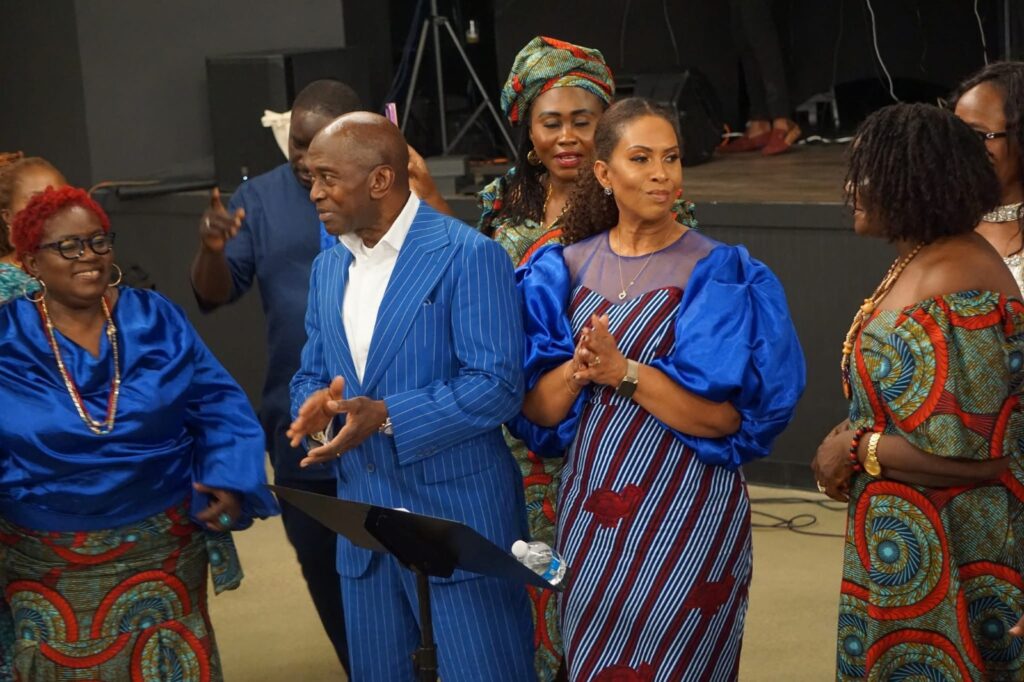
BEACHWOOD, Ohio – The Liberian community in Ohio was challenged to transform its diversity into a powerful engine for education, economic growth, and civic influence during the General Assembly of the Federation of Liberian Associations in Ohio (FOLAO), held at the Church of the Good Shepherd in Beachwood.
Delivering a keynote address themed “Unity in Diversity: The Power of Possibility,” Mr. Tamba Tandapolie called on Liberians across the state to move beyond slogans and social gatherings and instead build structured systems that will benefit the next generation.
“Diversity is not a weakness to be managed, but an engine to be harnessed,” Tandapolie said, speaking to an audience of elders, community leaders, professionals, students, and families. “If our unity stops at the door, we have only formed a club. If it crosses the street, we have built a community.”
Unity With Discipline, Not Denial
Tandapolie began by grounding his message in Liberian tradition, invoking the image of the palava hut—round so that “no corner can claim the truth alone.”
“The circle is a reminder: bring your story, and I will bring mine; somewhere in the middle, we will find our common future,” he said.
He warned, however, that genuine unity is demanding work:
- “Unity is not pretending the past didn’t wound us,” he noted. “Unity is healing out loud—forgiving without forgetting, and building so well that our children inherit our bridges, not our broken boards.”
- “Unity is not unanimity,” he added, emphasizing that disagreements over programs and priorities are healthy, as long as members accept decisions and deliver on them. “Unity is not the absence of disagreement; it is the presence of discipline.”
- He insisted that unity cannot be one-sided charity: “If you have knowledge, teach. If you have resources, share. If you have time, serve. If you have questions, ask. If you have a dream, speak it, because dreams grow legs when a community hears them.”
True unity, he said, will require transparent finances, respected term limits, credible elections, and members who “choose participation over complaint.”
“That is the hard part,” Tandapolie acknowledged. “But here is the holy part: when we do, our children will inherit momentum, not memories.”
From Talk to Structure: A Blueprint for Possibility
Tandapolie used the platform to outline a concrete vision for how FOLAO can leverage its diversity and presence in Ohio for measurable impact. He proposed that the community think in terms of systems, pipelines, and partnerships rather than one-off gestures.
Among his key proposals:
1. From Scholarship Fund to Scholarship Pipeline
He called for a comprehensive youth support structure—starting as early as middle school.
“Not one-time gifts, but a pipeline,” he said, proposing:
- Mentorship from middle school through college
- SAT preparation support
- FAFSA workshops
- Internships within Liberian-owned businesses
- A clear commitment: “If you are from Liberia and you’re willing to work, we will open a door.”
He challenged the organization to a “100-Scholarship Challenge” over the next 24 months, spanning college, trade, and certification programs. To set the tone, Tandapolie announced that he and his wife would contribute $1,000 to jump-start the scholarship fund and urged individuals and organizations to follow suit.
The scholarships, he suggested, should be governed by:
- A transparent fund structure
- A rotating selection committee representing every Liberian county
- Annual publication of outcomes and impact
“That’s not charity; that’s strategy,” he said.
2. Organizing Prosperity Through Business Networks
On economic empowerment, Tandapolie urged the community to move from informal support to structured investment and mentorship.
He proposed:
- A Liberia Business Network and directory
- Rotating markets to showcase Liberian-owned enterprises
- Transparent susu-style micro-investment pools
- Small grants for startups in sectors like catering, transportation, home health, logistics, and technology
- “Boardroom-ready” training and basic accounting support for entrepreneurs
“We don’t just talk wealth creation; we practice it,” he said.
3. Health & Wellness: “We Will Not Wait to Be Rescued”
Tandapolie called for a Health & Wellness mission that begins in Ohio but extends to Liberia.
His vision includes:
- Annual clinics in Ohio for blood pressure checks, diabetes screening, and mental health check-ins
- A culture of prevention within the diaspora community
- Partnerships with clinics in Liberia supported with targeted medical supplies
“We are not waiting for someone else to rescue our health,” he declared. “We will make prevention our culture and long life our heritage.”
4. Civic Voice and Local Impact in Ohio
Recognizing that Liberians in Ohio are more than remittance senders, Tandapolie called on the community to leverage its growing numbers and talents in local civic life.
“We are residents of Ohio, contributors to our cities. We will vote, volunteer, and partner with schools and neighborhoods,” he said. “Our accents are assets; our passports are perspectives; our presence is power.”
He urged FOLAO to place:
- Liberian interns in the Statehouse
- Liberian chefs in major food and cultural festivals
- Liberian nurses in leadership tracks
- Liberian coders in tech firms
- Liberian contractors on city projects and bids
“Diversity opens doors; unity walks through them together,” he said.
5. Culture as Laboratory, Not Museum
Tandapolie pushed back against the idea of culture as something frozen in the past.
“Culture is not a museum—it is a laboratory where we invent the future without losing the past,” he said, advocating for:
- Language classes for children
- Food and cultural festivals
- Arts initiatives that highlight Liberia’s beauty and history
The “LIBERIA Pledge”
To anchor his vision, Tandapolie introduced what he called the LIBERIA Pledge, a framework intended to be both memorable and actionable:
- Lift Our Youth – Commit to the 100-Scholarship Challenge, sustained mentoring, and transparent reporting.
- Organize Our Prosperity – Formalize a rotating micro-investment pool to seed Liberian-owned businesses in Ohio.
- Forward Not Only Remittances, but Skills – Launch a “Digital Bridge to Liberia”: monthly online sessions where diaspora professionals—nurses, engineers, farmers, coders, teachers—share best practices with schools, clinics, and youth groups back home. “Not charity—partnership,” he stressed.
- Align Across Faiths, Parties, and Professions – Adopt a culture of resolving differences internally while maintaining a united front publicly. “We can debate strategy in committee, but when we step out, our message is one: ‘Liberia first, future focused.’”
“Bilingual in Worlds”
Tandapolie highlighted the unique position of Liberians in Ohio, noting that the community spans elders with traditional wisdom, young professionals versed in technology and policy, and children being raised in American institutions.
“We are bilingual not just in words, but in worlds—able to translate village values into American velocity,” he said.
That, he argued, is a powerful strategic advantage, if properly harnessed.
Drums, Bridges, and a Shared Future
Closing on a symbolic and spiritual note, Tandapolie drew from two traditional images.
“In Liberia we have two ancient teachers: the drum and the bridge,” he said. “The drum reminds us we share a rhythm. The bridge reminds us we share a destination.”
He led the room through call-and-response affirmations:
- “If you believe that many roots can become one tree—say Amen!”
- “If you believe that many tongues can become one song—say Amen!”
- “If you believe that many gifts can become one future—say Yes!”
He then offered a unifying refrain:
“Many roots — one tree.
Many tongues — one song.
Many gifts — one future.” Tandapolie concluded with a blessing over FOLAO, Liberia, and the United States, urging the community to ensure that the “power of possibility” becomes not just a theme for a single event, but “our everyday reality” from Ohio to Liberia.