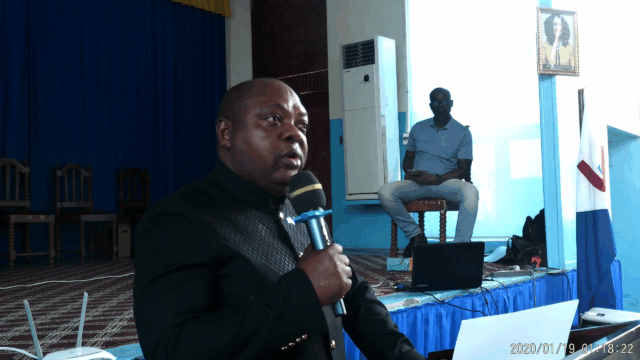
MONROVIA, Liberia — Liberia National Bar Association (LNBA) President Cllr. Bornor M. Varmah on Thursday, November 13, 2025 issued a blunt challenge to West African political leaders, warning that the ECOWAS Community Court of Justice will be rendered pointless unless member states start complying with its binding judgments.
Speaking at a special forum for lawyers and law students at the University of Liberia’s Louis Arthur Grimes School of Law, part of the Court’s first‑ever outreach in Liberia, Cllr. Varmah praised the ECOWAS Court as “the most principled organ in the sub‑region,” but said enforcement remains its Achilles’ heel.
“There is no way to give meaning and effect to the ECOWAS Community Court of Justice if the political leadership in the ECOWAS sub‑region will not support the Court by enforcing judgments and decisions of the Court,” Varmah said. “Let me be on the record to say there will be no need for this Court to exist if Member States of ECOWAS cannot enforce decisions and rulings emanating from this Court.”
Liberia Urged to Lead by Example
Varmah, who also serves as President of the West African Bar Association (WABA), urged President Joseph Nyuma Boakai to play a leadership role among his peers. “Liberia, I understand, is the only country in the sub‑region that has ratified almost all the protocols about the Court. There is a need that we must play the leadership role,” he said. “President Boakai has been encouraged to encourage his colleagues in the sub‑region.”
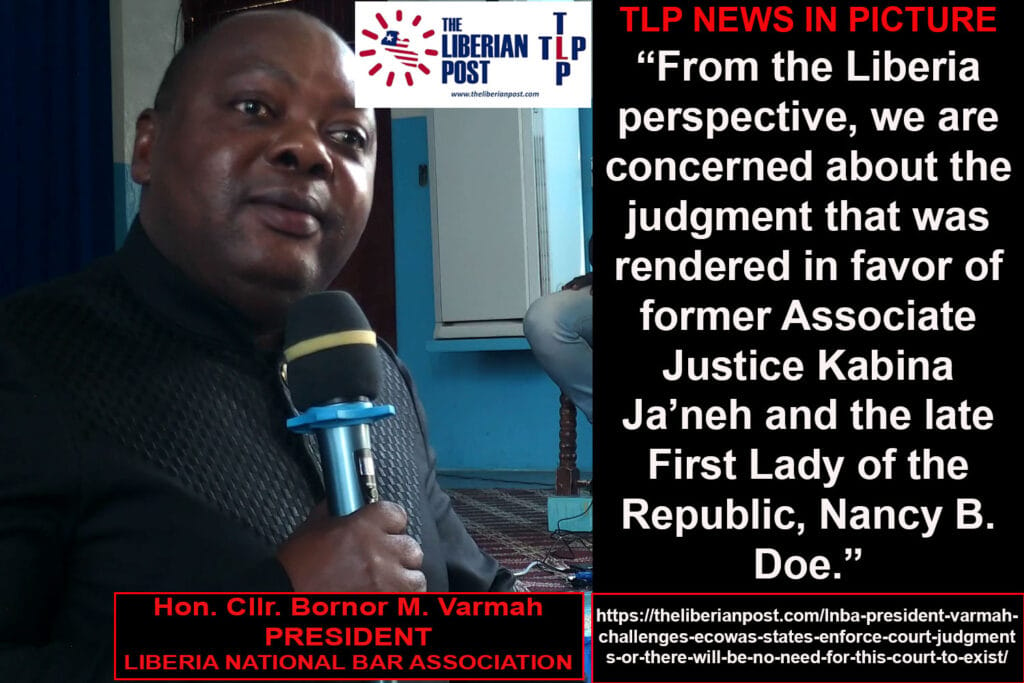
The LNBA president referenced ECOWAS Court judgments involving Liberia that he said still require action, including decisions in favor of former Associate Justice Kabineh Ja’neh and the late First Lady Nancy B. Doe. “From the Liberia perspective, we are concerned about the judgment that was rendered in favor of former Associate Justice Kabina Ja’neh and the late First Lady of the Republic, Nancy B. Doe,” he noted, adding that the Bar and Court agreed to share data to track compliance. The ECOWAS Court has previously ordered Liberia to afford remedies and compensation in those matters; full enforcement has been the subject of public debate.
Court Outreach Meets Liberia’s Pillars
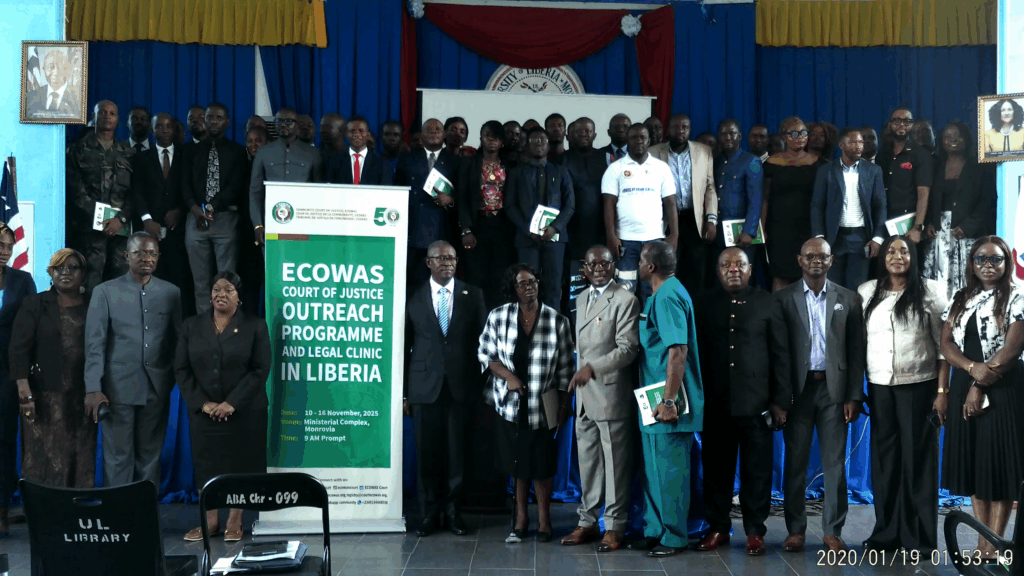
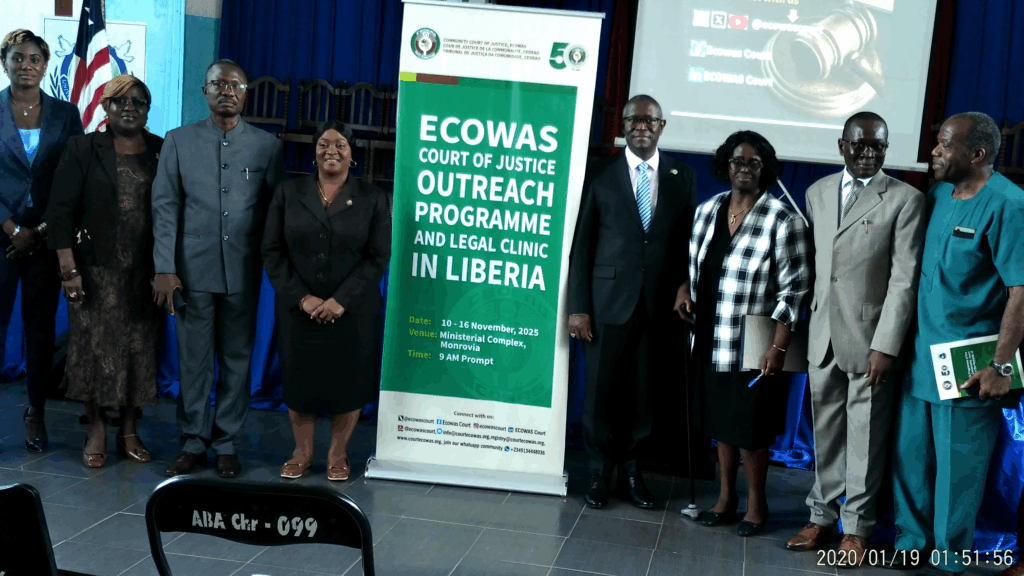
The ECOWAS Court delegation, led by President Hon. Justice Ricardo Claudio Monteiro Gonçalves and represented at the forum by Vice‑President Hon. Justice Sengu Mohamed Koroma, is in Liberia November 10–16 for its inaugural outreach—a program featuring technical sessions, public sensitization, and courtesy calls. On November 11 the delegation met Foreign Minister Sara Beysolow‑Nyanti, President Boakai, Justice Minister and Attorney General N. Oswald Tweh, Chief Justice Yamie Quiqui Gbeisay, Vice President Jeremiah Kpan Koung (President of the Senate), House Speaker Richard Nagbe Koon, the Liberia National Bar Association, and the Independent National Human Rights Commission.
At a separate technical workshop, the Court unveiled plans for an Electronic Case Management System to enable 24/7 e‑filing and virtual hearings, and promoted its regional moot competition for law students—moves designed to widen access and deepen legal capacity across West Africa.
Bar’s Platform—and A Compliance Agenda
Varmah told the forum the LNBA has repeatedly provided a platform for the Court at its conventions, including training with Ministry of Justice lawyers, but said the “critical” issue remains compliance. “All of what we’ve come to do in Liberia will only bring visibility to the Court. But what is significantly important is the issue that has to do with the enforcement of your rulings and decisions. That remains critical,” he said.
He pledged that the LNBA and WABA would continue to work with the Court on a concrete compliance agenda. “On behalf of the Liberian National Bar Association, and by extension the West African Bar Association, we can only assure you of our fullest commitment to working with you in achieving the mandate of the Court,” he said. “Our political leadership—the entire political leadership in the sub‑region—must be serious.”
Teaching the Next Generation—and Using the Court Well
Varmah also emphasized legal literacy about the Court. “My own Secretary General was telling me he doesn’t understand some of the nuances of this Court,” he said. “Tomorrow’s event will present a perfect opportunity to understand what the Court stands for, the jurisdiction, and other issues that the Court is confronted with.” He encouraged Liberian lawyers to master the Court’s procedures and jurisprudence so that meritorious cases are not lost on avoidable procedural grounds.
Why This Matters
Under the 2005 Supplementary Protocol, ECOWAS citizens can sue member states directly before the Court for violations of human rights attributable to the state, and the Court’s judgments are binding. Liberia’s unique status—having signed all Court protocols—positions it to lead on compliance and to leverage the Court to strengthen rights, rule of law, and regional integration. Varmah’s bottom line, however, was political. “In all of what we do here,” he said, “what is critical is enforcement. Without it, we weaken democratic governance in the West African sub‑region.”