MONROVIA, Liberia — Liberia’s Minister of Finance and Development Planning, Augustine Kpehe Ngafuan, has declared that the country’s economy is “materially stronger” than it was two years ago, citing improved growth, falling inflation, rising reserves, and record domestic revenue as evidence that President Joseph Nyuma Boakai’s reform agenda is beginning to deliver tangible results.
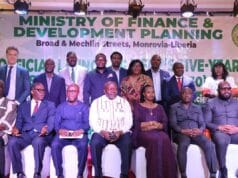
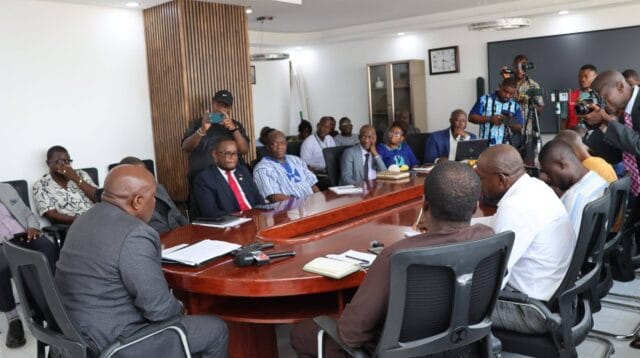
Speaking Wednesday, January 28, during his first press conference of 2026, Ngafuan said the engagement was intended to “unpack the numbers” contained in the President’s Third Annual Message and translate macroeconomic data into everyday realities for ordinary Liberians.
According to the Minister, Liberia recorded 5.1 percent economic growth in 2025, surpassing projections and improving on the previous year’s performance. Inflation, he said, fell to four percent by December 2025, the lowest level in more than two decades, while the country’s international reserves grew by over US$101 million.
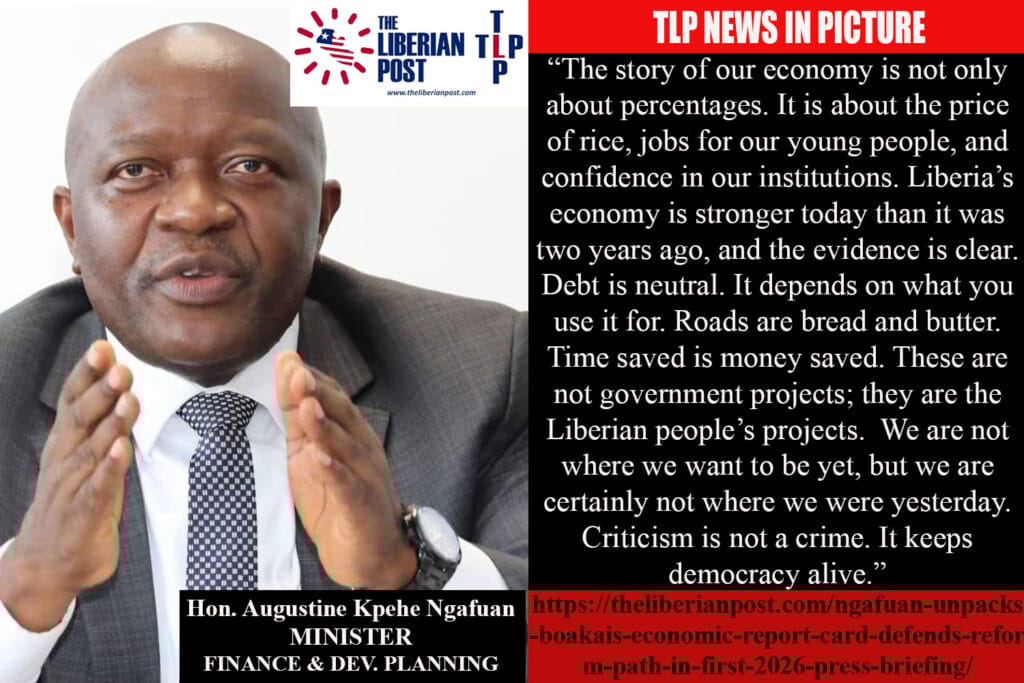
“These achievements are not abstract,” Ngafuan emphasized. “They form the foundation of a more stable market, a stronger currency, and a more predictable business environment.”
Record Revenues, Fiscal Discipline
Ngafuan disclosed that Liberia generated US$847.7 million in domestic revenue, the highest in the country’s history, exceeding the target by more than US$43 million. He attributed the performance to tightened fiscal controls, improved tax administration, and increased digitization at revenue-generating institutions.
The Finance Minister acknowledged that 2025 was particularly challenging due to a sudden reduction in donor support, but said the government responded with discipline rather than panic.
“Many predicted collapse,” he said. “Instead, we tightened expenditure management and protected health, education, and infrastructure.”
Debt and Supplemental Budget
Responding to concerns about rising public debt, Ngafuan said Liberia’s debt-to-GDP ratio stands at about 56 percent, which places the country in a low-to-moderate risk category. He stressed that debt itself is not harmful if used productively.
“Debt is neutral,” he explained. “It depends on what you use it for.”
On the proposed supplementary budget, Ngafuan said it reflects delayed revenues from 2025 and improved fiscal performance, not mismanagement.
Jobs, Salaries, and Cost of Living
Ngafuan addressed public skepticism about job creation figures and salary payments, admitting challenges in tracking employment data but insisting progress is real. He confirmed that government is transitioning civil servants to a 70 percent US dollar and 30 percent Liberian dollar salary structure to reduce exposure to exchange-rate shocks.
While acknowledging that not all problems have been solved, Ngafuan insisted Liberia is firmly on a positive trajectory.
“We are not where we want to be yet,” he said, “but we are certainly not where we were yesterday.”
Follow The Liberian Post on Facebook and X (formerly twitter)