MONROVIA, Liberia — Liberia’s procurement czar, Bodger Scott Johnson, on Thursday, October 9, moved to distance the Public Procurement and Concessions Commission (PPCC) from mounting controversy over the government’s plan to acquire 285 earth‑moving “yellow” machines, saying the commission did not pick a winner and attended overseas engagements strictly as observers under the law.
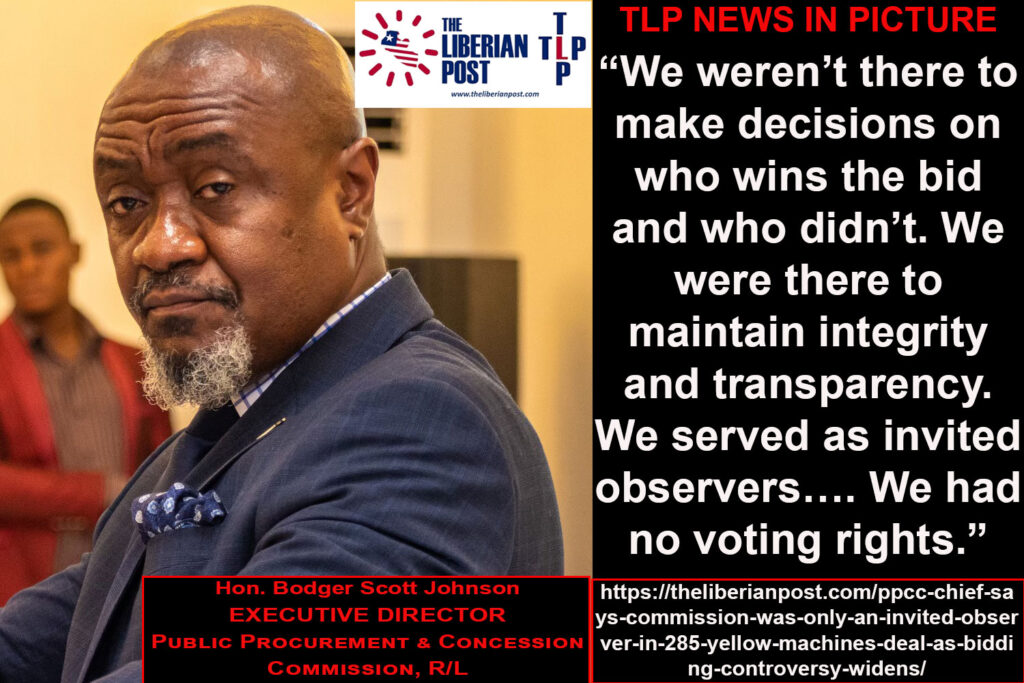
“We weren’t there to make decisions on who wins the bid and who didn’t,” Johnson told the Ministry of Information’s regular press briefing. “To maintain integrity and transparency, we served as invited observers…. We had no voting rights.”
Johnson said President Joseph Nyuma Boakai set up a special committee to handle the equipment procurement, chaired by Vice President Jeremiah Kpan Koung, and invited the PPCC to advise on procedure. He said the commission’s participation in a fact‑finding trip to China earlier in the process was lawful and consistent with the PPCC Act’s transparency and integrity provisions.
“In our law… that was more or like a national procurement,” Johnson said, adding that the PPCC’s role on the China trip was “more than a due diligence trip,” but grounded in the Act. “He [the Vice President] was there to advise that particular committee the President set up, on the whole procurement process, as it relates to the acquisition of the yellow machines.”
Johnson pushed back against claims of a sole‑source deal. “There was a bidding process that had gone on; it was not a single source,” he said. “It was more of a restrictive bidding—they invited a couple of companies… because the government had a ceiling.”
He declined to discuss bid rankings or money figures, saying Vice President Koung “will give or speak more to that at an appropriate time.” Johnson said that, from PPCC’s vantage point, “that procurement process went on successfully,” reiterating the commission did not have a vote on the outcome and “was there to guide the government on the different procurement processes” for acquiring the machines.
The yellow machines—meant to bolster road building and public works nationwide—have become a political flashpoint. Multiple reports have suggested the government set aside about $22 million for the acquisition, though authorities have not publicly confirmed the appropriation or its source. Competing vendors, allegations of shifting specifications and the early arrival of some equipment have fueled public skepticism.
What’s known and what’s contested
- A Liberian‑owned firm, ABK Incorporated, owned by Alieu B. Kromah, took part in the tender but did not win, according to people familiar with the process. There are unverified reports ABK bid a little over $24 million.
- Separate reports say a Chinese firm, Shantui Evergreen, was selected, proposing a price a little over $21 million. This has not been independently confirmed.
- A South African company, Guma Group, has been linked to at least 35 machines already shipped to Liberia but is said to have “lost interest” in the process amid the wrangling. Those accounts also remain unverified.
Johnson did not confirm any of those figures or outcomes Thursday. He stressed that “the Vice President will address that issue” regarding vendor selection and pricing.
Senior officials drawn in in addition to Vice President Koung’s leadership of the presidential committee, Johnson said the Ministry of Public Works took part in the China trip and subsequent reviews. Public Works Minister Roland Giddings’ portfolio places his ministry at the center of equipment specifications and deployment.
Ms. Mamaka Bility has also been named in public discussions around the machines; her precise role in the procurement has not been formally detailed. Johnson did not address Bility’s involvement during his remarks.

Historic scrutiny and Johnson’s prior stance
The machines have been debated for months across airwaves and social media, with critics questioning whether procedures were bent and whether political heavyweights influenced vendor selection. Johnson’s presence on the China visit drew particular scrutiny. On Thursday he reiterated that PPCC’s function was advisory, not determinative: “We were just there as observers… We had no voting rights.”
Process, not prize, says PPCC Johnson described the tender as “restrictive,” meaning a limited pool of companies was invited to submit proposals—a method allowed under Liberia’s procurement rules under certain conditions. He said the government operated under a price ceiling but did not say what that ceiling was. He also rejected suggestions that PPCC “selected” any company, stating the commission’s mandate is to ensure compliance, not to award contracts.
“We were there more to guide the government on the different procurement processes,” Johnson said, pointing to the PPCC Act’s integrity and transparency clauses as the basis for PPCC’s involvement as observers.
What’s next Johnson said Vice President Koung would “at an appropriate time” speak to the specifics of the bids, the government’s budget ceiling and the path to contract award. Under Liberia’s procurement law, losing bidders have avenues to file complaints or seek review; Johnson did not indicate whether any formal protests had been lodged.
Key questions still hanging include the exact funding source and amount, the status of any contract award, the disposition of the 35 machines reportedly already in-country, and the roles of all officials and companies referenced in public debate.