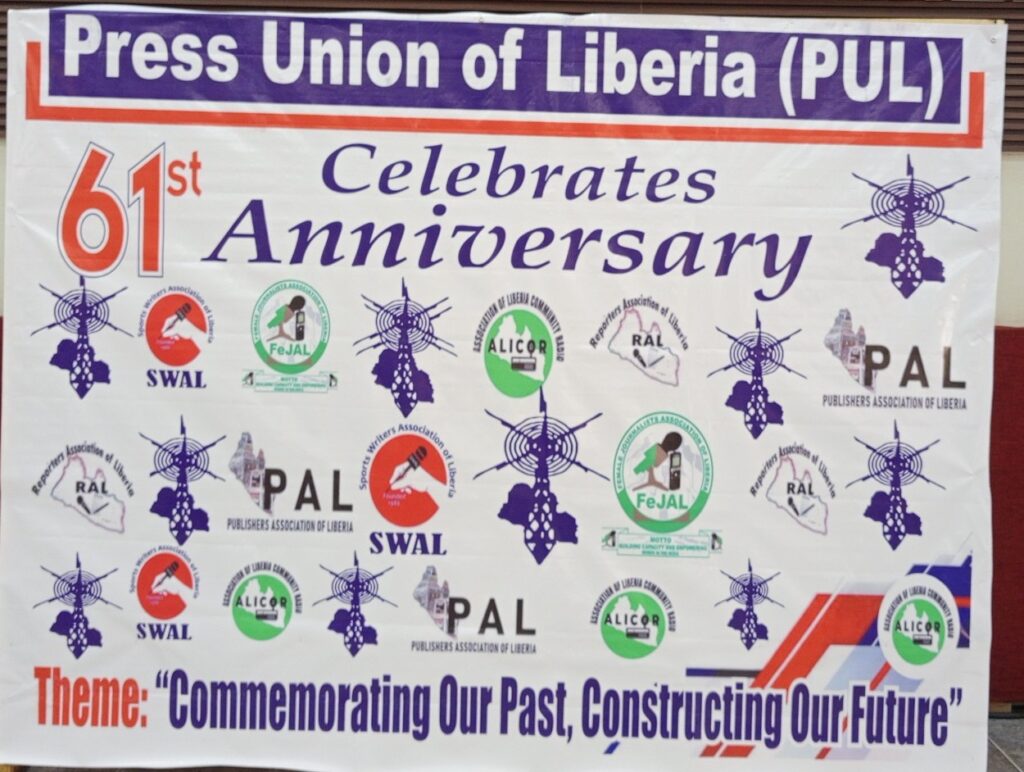
On Tuesday, September 30th, the Press Union of Liberia (PUL) turned 61 — an anniversary that is at once a celebration of Liberian journalism’s endurance and a sober reminder of the cost of reporting in a country that has known coups, civil war and politically driven repression.
Founded in the mid-1960s by a generation of pioneering journalists, the PUL grew from modest beginnings into the principal professional body for Liberian reporters, editors and media workers. Its early ranks included veteran practitioners such as the late Stanton Peabody and Kenneth Y. Best, who helped shape a press culture that valued independence, professionalism and public service. Over the decades those principles have guided the union’s work: defending press freedom, promoting ethical standards, and supporting journalists’ training and welfare.
A History of Resilience
Liberia’s press — and the union that represents it — has endured some of the most testing chapters of the country’s modern history. Journalists and media houses were tested by political crackdowns in the 1970s and 1980s; the 1980 coup and the successive years under military and authoritarian rule imposed censorship, intimidation and, in some cases, violence. The brutal civil wars (1989–2003) brought an even harsher reality: newspapers and broadcasters were shuttered or driven into exile, reporters were threatened, jailed or killed, and entire newsrooms were scattered.

Yet through conflict and instability the PUL remained a focal point for solidarity. When newspapers were forced to close, many Liberian journalists kept reporting from abroad; when peace returned, they came home to rebuild institutions, retrain a new generation and revive a free press as a cornerstone of Liberia’s democratic recovery.
A Voice for Accountability and Training
Beyond advocacy, the PUL has played a hands-on role in professional development — organizing workshops in reporting, ethics, safety and digital skills — and in pushing for legal reforms to protect media freedom. Its membership has helped document corruption, hold public servants to account and highlight issues from elections to public health and human rights. The union has frequently partnered with civil society and international press bodies to press for journalists’ safety and for laws that reflect modern media realities.
The path has not been easy. Attacks on journalists, court cases aimed at silencing reporting, surveillance and economic pressure on independent outlets remain real threats. The PUL has repeatedly called attention to these dangers and campaigned for stronger protections, better working conditions and greater transparency in public life.
Remembering the Pioneers
This anniversary is also a moment to recall the founders and early leaders who imagined a professional association able to defend the public’s right to know. Names such as Stanton Peabody and Kenneth Y. Best appear again and again in accounts of Liberian media history; they were among those who built institutions, trained colleagues and placed a premium on editorial independence. Their legacy lives on in the newsroom and in journalism classrooms across the country.
A Call to Protect and Strengthen the Fourth Estate
As the PUL marks 61 years, the moment calls for more than congratulations. It asks citizens, the government, development partners and media owners to reaffirm support for an independent press: to protect journalists from violence and legal harassment; to fund training and safety programs; to reform media laws that inhibit reporting; and to bolster economic models that allow independent outlets to survive and thrive.
The Press Union has been, and must remain, more than a professional association. It is a guardian of conversation and a bulwark against secrecy. In fragile democracies, a robust press is not a luxury — it is a necessity.
On this anniversary, Liberians should honor the PUL by remembering the sacrifices behind every news story, by protecting those who report the news, and by supporting a media that lifts the country’s problems into the light of day. The union’s 61 years are a story of persistence, courage and public service — and its next chapter depends on all of us ensuring that journalists have the freedom and resources to do their work safely and unimpeded.