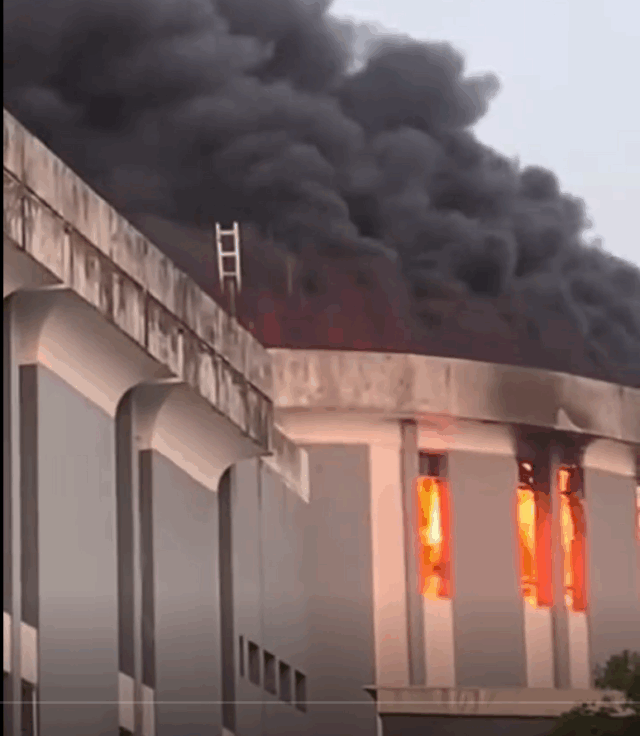
MONROVIA, Liberia — The prosecution’s case in the alleged arson of the Capitol Building suffered a major setback Monday after a key witness delivered testimony that conflicted with call-log records and an official forensic report, prompting sharp criticism from the observer.
During cross-examination, the witness told the court that Vehicle 98 was seized at the Capitol Building and later taken to the Liberia National Police (LNP) headquarters together with defendant Thomas Etheridge and other accused persons. He further alleged that although the vehicle was initially found to have no connection to the incident, investigators later suspected it was used to transport individuals and materials linked to the arson. According to the witness, Cllr. Massaquoi signed for the vehicle before it was turned over to police custody.
Defense counsel immediately objected, arguing that the testimony was speculative, prejudicial, and unsupported by evidence, as no proof had been produced showing the vehicle was used in the commission of the crime.

Call Logs Challenge State’s Timeline
In response, the defense introduced call-log records that directly contradicted the prosecution’s account of Etheridge’s movements. The records place Etheridge at the Liberia Electricity Corporation (LEC) in Waterside at 5:07 a.m. on December 18, 2024—the timeframe during which prosecutors allege the arson occurred. The logs further show him at Capitol Bypass at 5:51 a.m., when the building was already on fire, and later at the Capitol Building at 6:25 a.m.
Defense lawyers argued that the records establish a credible alibi, making it impossible for Etheridge to have been present at the crime scene at the time of the alleged arson. They maintained that the evidence raises serious doubt about the prosecution’s narrative.
Although the prosecution indicated that a technical expert would later testify on GPS and call-log interpretation, the court ruled that the witness, having already referenced the records, was required to respond to questions concerning them.
Forensic Account Called Into Question
The witness’s credibility was further challenged when his testimony conflicted with a forensic report he personally signed. In court, he stated that investigators discovered an empty chloride bottle approximately 25 feet from where the Speaker’s vehicle was parked, while a box of matches was found on the second floor of the Capitol Building.
Defense counsel countered by reading from the Special Investigative Report, page four, paragraph five, which states that the Liberia National Police forensic team lifted an empty chloride bottle from the ground around the William R. Tolbert Hall of the Capitol Building. The report also confirms that a box of matches containing several sticks was found on the second floor of the joint chambers.
The report, signed by Assistant Commissioner of Police Rafel Wilson, head of the Crime Services Department, was admitted into evidence and read by the court clerk.
In a stern remark, presiding Judge Roosevelt Z. Willie described the prosecution witness as “not properly arranged,” pointing to irreconcilable contradictions between his oral testimony, the forensic report, and the call-log evidence. The judge observed that while the witness suggested Etheridge was at the Capitol Building around 5:00 a.m., the call logs placed him at LEC at 5:07 a.m., Capitol Bypass at 5:51 a.m., and the Capitol Building at 6:25 a.m. The case was adjourned as the court continues hearing evidence in the high-profile and increasingly contentious Capitol arson trial.