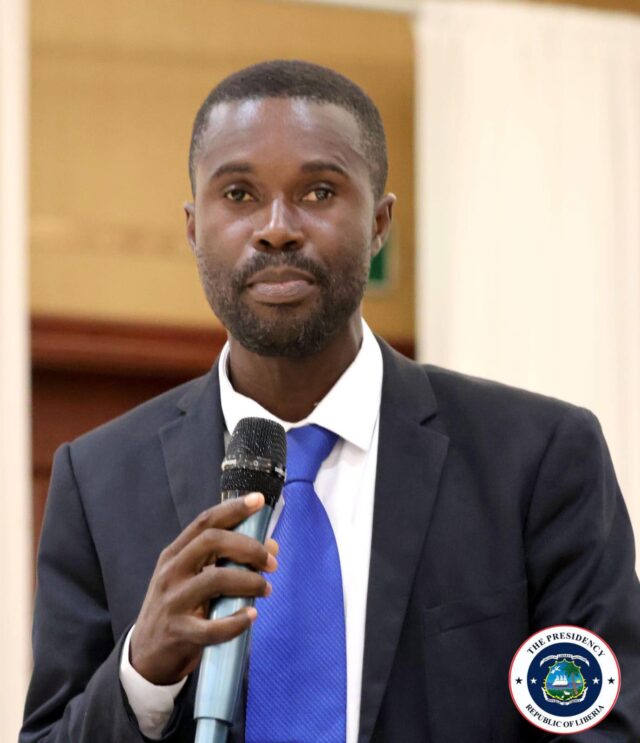
MONROVIA – In a poignant address delivered on July 19, 2025, Julius Kanubah, President of the Press Union of Liberia (PUL), honored the memory of those who suffered during Liberia’s armed conflict while advocating for justice and accountability through the establishment of a War and Economic Crimes Court and a National Anti-Corruption Court. The event, held at Old CID Road in Mamba Point, Monrovia, was part of the launch of a National Outreach Campaign aimed at enhancing public awareness and engagement regarding the critical work of the Office for the Establishment of War and Economic Crimes Court (OWECC) in Liberia.
Kanubah began his speech by inviting attendees to observe a moment of silence in remembrance of the countless lives lost during the conflict, highlighting the poignant reminder that the scars of war still linger in Liberia. “Our violent armed conflict cost the lives of about 250,000 people,” he stated, underscoring the profound impact of governance failures, corruption, and a wartime economy that plundered the nation’s rich natural resources.As Kanubah b the audience, he reaffirmed the PUL’s commitment to promoting freedom of speech, media rights, integrity, and accountability within journalism. “The PUL is the umbrella organization for professional Liberian journalists and media institutions,” he said, emphasizing the importance of responsible journalism in fostering democracy and rebuilding trust in post-war Liberia.
Echoing the sentiments of many Liberians, he pointed out that the quest for justice remains unfulfilled, with “impunity thriving” and the cries for accountability growing louder. “Ending impunity, advancing accountability, and promoting national healing and unity are crucial,” he reiterated, urging support for OWECC as a vital step towards achieving these goals.
Kanubah called for broad backing from the public, international community, and the Liberian government to ensure the establishment of the War and Economic Crimes Court and the Anti-Corruption Court. “Support must not only be in words but must be backed by concrete moral and financial resources,” he asserted, stressing the necessity for governmental and civil society collaboration to pave the road to justice for victims of wartime abuses.
Furthermore, he encouraged journalists to uphold the highest standards of reporting, stating, “As we report on OWECC and transitional justice processes, we should remind ourselves of our responsibility in this pivotal moment.” His message was a clarion call for accurate, fair, and unbiased journalism that champions the rights of the marginalized and holds power to account.
In closing, Kanubah expressed gratitude to his colleagues in the journalism field for their dedication and hard work, emphasizing that the PUL stands firmly behind the outreach campaign and the establishment of key judicial mechanisms necessary for Liberia’s journey toward accountability and reconciliation.
The event served as a powerful reminder of Liberia’s past and the collective hope for a future defined by justice, transparency, and equitable governance.