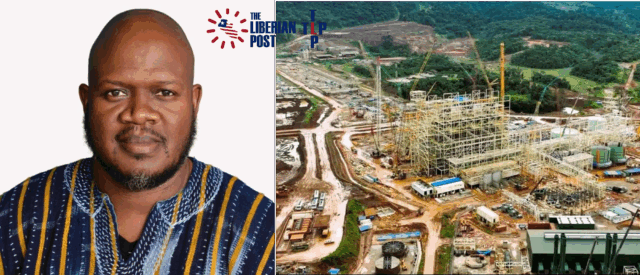
MONROVIA, Liberia — Nimba County Senator Nya D. Twayen has renewed his strong opposition to the proposed third amendment to Liberia’s Mineral Development Agreement (MDA) with ArcelorMittal, warning that the revised deal risks diluting corporate accountability, undermining community rights, and weakening legislative oversight.
Addressing a press conference at the Capitol on Thursday, January 15, Senator Twayen described the amendment currently before the Legislature as “not a routine administrative exercise,” but rather a “consequential restructuring” of one of Liberia’s most strategic concession agreements, demanding rigorous scrutiny before ratification.

Change of Corporate Identity Raises Red Flags
At the heart of Senator Twayen’s concerns is the reassignment of rights and obligations from ArcelorMittal Switzerland AG to ArcelorMittal USA Liberia, LLC—an entity he said was created just days before the amended agreement was signed.
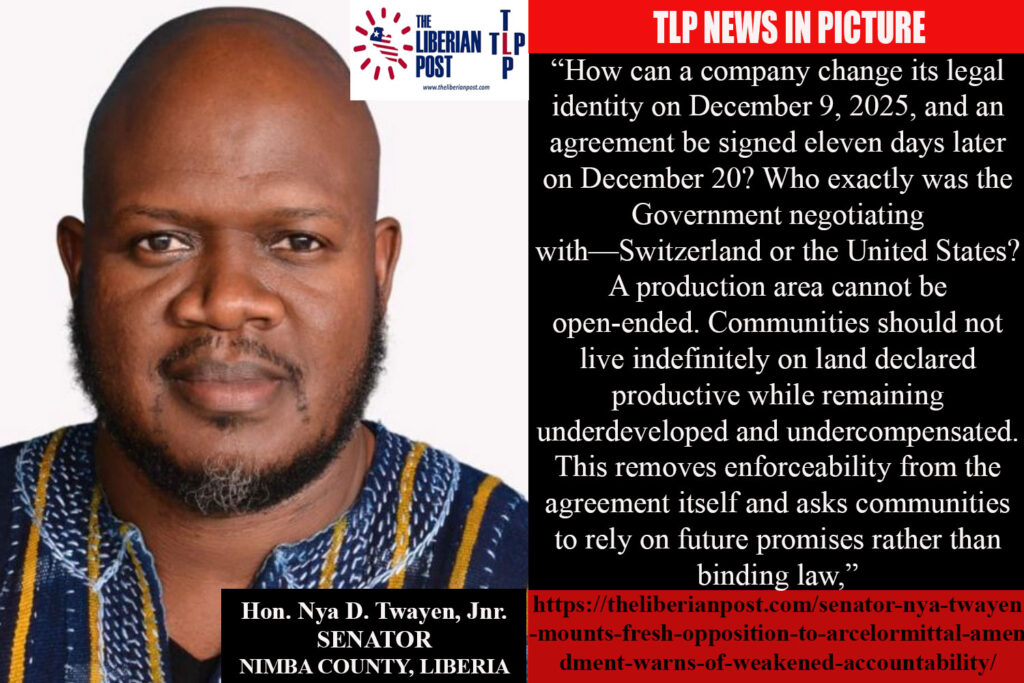
“How can a company change its legal identity on December 9, 2025, and an agreement be signed eleven days later on December 20?” Twayen asked. “Who exactly was the Government negotiating with—Switzerland or the United States?”
He warned that without explicit parent-company guarantees, continuity clauses, and enforceable security instruments, Liberia risks losing leverage over past breaches and outstanding liabilities tied to the original MDA.
Production Area Clause Draws Sharp Criticism
Senator Twayen also objected to provisions that treat the entire concession area—including undeveloped and future exploration zones—as a single production area. He argued that such an approach contradicts international best practice and could result in “mineral warehousing” that locks communities into long-term restrictions without corresponding benefits.
“A production area cannot be open-ended,” he said. “Communities should not live indefinitely on land declared productive while remaining underdeveloped and undercompensated.”
He stressed that while infrastructure such as rail and port facilities may be integrated, mineral extraction should remain subject to phased, area-by-area approval by the Legislature.
Social Infrastructure Obligations Omitted
One of the most contentious issues raised at the briefing was the removal of binding social infrastructure obligations—such as hospitals, schools, roads, and bridges—from the amended agreement.
Under the original MDA, ArcelorMittal was legally obligated to construct and equip social infrastructure across affected counties, including Nimba. Senator Twayen said those commitments were largely unmet and are now conspicuously absent from the proposed amendment.
Instead, the new agreement defers community development to a post-ratification “social infrastructure plan” to be developed within three months—an approach Twayen called unacceptable.
“This removes enforceability from the agreement itself and asks communities to rely on future promises rather than binding law,” he warned.
Call for Audits and Legal Safeguards
Twayen called on the Legislature to demand audited financial statements from ArcelorMittal Liberia dating back to 2005, disclosure of beneficial ownership documents, and clear transfer instruments showing how liabilities were assumed by the new corporate entity.
He also indicated that legal action remains an option, noting that his advocacy is grounded in research and documentation rather than political posturing.
“This is not an anti-investment position,” he said. “It is pro-rule of law, pro-Nimba, and pro-Liberia.”

A Longstanding Position
Senator Twayen has been one of the Legislature’s most vocal advocates for concession compliance, repeatedly pressing ArcelorMittal on issues ranging from unfulfilled social obligations to environmental degradation along rail corridors in Nimba, Bong, and Grand Bassa counties.
In previous Senate hearings, ArcelorMittal officials acknowledged gaps in compliance, including the failure to fully deliver community infrastructure as required under earlier agreements.
No Rush to Ratification
Despite arguments from some quarters that the amendment must be urgently approved, Twayen rejected claims of time pressure, pointing out that the current MDA does not expire until 2030 and the new amendment would not take effect until 2031.
“We have the next four years to examine this document properly,” he said. “Rushing to ratify a flawed agreement would be one of the most damaging decisions this Legislature could make.”
As debate over the amendment intensifies, the Senate and House of Representatives are expected to continue hearings through their respective committees. The Executive Branch has not publicly responded to Senator Twayen’s latest assertions, while ArcelorMittal Liberia has maintained that the amendment strengthens investment and infrastructure integration.
For now, the proposed amendment remains before the Legislature, with its fate likely to hinge on whether lawmakers heed calls for stronger safeguards, clearer accountability, and binding protections for affected communities.