-Rejects Government Claim He Seeks to Destabilize Liberia
MONROVIA, Liberia – Bomi County Senator Edwin Melvin Snowe has warned of what he calls a growing “culture of disrespect and intimidation” against members of the Legislature by senior officials of the Executive, accusing the Boakai administration of weaponizing state platforms against lawmakers who exercise constitutional oversight.
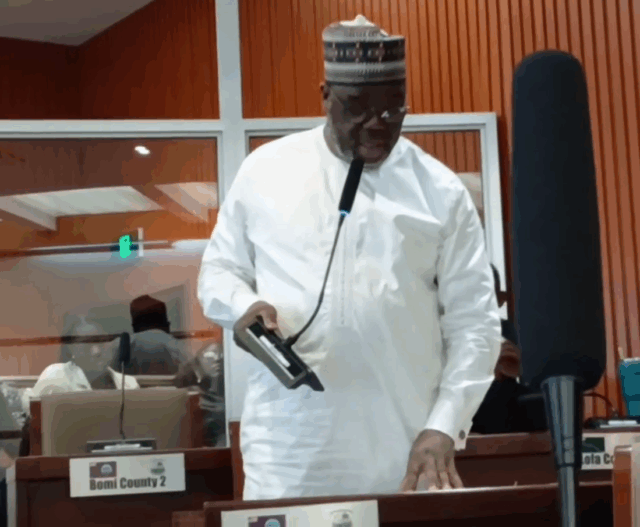
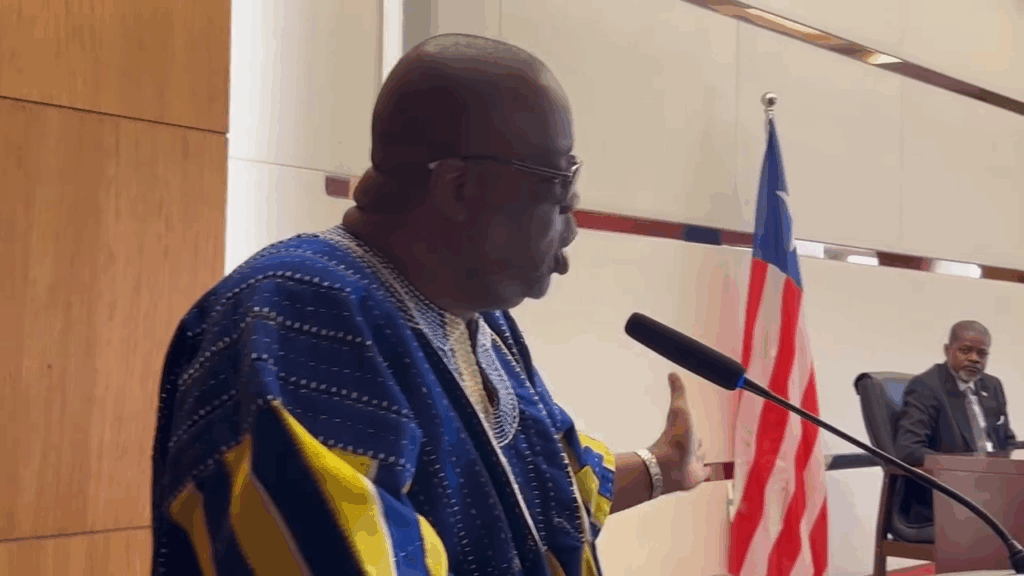
Speaking in plenary recently, Snowe said it is “fast becoming precedent” that whenever senators and representatives attempt to hold government officials accountable, they are met not with cooperation but with public insults, smear campaigns and even allegations of plotting to destabilize the country.
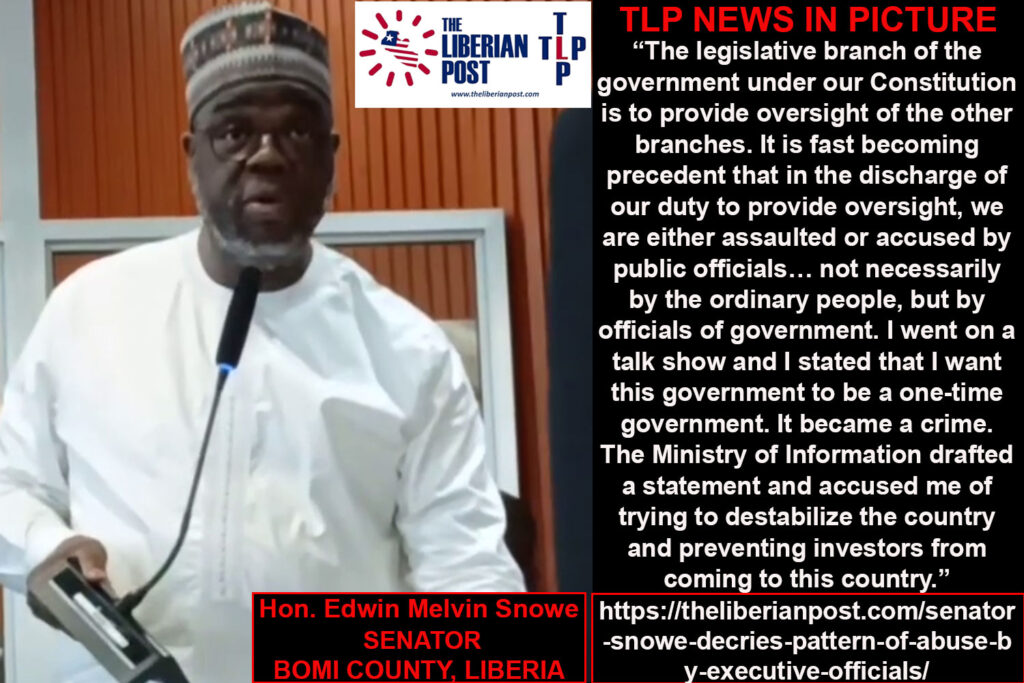
“The legislative branch of the government under our Constitution is to provide oversight of the other branches,” Snowe told his colleagues. “It is fast becoming precedent that in the discharge of our duty to provide oversight, we are either assaulted or accused by public officials… not necessarily by the ordinary people, but by officials of government.”
Clash Over Diplomatic Passports and “One-Term Government” Comment
Snowe recounted a heated dispute earlier this year when the Senate Committee on Foreign Affairs, which he is a member of, invited Foreign Minister Sara Beysolow Nyanti to respond to concerns over the alleged misuse of Liberian diplomatic passports.

According to the senator, committee members had raised alarm that individuals were openly displaying Liberian diplomatic passports on aircraft and posting them on social media, in ways he believes undermine national security and the country’s image abroad.
He said his public criticism of the situation triggered a media backlash from two senior officials of the Executive, who “went on the airwaves and in the papers and assaulted me for expressing my concern.”
The conflict escalated after Snowe appeared on a local talk show and said he wanted the current government to remain a “one-time government” – a formulation opposition figures and civil society actors in Liberia have used in the past to signal their desire for democratic change through the ballot box.
Snowe told the Senate that his remark was treated as if it were a criminal act.
“I went on a talk show and I stated that I want this government to be a one-time government. It became a crime,” he said. “The Ministry of Information drafted a statement and accused me of trying to destabilize the country and preventing investors from coming to this country.”
The Ministry’s statement, released via official channels, accused the Bomi lawmaker of making “reckless and unpatriotic” comments that could scare away investors and “undermine peace and stability” – language Snowe says was designed to portray legitimate political opposition as a security threat.
The senator said he formally complained to the Senate leadership, asking the body to treat the matter as an institutional affront, not just a personal slight.
“I complained formally to the Senate and the Senate leadership to seize of the matter,” Snowe said, adding that he is “looking forward for a better solution based on the discussions that were held.”
ELBC Boss, Gambling Center Allegation and “Insults on the Senate”
Snowe also cited a more recent incident involving the state broadcaster, the Liberia Broadcasting System (LBS), and its radio arm, ELBC.
According to him, he had written to the Senate plenary alleging that a gambling center had been opened within or in connection with ELBC facilities – an issue he wanted properly investigated.
Rather than responding formally to the Legislature, Snowe says the Director General of ELBC took to social media to attack not only him but the Senate as an institution.
“In his response, Eugene Fahngon went to the social media and rained insults this time not just on me, but even on the Senate,” Snowe told his colleagues. “Questioning the Senate, insulting me and all.”
He argued that when heads of state entities challenge and insult the Legislature in public forums instead of following official channels, it undermines respect for checks and balances and encourages ordinary citizens to treat the Senate with disdain.
Dillon Cited as Evidence Problem Crosses Party Lines
To underscore that the problem affects lawmakers from both sides of the aisle, Snowe pointed to the case of Montserrado County Senator Abraham Darius Dillon, a prominent figure in the ruling Unity Party coalition.
Snowe said Dillon has been raising questions about work permits and labor practices, only to face personal attacks from Labor Minister Cllr. Cooper Kruah.

“Senator Abraham Darius Dillon has been talking about the issue of work permit,” Snowe said. “In response, the Minister of Labor, Cllr. Cooper Kruah, went to the Ministry of Information, a government platform, and said he was nominated by the President to be Minister of Justice, and that Senator Abraham Darius Dillon, of course, rejected that nomination and that’s how he became Minister of Labor.”
The Bomi senator said Kruah’s comments were amplified by a social media group and even by a formal statement from the minister’s own political party, which he said chairs. According to Snowe, that statement accused Dillon of harboring hatred for Nimbaians and linked him, rhetorically, to the eventual death of former Nimba County strongman Senator Prince Y. Johnson.
“Even his own political party… made a formal statement accusing Senator Dillon of attacking Nimbaians, even accusing Senator Dillon of attributing to the death of Senator [Prince Y.] Johnson, that he doesn’t like the Nimbaians,” Snowe said. “That which I consider a threat to his person, his life.”
Snowe stressed that Dillon’s situation demonstrates that the issue is bigger than party politics.
“Today it might be Edwin Snowe as an opposition, a proud opposition,” he said. “But what about Dillon, who is supposed to be a member of the ruling party, and that’s why I use him as a reference. We all here have been under attack one day or the other.”
“Act Now, or Forever Hold Our Peace”
Snowe urged the Liberian Senate to treat the incidents as an institutional crisis, not a series of isolated disputes.
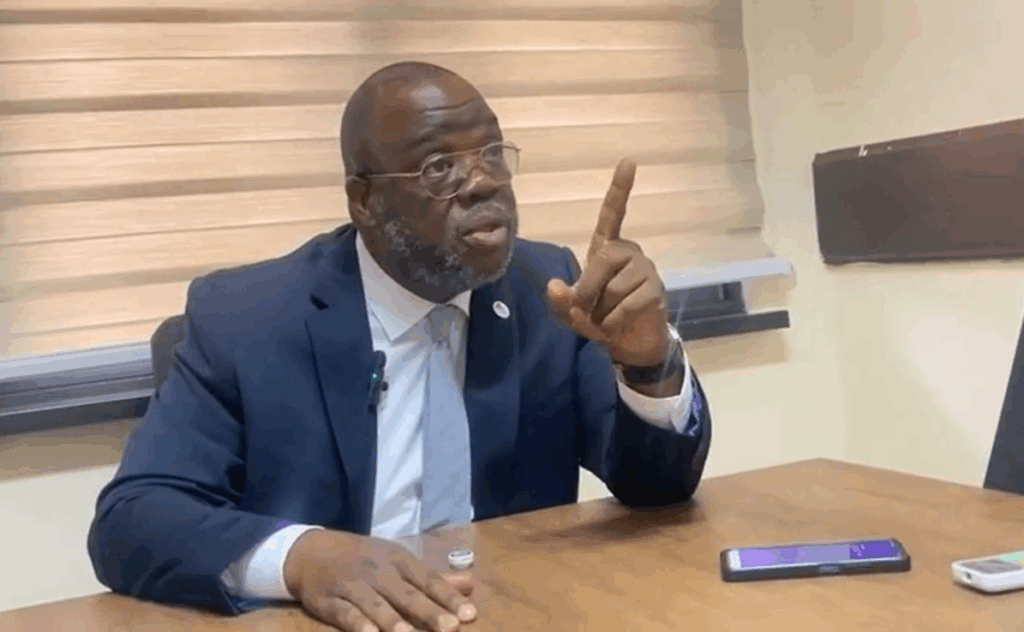
“My prayer to this Senate is that we deem it right to act now, or we forever hold our peace,” he warned. “When it begins to go around, nothing is happening today, when it begins to go around, and we’ll all sit supinely and see what will happen.”
He characterized the repeated public confrontations by executive officials as both “gross disrespect” to the Senate and an infringement on its constitutional mandate.
“I think it’s a gross disrespect to the Senate; it infringes on our constitutional responsibility, that in the discharge of our duty, we are either being threatened or we are being assaulted, not just by the ordinary people in the market, but by officials of our government for doing our job.”
The Bomi Senator called for clear institutional responses, ranging from formal citations of offending officials to possible contempt proceedings, to send a message that “no state actor is above the Legislature.”
Government’s Accusation: Snowe Seeking to Destabilize Liberia
The Ministry of Information’s statement against Senator Snowe, which followed his “one-time government” comment, forms the crux of the government’s charge that he is seeking to destabilize Liberia.
In that statement – part of a broader pattern in which administration spokesmen have publicly rebuked critical lawmakers – Snowe was accused of:
- Using inflammatory language that could “incite public disaffection”;
- “Scaring potential investors” through his remarks about the government; and
- Allegedly aligning with elements “bent on undermining peace and stability.”
Officials have argued that such rhetoric, especially in a fragile post-conflict democracy, carries security implications and may embolden anti-government actors.
Snowe flatly rejects that characterization, insisting that his words were clearly within the bounds of democratic free speech and opposition politics.
Associates of the senator point out that Liberian politicians, activists and religious leaders have, across administrations, frequently declared a desire to make incumbent governments “one-term governments” through elections – language that has rarely been equated with insurrection.
Rights advocates and some legal analysts note that the Constitution protects lawmakers’ speech in the discharge of their functions, and warn that loosely framed accusations of “destabilization” risk chilling democratic debate.
Oversight vs. Thin Skin: Broader Tension Between Branches
The clash highlights ongoing tension between Liberia’s Legislature and Executive over the limits of criticism and oversight.
Liberia’s 1986 Constitution gives the Legislature broad powers to summon and question officials, approve key appointments, and oversee the use of public resources. In practice, however, lawmakers have often complained that executive officials treat legislative inquiries as personal attacks rather than institutional obligations.
In recent years, public spats between ministers, heads of state-owned entities and legislators have increasingly played out on radio talk shows and social media, where personal insults sometimes overshadow the policy issues at stake.
Snowe’s intervention suggests growing unease within the Senate that, left unchecked, this dynamic could erode respect for the Legislature and weaken checks and balances.
Next Steps: Senate Under Pressure to Respond
The Senate leadership has already received Snowe’s formal complaint and held preliminary discussions, according to the Bomi senator. Lawmakers are now under public pressure to show whether they are prepared to defend their institutional integrity.
Possible options include:
- Summoning the Information Minister, the ELBC Director General and Labor Minister Kruah for questioning;
- Demanding formal retractions or apologies for statements seen as demeaning or threatening to senators;
- Issuing a strong joint resolution reaffirming the Legislature’s oversight powers and condemning personal attacks from state actors; or
- Pursuing contempt charges in the most egregious cases.
For now, Snowe is framing the issue not as a personal grievance but as a test of whether Liberia’s post-war democracy will tolerate robust oversight without branding critics as enemies of the state.
“Today it is me,” he told his colleagues. “Tomorrow it could be any of us.”