-2025 State Department Review Notes 5.1% Growth, Easing Inflation, and a New 5-Yr Plan but Highlights Persistent Regulatory and Governance Hurdles
MONROVIA — Liberia’s economy is showing signs of growth and investment potential, particularly in the power, natural resources, and ICT sectors, but systemic corruption, weak courts, and poor infrastructure continue to undermine investor confidence, according to the U.S. State Department’s 2025 Investment Climate Statement for Liberia.
The report paints a mixed picture — one of economic promise constrained by persistent governance and logistical challenges.
Economic Growth and Key Indicators
Liberia’s economy expanded by 5.1% in 2024, buoyed by mining, agriculture, fisheries, and services. Inflation eased to 7.7%, down from 10% the previous year. The rebound was supported by donor-funded infrastructure and energy projects financed by the World Bank, IMF, AfDB, USAID, and the European Union.
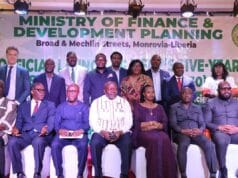
In January 2025, the government launched the ARREST Agenda for Inclusive Development (AAID) — a five-year development plan centered on agriculture, roads, rule of law, education, sanitation, health, and tourism.
Trade with the United States, however, remains limited. In 2024, Liberia imported $63 million worth of U.S. goods from total import payments of $1.5 billion, and exported $57 million to the U.S. from total export receipts of $1.3 billion.

Sectors Ripe for Investment
The report identifies substantial investment openings in:
- Natural resources — including mining, forestry, and aquaculture
- Infrastructure — such as electricity generation, airport upgrades, and transportation networks
- Emerging sectors — like telecommunications, agribusiness, tourism, financial services, and renewable energy
Liberia’s economy remains heavily commodity-based and dependent on imports, leaving it vulnerable to global price shocks. Core exports include iron ore, gold, diamonds, rubber, and oil palm, while key imports such as fuel, machinery, clothing, and rice remain essential to domestic consumption.
Investment Regulation and Oversight
Several agencies oversee investment policies, including the National Investment Commission (NIC), Ministry of Finance and Development Planning, Ministry of Commerce and Industry, and the Liberia Revenue Authority (LRA).
The NIC leads investment promotion and negotiates contracts through an Inter-Ministerial Concession Committee (IMCC). Deals worth $10 million or more require review by the IMCC, legislative ratification, and presidential approval.
Restrictions on Foreign Ownership
Under the 2010 Investment Act, certain sectors are reserved exclusively for Liberians — including retail trade of rice and cement, block making, gas station operations, taxi services, and used car sales (except certified dealers).
Foreign investors must meet minimum capital requirements of $500,000 for wholly foreign-owned enterprises or $300,000 for joint ventures with at least 25% Liberian ownership.
The Constitution restricts land ownership to Liberians of Negro descent. Non-Liberians may only obtain long-term leases. Notably, large agricultural and forestry concessions already cover roughly 25% of Liberia’s land mass.
Starting a Business and Incentives
Businesses must register with the Liberia Business Registry (LBR) and the LRA, and enroll with NASSCORP for social security. Work permits for expatriates are issued online by the Ministry of Labor.
The NIC helps investors access tax and customs incentives under the 2021 Liberia Tax Amendment Act. However, the report flagged the LBR’s insecure website as a concern for online registration reliability.
Governance and Corruption Challenges
Despite progress in revenue collection and policy reform, the State Department underscores continuing governance problems:
- Foreign investors report difficulties accessing officials without offering bribes.
- Non-transparent contract awards, political favoritism, and a weak legal framework hinder fair competition.
- Some officials “view foreign investors as opportunities for short-term graft,” the report warns.
- Firms that comply with regulations often receive little support and may even be targeted for extortion, while those that pay bribes enjoy impunity.
Market Entry for U.S. Investors
The report identifies promising entry points for U.S. businesses in:
- Agro-processing and food production
- Renewable energy and ICT
- Financial services and fintech
- Manufacturing and waste management
Top constraints include poor infrastructure, low purchasing power, tax inconsistencies, and weak contract enforcement. Many American firms opt to partner with local agents or legal counsel to navigate regulatory processes.
Trade Treaties and Investment Agreements
Liberia maintains bilateral investment treaties with France, Germany, Switzerland, and Taiwan. Treaties with the UAE (2019) and Belgium–Luxembourg Economic Union (1985) are pending ratification.
It also benefits from trade access under the African Growth and Opportunity Act (AGOA) and the U.S.–ECOWAS Trade and Investment Framework Agreement.
The report notes that while Liberia does not promote outward investment, it also places no restrictions on Liberians investing abroad.
Bottom Line
Liberia’s economy is stabilizing, inflation is moderating, and a new five-year development plan is in motion. The country’s strategic location, natural resources, and donor-backed projects present real opportunities — especially in energy, transport, agribusiness, ICT, and natural resources.
However, entrenched corruption, judicial weakness, and infrastructure decay continue to inflate business risks. The report concludes that investors who establish strong compliance mechanisms, local partnerships, and clear contracts can tap into Liberia’s potential — provided they are prepared for governance challenges and persistent regulatory uncertainty.