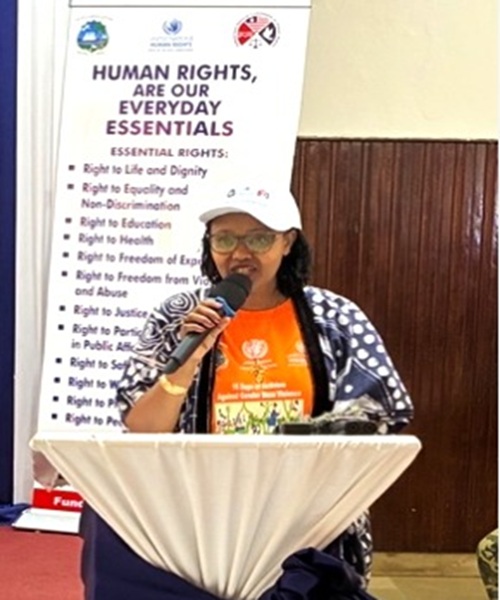
MONROVIA – Speaking recently at programs marking celebration of International Day of Human Rights, Christine N. Umutoni, U.N. Resident Coordinator to Liberia, restated that all stakeholders are needed on board to establish a War and Economic Crimes Courts for Liberia.
The UN Resident Coordinator in Liberia reaffirmation of UN’s support for the Office of War and Economic Crimes Court comes as a public dispute widens between the Office and a Human Rights Commission–led civil society bloc. The rift reportedly deepened after the civil society bloc submitted its own draft bill for a war crimes court to the Senate Judiciary Committee saying the Office was taking too long.
However, Umutoni has urged broad coordination among the Court Office, civil society, the Human Rights Commission and key state institutions to establish the courts.
The United Nations has taken a lead role in coordinating international support for Liberia’s post war justice process. The intervention of Umutoni, the top U.N. official in Liberia, comes as almost all international donors have signaled that why they will likely provide technical support and training to the Office, they will not directly provide funds.
They have urged the Boakai government to fund the court itself. “It is essential the Office works with the Ministry of Justice, the Legislature, as well as civil society organizations, the Human Rights Commission and the Anti-Corruption Commission, and all of you, to achieve this,” Umutoni averred. “This strives in upholding human rights obligations and best practice, speaking to the Liberian government’s willingness and preparedness to strengthen accountability, as well as the promotion, protection and fulfillment of human rights.”
The reported clash between the civil society actors and the Office of the War and Economic Crimes Courts – Liberia (OWECC-L), centers on how quickly Liberia should move to establish a war and economic crimes court — and who should shape the legislation that would bring those tribunals into being. The Human Rights Commission-led coalition of civil society actors recently submitted a draft bill for a war crimes court to the Senate, arguing that time is running out to deliver long-delayed justice for victims of the civil wars, which killed an estimated 250,000 people. They have long complained that the Office has been slow to submit its own bill.
Dempster Brown, a lawyer and chairman of the Human Rights Commission, said the coalition acted so that “the president’s efforts do not go in vain.”
But Cllr. Dr. Jallah Barbu, Executive Director of the OWECC-L, which has been formally tasked with guiding the government’s process, has sharply criticized the civil society initiative. He dismissed the civil society submission to the Senate as “mischief” and “a distraction,” while members of the coalition have accused him of not knowing “what he’s doing.”
The Office has the backing of some civil society actors and victims’ groups, including the Lutheran Massacre Survivors Association, Liberia’s most prominent survivors’ organization.
The dispute intensified after Senator Joseph Jallah and Senate Pro Tempore Nyonblee Karnga- Lawrence introduced two other bills – one focused on wartime atrocities and another on corruption and economic crimes – that would route cases through Liberia’s domestic courts and exclude prosecution for international crimes. Critics say the bills would undermine accountability and shield accused perpetrators, including some who serve in the Legislature, from prosecution for the most egregious crimes.
Speaking at Liberia’s local commemoration of Human Rights Day, the UN Resident Coordinator in Liberia, Christine Umutoni said the court process requires coordination among all institutions involved. Her comments were the most explicit public statement yet of U.N. support for the Office at a moment when the court process has become mired in competing draft bills and organizational distrust.
The United Nations has played an influential role in Liberia’s postwar transitional justice efforts for years. Earlier this year, the U.N. sent a team of technicians to assist the Office, a deployment triggered by a request from President Joseph Boakai to António Guterres, the U.N. secretary general, for technical and financial support.
“The U.N. remains highly supportive of the work of the Office of the establishment of the War and Economic Crimes Court of Liberia, a transitional justice architecture set up by His Excellency, the President of Liberia, to guide the government on the establishment of the war and economic crimes court and a national anti-corruption court,” she said. “These mechanisms are essential not only for addressing past gross human rights violations and combating impunity, but also for fostering reconciliation and building lasting peace in the country.”
The transitional justice process was dealt a blow last week with the news that Sweden, the largest remaining bilateral donor to Liberia, after the shutdown of USAID this year, and the only country to donate funds directly to the Office, plans to close its Embassy in Liberia in August 2026. Sweden said its support to Liberia will continue “through global support to multilateral organizations and through the European Union.”
Umutoni’s call for the courts’ establishment was echoed by Cllr. Bornor M. Varmah, president of the Liberian National Bar Association, which will also have a prominent role in the court.
“The call for accountability for war and economic crimes is not a call for revenge,” Cllr. Vamah said at the UN event. “It is a call for national moral clarity. It is a call for the families who still carry pain. It is a call for the children who deserve to know that impunity is not a Liberian inheritance. It is a call for institutions that must show that the law is indeed supreme.”
He warned that when a country refuses to confront past abuses, it leaves space for new ones. “Justice delay is not just a denial only for the victim,” he said. “It is justice waiting for the entire nation.”
Cllr. Dempster Brown, Chairman of the Independent Commission on Human Rights (ICHR), speaking at the event, defended the coalition’s decision to submit its own bill. He argued that civil society advocacy and appeals to the President and the Legislature helped the OWECC-L’s creation and revived momentum around a process that had been stalled for years. He rejected the suggestion that disharmony would deter international support for the court.
“That bill, automatically, it meets international standards,” Cllr. Brown stated. “There is no way that it will be objected to by the international community.”
He framed the coalition’s move as an effort to protect the President’s stated goal. “The president is concerned. He wants war crimes court,” he noted. “But who is undermining this war crimes court establishment? This is why we got involved.”
As competing bills and recriminations continue, transitional justice observers warn that the fractures could embolden opponents of the courts and further delay a process that has already stretched across decades.