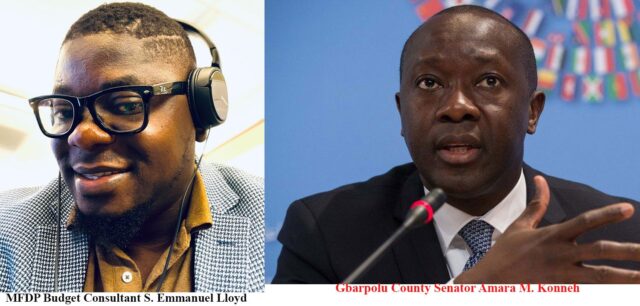
MONROVIA, Liberia — A public disagreement has erupted between Gbarpolu County Senator Amara M. Konneh and a budget consultant at the Ministry of Finance and Development Planning (MFDP), S. Emmanuel Lloyd Sr., over the handling of budgetary transfers and the integrity of Liberia’s Public Sector Investment Plan (PSIP), following the House of Representatives’ passage of the FY2026 National Budget at the aggregate level.
In a detailed statement posted to Facebook, Senator Konneh — a former Minister of Finance and current Chair of the Senate Committee on Public Accounts — warned that extensive reallocations of development funds during FY2025 undermined fiscal discipline, compromised statutory safeguards, and weakened public trust in the budget process.
Konneh argued that PSIP-approved projects totaling US$16.1 million experienced significant diversions as of October 31, 2025, with more funds transferred to other entities than directly implemented. He cited several cases in which projects received zero disbursement despite legislative approval, including the Renovation of the Executive Mansion, the Roberts International Airport (RIA) Upgrade, MFDP Headquarters construction, and Landfill and Urban Sanitation, asserting that such transfers may have violated the Budget Transfer Act of 2008.
The senator further pointed to excess execution, notably the National Service Program, where disbursements and transfers allegedly exceeded the approved ceiling by nearly 39 percent, and raised concerns about a new General Government Expenditure category in the FY2026 proposal amounting to US$256 million, questioning oversight and transparency.
Finance Ministry Consultant Pushes Back
In a sharp rebuttal, S. Emmanuel Lloyd Sr. dismissed Konneh’s claims as mischaracterizations of lawful fiscal practice, arguing that budgetary transfers are permitted tools under the Public Financial Management framework when executed within approved appropriations. He accused the senator of sensationalizing routine reallocations and eroding informed public debate.
Lloyd cited historical data to argue that transfer levels in FY2025 — estimated at about 4.5 percent of the total budget — were well below statutory thresholds and significantly lower than levels recorded during earlier administrations, including FY2012/13, when transfers reportedly reached 28.6 percent of the national budget. By comparison, he said, FY2025 reallocations were “routine and lawful.”
Responding to criticisms of General Claims and the new General Government Expenditure category, Lloyd said these classifications were introduced to improve transparency by separating non-agency-specific obligations — such as debt service, ECOWAS levies, social benefits, and bank charges — from individual ministries’ operational budgets. He noted that similar categories existed and expanded during prior fiscal years, including when Konneh served as finance minister.
Lloyd also defended FY2025 reallocations as responses to unforeseen national needs, including by-elections, reburials of former presidents, settlement of arrears, international obligations, security-related expenditures, and health interventions, stressing that none were directed to MFDP operational spending.
Budget Oversight Moves to the Senate
While acknowledging the historic size and revenue potential of the FY2026 budget, Senator Konneh cautioned that the House’s decision to pass the budget “at the aggregate level” risked weakening legislative oversight and exposing Liberians to high taxes without commensurate public benefits. He urged the Senate to conduct a sector-by-sector review before concurrence, echoing earlier calls for deeper scrutiny.
For his part, Lloyd argued that the debate should be grounded in law, evidence, and context, warning against framing transfers as inherently improper. He called for disciplined execution and constructive oversight rather than what he described as rhetorical excess. As the Senate prepares to take up the budget, the exchange underscores a broader national tension: balancing flexibility in fiscal management against strict adherence to development priorities — and determining how best to safeguard transparency in a constrained economic environment.