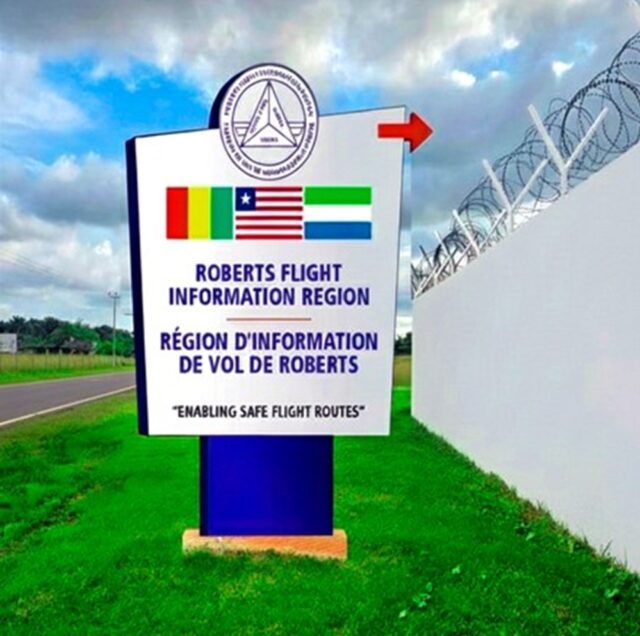
UNIFICATION TOWN, Margibi County Guinea, Liberia, and Sierra Leone have reaffirmed their long-standing aviation partnership as the Roberts Flight Information Region (Roberts FIR) commemorated its 50th anniversary, celebrating five decades of uninterrupted collaboration in managing one of West Africa’s most critical shared airspaces.
The Golden Jubilee celebrations, hosted by Liberia, combined technical deliberations, ministerial-level policy discussions, and ceremonial recognition, underscoring the Roberts FIR’s status as one of Africa’s most enduring and functional examples of regional integration in civil aviation.
Established in January 1975, the Roberts FIR manages approximately 770,777 square kilometers of upper airspace across the three Mano River Union countries, providing safe, efficient, and harmonized air navigation services for international and regional flights traversing the sub-region.
A Three-Tier Governance Model That Endured Five Decades
The anniversary events featured meetings of the Technical Committee and the Ministerial Council, highlighting the institutional framework that has sustained the Roberts FIR for half a century. The system is governed through:
- The Ministerial Council, which provides political oversight and policy direction;
- The Technical Committee, responsible for operational, regulatory, and safety guidance; and
- The Roberts FIR Secretariat, which executes day-to-day air traffic and administrative functions.
Officials attributed the longevity of the arrangement to strict adherence to the Aeronautical Accord, mutual respect among member states, and insulation of technical operations from political instability.
Technical Committee Reports Major Modernization Gains
During the Technical Committee meeting, the TC commended the Secretariat for steady modernization despite historical challenges including aging infrastructure, funding constraints, and regional crises.

According to the Secretary-General’s report, the Roberts FIR has achieved:
- 95 percent completion of a new Air Traffic Management (ATM) system;
- Deployment of Automatic Dependent Surveillance–Broadcast (ADS-B) and Controller–Pilot Data Link Communications (CPDLC);
- Introduction of ADS-C, space-based surveillance, and transition from Aeronautical Information Services (AIS) to Aeronautical Information Management (AIM);
- Establishment of Quality Management Systems (QMS); and
- Installation of solar-powered infrastructure now supplying approximately 95 percent of the FIR’s energy needs.
Officials noted that these reforms helped avert potential regulatory actions previously flagged by international aviation bodies and restored confidence among global airlines operating in the region.
Liberia: Roberts FIR Is a Symbol of Unity Beyond Borders
Liberia’s Minister of Transport, Sirleaf Ralph Tyler, speaking as Chairman of the Ministerial Council, described the Roberts FIR as “a symbol of collaboration and unwavering unity” among the three states.
“Aviation knows no borders,” Minister Tyler said, emphasizing that safety in the skies depends on trust, cooperation, and collective vigilance. He paid tribute to the founding vision of Presidents Ahmed Sékou Touré of Guinea, William R. Tolbert Jr. of Liberia, and Siaka Stevens of Sierra Leone, whose leadership laid the foundation for the shared airspace arrangement at a time of growing global air traffic.
Looking ahead, Minister Tyler proposed three strategic priorities:
- Safety, with zero tolerance for complacency;
- Innovation and technology, including satellite-based navigation and digital decision-support systems; and
- Sustainability, aligning aviation growth with environmental responsibility.
“Our unity is our strength,” he said. “By pooling our resources and expertise, we can deliver world-class aviation services across the region.”
Guinea Reaffirms Commitment to Regional Aviation Accord
Representing Guinea’s Minister of Transport, Madam Yéh Mariam, Aviation Adviser, conveyed greetings from President Mamadi Doumbouya and reaffirmed Guinea’s commitment to the Aeronautical Accord governing the Roberts FIR.
She described the FIR as a practical demonstration of how regional cooperation can deliver safe, seamless air navigation services while supporting economic growth and integration. Guinea, she said, remains focused on aviation safety, sustainability, and training the next generation of professionals.
Sierra Leone Praises Stability and Economic Value
Sierra Leone’s Minister of Transport and Aviation, Hon. Ambassador Alhaji Fanday Turay, praised the Roberts FIR as one of the few international aviation arrangements that has progressed steadily for 50 years without interruption.
“For half a century, this organization has moved forward—not backward,” he said, crediting respect for the Aeronautical Accord, strong technical leadership, and effective oversight by the Ministerial Council.
Minister Turay emphasized that strengthened air traffic services deliver immense economic value, enhancing airline confidence, improving airspace utilization, and supporting trade and connectivity across the three countries.
International Confidence and Partnerships
The anniversary program highlighted support from regional and international aviation partners, including ICAO, IATA, CANSO, AFCAC, BAGASOO, ASECNA, and civil aviation authorities from countries such as Ghana and Kenya. Financial institutions, including Ecobank, Vista Bank, and SGBG, were also acknowledged for their support, reflecting broad confidence in the Roberts FIR’s governance and operational credibility.

Golden Jubilee Dinner and Recognition
The celebrations concluded with a 50th Anniversary Dinner, during which awards and commendations were presented to institutions and individuals for long service, professionalism, and contributions to aviation safety and regional cooperation.
Mr. Daniel T. Johnson, Deputy Secretary General for Administrative Affairs and Liberia’s representative on the Secretariat, speaking during the dinner said beyond routine operations, the Roberts Flight Information Region (FIR) has repeatedly demonstrated exceptional resilience during major global and regional crises. According to him, during the devastating Ebola epidemic of 2014–2015, which swept through Guinea, Liberia, and Sierra Leone, Roberts FIR maintained uninterrupted air navigation services while coordinating critical emergency medical evacuations and safeguarding personnel under extreme health conditions. “Similarly, amid the COVID-19 pandemic, when global aviation faced unprecedented disruption, the FIR sustained continuous operations throughout lockdowns and travel restrictions, ensuring the safe movement of essential cargo, humanitarian flights, and repatriation missions,” Johnson added. These experiences have since informed ongoing recovery and strengthening initiatives, including enhanced resilience protocols, capacity rebuilding, and operational preparedness to confront future public health or security emergencies without compromising airspace safety.
Officials described the dinner evening as both a moment of reflection and a recommitment to the principles of unity, equity, and shared responsibility that have defined the Roberts FIR since its inception.
Looking Ahead
As the Roberts FIR enters its next chapter, member states pledged to further modernize air traffic systems, strengthen governance, and position the region to meet the demands of a rapidly evolving global aviation landscape.
Five decades on, officials agreed that the Roberts FIR remains not only a hub of aviation excellence, but also a beacon of what sustained regional cooperation can achieve in West Africa’s skies.