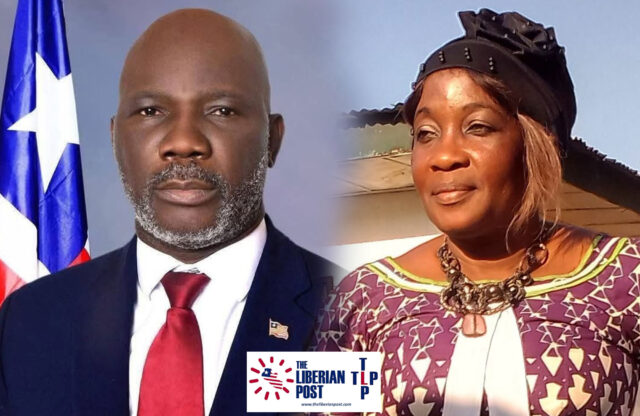
MONROVIA, Liberia — Fresh controversy has erupted around Speaker of the House of Representatives Richard Nagbe Koon following explosive allegations by Ms. Cecelia Kpor Koon, who claims that the Speaker fraudulently obtained U.S. immigration benefits through a sham marriage—an accusation the Speaker has strongly denied, insisting instead that the woman is his biological sister and not his spouse.
The dispute, which has played out publicly on radio, online platforms, and social media, has raised serious questions about possible violations of United States immigration law, even as it exposes deep personal contradictions that now intersect with Liberia’s highest legislative office.
Allegations of Immigration Fraud
During a lengthy appearance on the Spoon Talk radio and online talk show earlier this week, Ms. Cecelia Kpor Koon alleged that Speaker Koon entered into a marriage with her in the United States primarily to secure legal immigration status, including a green card and eventual U.S. citizenship.

She claimed she filed multiple immigration petitions on his behalf while serving in the U.S. military and later discovered—through immigration correspondence—that Speaker Koon had allegedly married another woman while still legally married to her, an act that could constitute bigamy, a criminal offense under U.S. law.
Ms. Koon further alleged that U.S. immigration authorities ultimately denied and revoked Speaker Koon’s immigration benefits after determining that conflicting marital filings existed under his name. She asserted that these findings were documented in U.S. immigration records and linked to petitions filed by different women at different times.
“These are not rumors. These are immigration documents,” she said during the broadcast, insisting that the Speaker’s actions amounted to fraud against the U.S. Government.

Speaker Koon’s Response: “She Is My Sister”
In response to the growing public scrutiny, Speaker Koon broke his silence on December 24 via a statement posted on his verified Facebook page, categorically rejecting the allegations.
“I urge my sister, Mrs. Cecelia Koon Kpor, and all others who think that they have any legitimate claims against me, to use the courts for redress,” the Speaker wrote, describing the allegations as malicious and defamatory.
Speaker Koon explicitly stated that Ms. Cecelia Kpor Koon is his sister, not his wife, and dismissed her public claims as an attempt to damage his reputation through media exposure rather than lawful processes.
“Using a media platform to denigrate me and bring my reputation to disrepute finds no solution,” he added, urging peaceful coexistence and respect for the rule of law.

The Sibling Controversy
The Speaker’s assertion that Ms. Koon is his biological sister has fueled intense debate, particularly on Liberian social media, where users have questioned whether a sibling relationship—if true—would significantly alter the gravity of the alleged immigration violations.
During her Spoon Talk appearance, Ms. Koon categorically denied being related to Speaker Koon by blood, stating that while their fathers were acquaintances, there was no familial relationship between them. She challenged the Speaker’s claim and offered to present birth and marriage records to substantiate her account.
Legal analysts note that even if a sibling relationship were proven, it would not automatically resolve the core issue: whether false marital representations were made to U.S. immigration authorities. Submitting fraudulent or inconsistent marital information—regardless of personal disputes—can trigger serious legal consequences under U.S. federal law.
Public Office and Public Trust
Speaker Richard Koon, a senior member of the ruling Unity Party and one of the most powerful figures in Liberia’s Legislature, has already faced criticism since his elevation to the speakership, including accusations of heavy-handed leadership and partisan maneuvering within the House.
This latest controversy, however, touches on a different and more sensitive dimension: personal integrity and international legal compliance. While no formal charges have been announced by U.S. authorities, the allegations have intensified calls from civil society actors for clarity and transparency.

Some commentators argue that the Speaker should proactively address the immigration questions through verifiable documentation, while others caution against trial by media, emphasizing due process.
What Comes Next
As of now, no Liberian court has ruled on the marital dispute, and U.S. immigration authorities have not publicly commented on the matter. Speaker Koon maintains that any legitimate claims should be resolved in court, while Ms. Koon insists she will continue pursuing legal redress, including the dissolution of what she describes as a valid marriage.
What remains clear is that the controversy has moved beyond personal grievance into the realm of national and international scrutiny, with implications for public confidence in Liberia’s political leadership.
For a country seeking to strengthen governance, accountability, and international credibility, the unfolding situation underscores the fragile intersection between private conduct and public responsibility—an intersection that, in this case, shows no sign of quiet resolution.