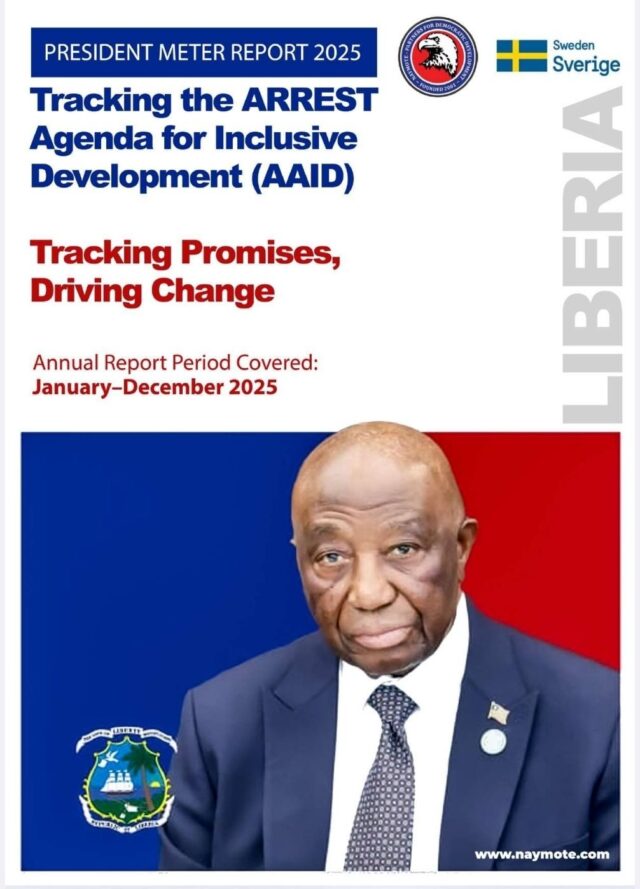
MONROVIA – President Joseph Nyuma Boakai’s flagship ARREST Agenda for Inclusive Development, (AAID) unveiled in 2025 as the policy anchor of his administration, has recorded minimal progress in its first year of implementation, raising concerns about the pace and coordination of government delivery.
According to the 2025 President Meter Report released by NAYMOTE Partners for Democratic Development, only three of the 378 planned interventions under the ARREST Agenda were completed between January and December 2025—representing just 0.8 percent of the total commitments.
The ARREST Agenda—an acronym for Agriculture, Roads, Rule of Law, Education, Sanitation, and Tourism—serves as the Boakai administration’s five-year national development blueprint (2025–2029), aimed at accelerating economic growth, strengthening governance, expanding infrastructure, and improving social services nationwide.
Limited Deliverables, Slow Momentum
The report identifies the three completed interventions in 2025 as the construction of a 17,000-cubic-meter gasoline storage tank, the establishment of a modern petroleum testing laboratory, and the passage of the 2025 Liberia National Tourism Act, alongside the National Action Plan on Business and Human Rights.
While 165 interventions (43.7 percent) are classified as “ongoing,” NAYMOTE cautions that many of these initiatives remain in early or preparatory phases, with little measurable output to date. Additionally, 76 interventions (20.1 percent) have not commenced at all, while 134 interventions (35.4 percent) could not be assessed due to insufficient or unavailable reporting from Ministries, Agencies, and Commissions (MACs).
This reporting gap, the organization notes, underscores persistent challenges related to transparency, coordination, and performance tracking within the public sector.
Warning Signs for Agenda Delivery
Speaking on the findings, NAYMOTE Executive Director Eddie Jarwolo warned that the current pace of implementation falls “significantly short” of what is required for the ARREST Agenda to achieve its stated objectives within the five-year timeframe.

To remain on course, the report estimates that the government would need to complete at least 93 interventions annually, a target that stands in sharp contrast to the three achieved in 2025.
NAYMOTE attributes the sluggish performance to several interrelated factors, including weak planning and sequencing, limited resource mobilization, inadequate inter-agency coordination, and a transparency deficit driven by inconsistent reporting across government institutions.
Call for Course Correction
As the ARREST Agenda enters its second year, NAYMOTE is urging the Boakai administration to accelerate implementation, strengthen monitoring and evaluation mechanisms, and enforce accountability across MACs to ensure that commitments translate into tangible outcomes for citizens.
The organization emphasizes that without decisive corrective action, the Agenda risks falling behind schedule, undermining public confidence in the government’s ability to deliver inclusive and measurable development.