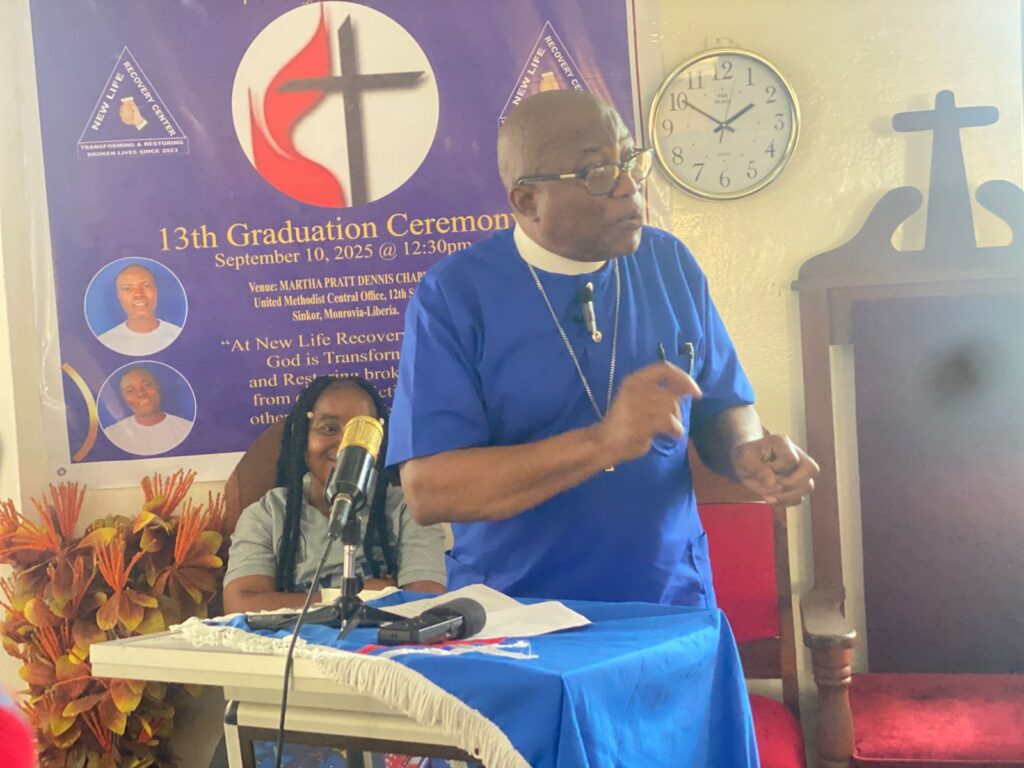
MONROVIA – In a poignant address at the West Africa Regional Conference, Bishop Samuel J. Quire Jr., the Resident Bishop of the Liberia Area of The United Methodist Church, urged a unified response to the alarming rise of drug abuse among the region’s youth.
Describing the situation as a “spiritual, moral, and human emergency,” Bishop Quire’s sermon, titled “Confronting the Crisis: A Unified Response of Faith, Action, and Restoration in West Africa – Say NO to Drugs,” resonated deeply with attendees.
Drawing from the scriptures, particularly Isaiah 1:16–17 and Romans 12:2, he asserted, “This is not only a social problem; it is a spiritual crisis. Drugs are not freedom—they are bondage.
Our young people were created in the image of God, and no life is disposable.” His passionate call for action highlighted the Church’s duty to speak out against drug abuse and to engage in meaningful initiatives that offer support and guidance.
Bishop Quire emphasized the need for a coordinated effort involving parents, churches, and governments.
He stated, “Silence in the face of such destruction would be a failure of Christian witness,” urging communities to work together in mentoring youth and enforcing just drug laws.
He called upon nations including Liberia, Sierra Leone, Ghana, Nigeria, Senegal, and Cameroon to collaborate in educational and rehabilitative efforts, reinforcing that “no single country can confront this crisis alone.”
The emphasis on restoration was a recurring theme in his address. “The Gospel is a Gospel of second chances,” he affirmed. “The broken can be healed, the lost can be found, and those trapped in addiction can be restored through Christ.”
He concluded with a heartfelt appeal for ongoing commitment, urging sustained investment in youth development and mental health support. “The gates of hell shall not prevail against the Church,” he declared. “This crisis will not defeat us, because God is with us.”
DCP Fitzgerald T.M. Biago, head of the Liberia Drugs Enforcement Agency, also spoke passionately about the drug crisis, describing it as “a daily battle that requires courage.”
He acknowledged the complex factors that lead young people to substance abuse, including peer pressure and mental health issues. “We need to understand why people turn to drugs,” Biago emphasized, underscoring the importance of education and empowerment to prevent drug dependency.
In her remarks, Deputy Minister for Children and Social Protection, Minister Garmai S. Tokpah, reinforced the significance of youth participation in the conversation surrounding drug abuse. “This conference brings together youth, experts, faith leaders, policymakers, and civil society actors,” she noted.
“The proliferation of drugs across West Africa is no longer a hidden crisis. It is visible in our streets, communities, and homes.”
Minister Tokpah pledged the government’s commitment to safeguarding children and young people through prevention and rehabilitation efforts, acknowledging, “Government action alone is not enough.”
She highlighted the critical role of faith-based organizations in shaping values and offering hope. “Your life matters. Saying no to drugs is not a sign of weakness; it is an act of courage and self-respect,” she asserted, empowering youth to become change-makers in their communities.
The conference is expected to conclude on Saturday with a resounding unified declaration from participants: “Say NO to drugs. Say YES to life.
Say YES to Christ.” Bishop Quire’s address was described by attendees as a powerful call to action, reminding all present of their shared responsibility to protect the youth of West Africa and secure a brighter future. In a time when the challenges of drug abuse loom large, the conference’s collective voice stands as a testament to faith, hope, and a commitment to restoring lives across the region.