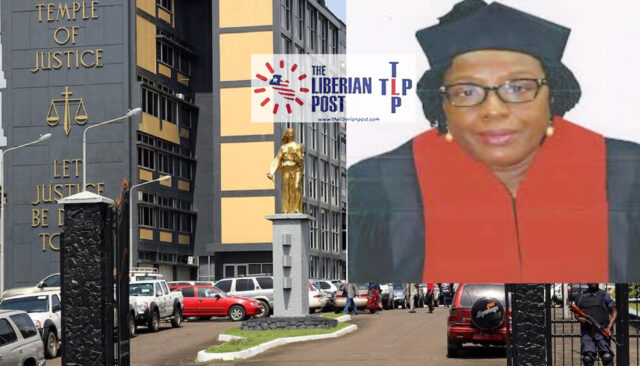
MONROVIA — Associate Justice Jamsetta Wolokolie of the Supreme Court of Liberia has issued a strong call for courage, integrity, and transparency within Liberia’s judiciary, warning that any compromise of judicial independence undermines public trust and weakens the rule of law.
Delivering the keynote address at the convention of the National Association of Trial Judges of Liberia (NATJL), Justice Wolokolie cautioned judges against yielding to pressure from political actors, superiors, or personal interests. She stressed that judicial authority derives from fidelity to the law—not from obedience to influence.
“Judicial authority is the strength of a judge,” she told the gathering. “When that authority is compromised, the constitutional mandate to dispense justice without fear or favor is weakened.”
Justice Wolokolie revealed that she has, on occasion, heard judges privately admit to deciding cases contrary to their own understanding of the law out of fear of repercussions. Such actions, she said, raise troubling questions about the credibility of judicial independence and deny litigants the justice they deserve.
Challenging judges to build reputations anchored in firmness and integrity, she noted that in high-profile or contentious matters, it is judges known for independence and resistance to influence who are most trusted to preside. “A judiciary defined by ‘Yes Sir’ and ‘Yes Madam’ cannot claim independence,” she warned, urging judges to defend their rulings respectfully but resolutely, grounded in the law and their judicial oath.
Citing constitutional safeguards, Justice Wolokolie reminded judges that Liberia’s Constitution already provides the authority necessary to act independently. Referencing Article 11(c), which guarantees equality before the law, she emphasized that judges are sworn to administer justice without respect of persons.
At the same time, she underscored the importance of balance and restraint. Referring to Article 3 on the separation of powers, she cautioned that the Judiciary must avoid encroaching on the roles of the Legislature or Executive, except where clear constitutional violations are at issue. “The role of the courts is to adjudicate, not to govern,” she said, adding that restraint ultimately strengthens democratic governance.
Addressing public criticism that the courts often remain silent on national controversies, Justice Wolokolie clarified that the Judiciary can only act when cases are properly brought before it by parties with legal standing. “The Judiciary does not enter public debates on its own initiative,” she explained.
Transparency, she said, remains a cornerstone of public confidence. She called for open court proceedings, timely delivery of judgments, and clear, well-reasoned written opinions that explain the legal basis of decisions, in line with Article 21(f) of the Constitution. “Justice must be visible to be legitimate,” she noted, adding that transparency protects judges from allegations of bias and helps litigants understand outcomes.
Justice Wolokolie also encouraged trial judges to expand the use of pretrial conferences involving litigants and counsel, describing the approach as a practical tool to improve understanding, reduce delays, and promote amicable settlements.
She concluded by emphasizing that a Judiciary that is independent, balanced, and transparent will earn public respect—even in cases where outcomes disappoint one side. Upholding these principles, she said, is essential to restoring and sustaining confidence in Liberia’s justice system.
Follow The Liberian Post on Facebook and X (formerly twitter)