-Former President Defends AU Appearance, Backs Rule of Law, Urges Action on Corruption, Land Reform and Women’s Leadership
MONROVIA – Former President Ellen Johnson Sirleaf has called on Liberians to rise above partisan rancor and embrace a renewed sense of patriotism, institutional discipline, and national responsibility, warning that the country cannot progress if citizens remain trapped in selfish interests and political bitterness.
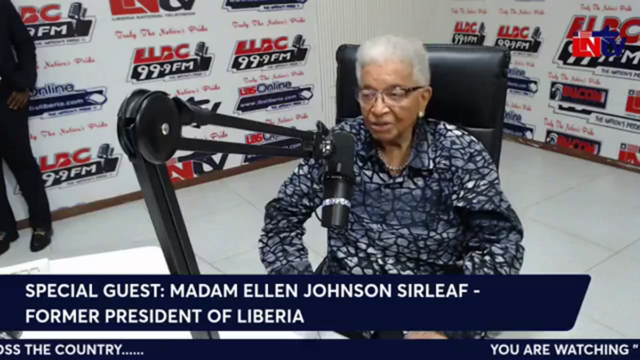
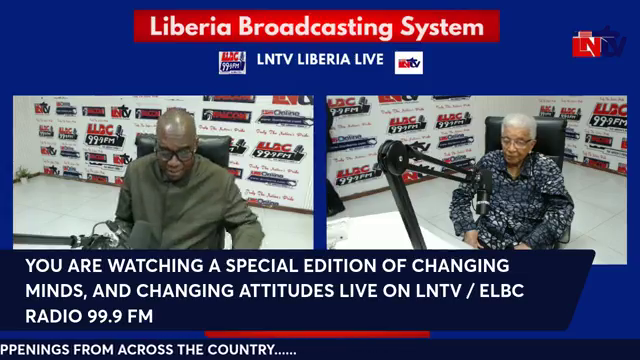
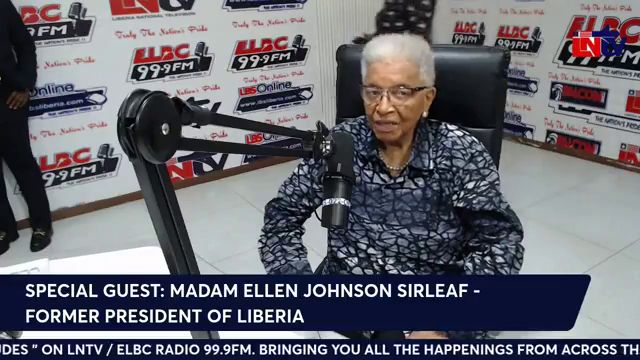
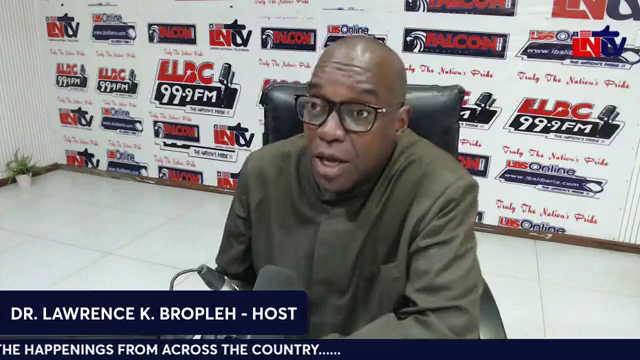
Appearing on Dr. Laurence K. Bropleh’s popular radio talk show, Changing Minds, Changing Attitudes, the former Liberian leader addressed a wide range of national issues—from her recent appearance at the African Union Summit in Addis Ababa to the rule of law, corruption, women’s political participation, land reform, and civic responsibility.
The program, broadcast on February 24, 2026, also touched on the legacy initiatives she is currently advancing and the state of Liberia’s democratic and institutional development.
AU Appearance: “In the Interest of Liberia”
Responding to public debate over her recent appearance alongside President Joseph Nyuma Boakai at the African Union Summit, Sirleaf dismissed suggestions of political maneuvering, stating that her participation was strictly in the national interest.
She clarified that she attended the summit in her capacity as a Patron of the African Union and co-chair of an initiative promoting women in agriculture, a program she described as critical to Africa’s economic transformation.
“As the leader of Liberia, I have the right to make a contribution and continue to be a leader,” she said. “I have a good relationship with President Boakai in the interest of Liberia. I had the same relationship with President Weah in the same interest of Liberia.”
Sirleaf revealed that she was invited through the Ministry of Foreign Affairs to participate in discussions connected to Liberia’s diplomatic engagements, including matters relating to the United Nations Security Council.
“I did so in the interest of Liberia because I think that’s my responsibility,” she emphasized. “As long as what I say is factual, legal and peaceful, I can say it anytime, anywhere.”
She also took aim at what she described as “nonsense” and “crazy photos” circulated online, warning about the misuse of artificial intelligence to manipulate public perception.
A Crisis of Patriotism
Shifting to broader concerns about Liberia’s national direction, Sirleaf delivered a blunt assessment of what she views as a deficit in civic responsibility.
“Liberians are very selfish,” she said pointedly. “What they want is the things that interest them, that promote them and their immediate collaborators.”
She argued that Liberia’s development challenges are rooted not only in governance shortcomings but in a collective failure to prioritize country over self.
“If we’re going to build this country, it has to be built on Liberians—Liberians who are dedicated to the promotion of Liberia,” she said.
Sirleaf urged greater emphasis on civic education in schools, suggesting that patriotism and responsibility should be deliberately taught and reinforced at all levels of society.
“I could easily be sitting down in the United States,” she noted. “Why would I get out of there? Why would I spend all my time going through the things I went through to be President unless I still believe in this country?”
On Free Speech and the Rule of Law
Asked about the recent contempt conviction of controversial preacher Justine Oldpa Yeazeahn, also known as “Prophet Key,” Sirleaf declined to delve deeply into the specifics of the case but underscored the importance of responsible expression.
“I believe in free expression and free speech. I live by that,” she said. “But free speech also has responsibility.”
She warned that speech which is false, inflammatory, or deliberately disruptive to public order must carry consequences under the law.
“If you don’t meet certain standards, you should bear the punishment. Period,” she stated.
While acknowledging Liberia’s history of decriminalizing certain speech offenses during her administration, Sirleaf stressed that freedom of expression must not be abused in ways that undermine national stability.
Legacy Project: Empowering African Women
The former President also spoke extensively about the ongoing development of a women’s leadership and knowledge center—part of her broader legacy initiative aimed at preserving the contributions of African women leaders.
She described the center as a space that will house autobiographies, scholarly writings, and archival documents of prominent Liberian and African leaders, including her own presidential papers.
“This structure will attract international people coming to learn, coming to understand part of the history of African women,” she explained.
Sirleaf confirmed that her official papers are being digitized and archived in collaboration with the University of Liberia and that original documents will ultimately be preserved at the National Archives.
“This is not personal,” she stressed. “It will carry on when I’m not around.”
Corruption: “It Has Become Part of the Culture”
On Liberia’s recent marginal improvement in global corruption perception rankings, Sirleaf described the country’s progress as fragile and insufficient.
“Corruption has been with us for so long, and it has become part of the culture,” she lamented.
She called for stronger enforcement through institutions such as the Liberia Anti-Corruption Commission (LACC), asset recovery mechanisms, and faster judicial processes.
“If the lawyers would do what they are supposed to do—take that evidence to court and take it quickly—it would strengthen the fight,” she said.
Sirleaf emphasized that combating corruption must go beyond prosecutions and include sustained civic education.
“We have to start teaching in the schools. We have to tell people the consequences of corruption—why our country is like this,” she added.
Land Reform and Eminent Domain
Addressing ongoing court-ordered evictions in parts of Monrovia, Sirleaf acknowledged the human pain involved but maintained that property rights must be respected.
“If someone has stolen property, it’s that person that’s wrong,” she said.
However, she also raised concerns about large tracts of land being held undeveloped by individuals and institutions, arguing that government should consider using its power of eminent domain where appropriate.
“Either they must develop it, or the government must exercise the right of eminent domain,” she asserted. “You cannot develop unless you’re willing to take certain strict actions.”
She also suggested that land reform should include expanding affordable housing through the National Housing Authority to reduce illegal settlements.
Women in Politics: Liberia Falling Behind
On women’s political participation, Sirleaf expressed concern that Liberia has fallen behind regional peers in legislative representation.
“When it comes to women members in the legislature, Liberia has fallen far behind,” she said.
She encouraged legal and policy reforms—including possible quota systems—to ensure greater inclusion of women in decision-making structures.
“We must look at our laws and policies to ensure women enjoy the same rights and protection that other nations have ensured,” she added.
A Final Word: Speak Up for Liberia
As the program drew to a close, Sirleaf reiterated her belief that leadership requires courage—not just to celebrate achievements but to confront uncomfortable truths.
“We have an obligation to talk about the good things, but to also point out the wrong things,” she said.
“I just wish more people felt that responsibility—love for their country, interest in the development of this country—and that they too would speak up.”
Her appearance once again reinforced her enduring role in Liberia’s public discourse, as she continues to shape conversations around governance, accountability, unity, and national renewal.
For many listeners, the message was clear: leadership, in her view, does not end with leaving office—it evolves into stewardship of national conscience.
Follow The Liberian Post on Facebook and X (formerly twitter)