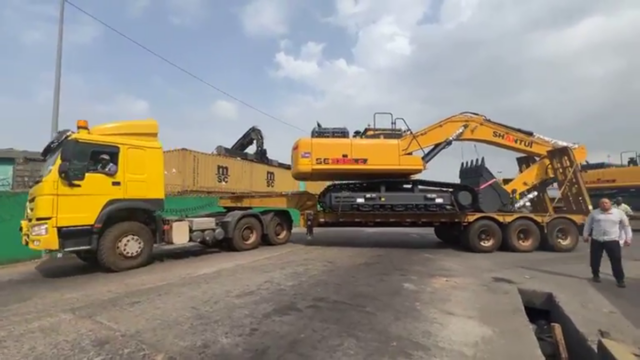
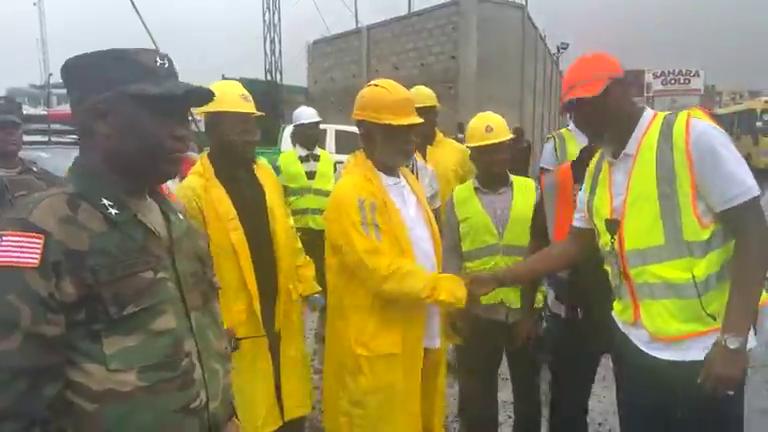
MONROVIA/CAREYSBURG– In a scene marked by excitement, national symbolism, and heightened public scrutiny, the first batch of 137 pieces of earth-moving equipment—popularly known as the “yellow machines”—departed the Freeport of Monrovia en route to Camp Sandee S. Ware, the Armed Forces of Liberia (AFL) military barracks in Careysburg.
The movement of the heavy-duty equipment on Thursday marks the third major milestone in what has become one of the most closely watched infrastructure initiatives of the Boakai-Koung Administration.
From China to Liberian Soil
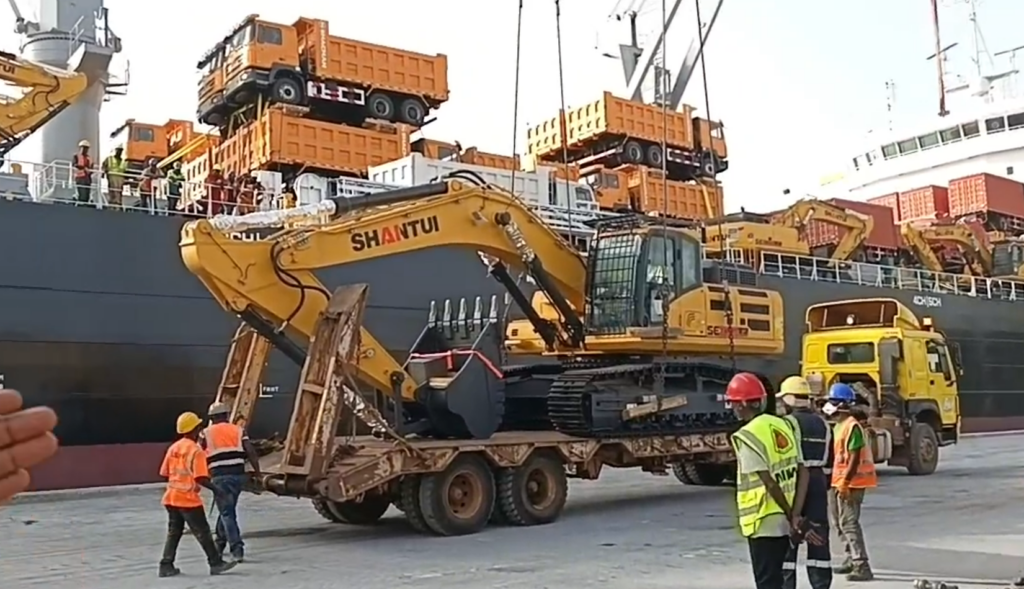
The consignment arrived on Sunday aboard the vessel HJ Singapore, which berthed at the National Port Authority (NPA) after sailing from China. The offloading of the equipment signaled what government officials described as a pivotal step toward fulfilling the administration’s “Road, Road, Road” agenda and expanding farm-to-market access across Liberia’s counties.
The first batch includes:
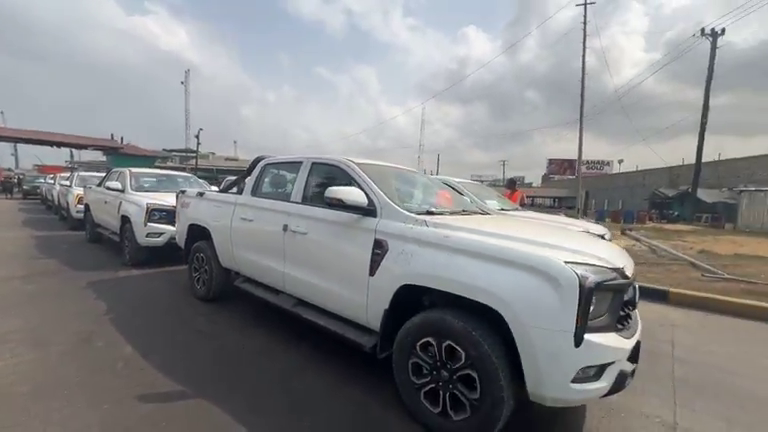
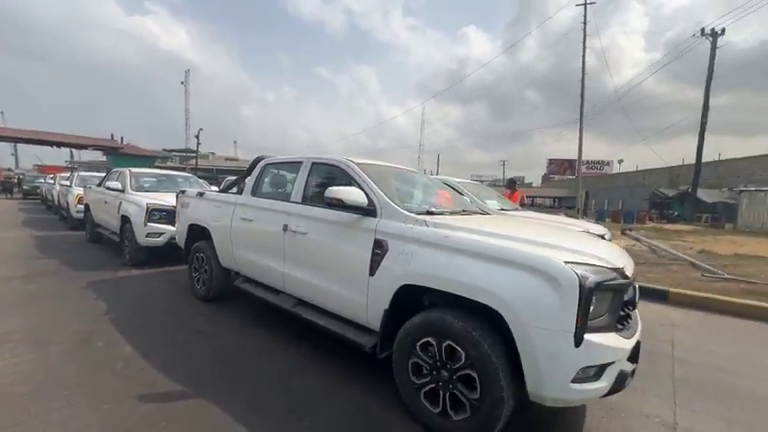
- 20 utility 4×4 pickup trucks
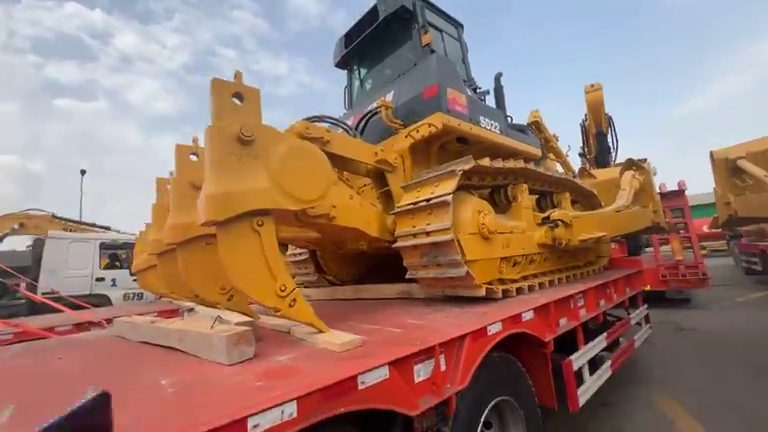
- 19 bulldozers
- 19 excavators
- 19 service trucks
- 19 fuel tankers
- 19 water tankers
- One backhoe
- One roller
These 137 units represent the first of three consignments totaling 285 pieces of equipment expected to arrive in the country within weeks.
President Joseph Nyuma Boakai made a brief stop at the Freeport earlier in the week to inspect the newly arrived equipment, describing the acquisition as a foundational project of his administration. Officials say the next two batches will follow shortly, after which distribution to the counties will accelerate.
A Sea of Orange and White
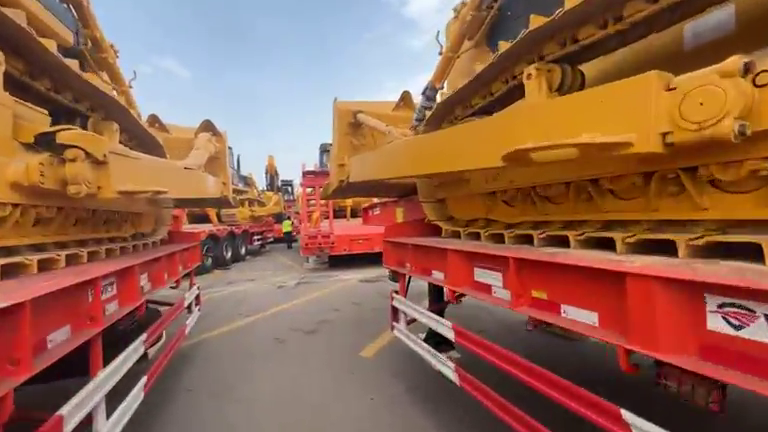
By Thursday morning, the NPA yard had transformed into a striking display of white pickup trucks and orange heavy-duty machinery lined up in long formation.
Bulldozers and excavators bearing the flags and names of Liberia’s fifteen counties were carefully staged on low-bed trailers. Maintenance trucks, fuel tankers, and water tankers stood in disciplined rows as drivers prepared for the motorcade.
From Maryland to Nimba, Lofa to Grand Gedeh, Sinoe to Montserrado, residents and officials searched for equipment marked with their county flags, taking photos and cheering as the procession began forming.
The convoy’s route from the Freeport follows the Japan Freeway, through Red Light, and onward to Careysburg, where the machines will be temporarily stored at Camp Sandee S. Ware until the remaining consignments arrive.
Why Camp Sandee Ware?
Government officials indicated that the AFL barracks in Careysburg was selected as a secure holding site to safeguard the equipment while awaiting the arrival of the second and third batches.
The Armed Forces of Liberia, through the Ministry of National Defense, is also represented on the Yellow Machines Steering Committee, reflecting what authorities describe as a “whole-of-government” approach to the project.
Once all consignments are assembled, coordinated deployment to the counties will begin.
Distribution Plan and Oversight
According to project coordinator Brownie Samukai, four counties—Nimba, Lofa, Bong, and Grand Bassa—will receive two full sets of equipment due to their size and road network demands. A “set” consists of 19 units, meaning these counties will each receive 38 pieces.
The remaining counties will receive one set each.
Samukai also disclosed that recruitment for operators and technical staff is underway, with priority expected to be given to qualified candidates from the respective counties.
That recruitment process, like the procurement itself, has been under intense public scrutiny. Many Liberians have insisted that transparency and accountability accompany the excitement surrounding the machines.
A Signature Project Under the Spotlight
For supporters of the Boakai-Koung Administration, the yellow machines represent the government’s first major signature initiative—distinct from projects initiated under previous administrations.
Opposition critics had earlier questioned whether the new government would deliver original infrastructure interventions or rely primarily on inherited programs.
The administration has responded by framing the yellow machines initiative as a cornerstone of its rural connectivity strategy, designed to:
- Open farm-to-market roads
- Improve access to remote communities
- Stimulate agricultural productivity
- Create employment for machine operators and maintenance staff
- Strengthen local economic activity
Vice President Jeremiah Kpan Koung chaired the high-level committee tasked with overseeing the procurement process. The committee traveled to China, including visits to Shenzhen and Qingdao, to inspect manufacturing facilities and negotiate terms aimed at ensuring what officials describe as “value for money.”
Public Anticipation
As the convoy prepared to roll out, crowds gathered along the Freeport gates and major roadways, eager to witness what has been widely described as a historic movement of heavy machinery across Monrovia’s streets.
The spectacle—white pickups leading, followed by orange tankers and low-bed trailers carrying towering bulldozers—drew comparisons to a ceremonial parade, though officials emphasize that the real test lies ahead.
Liberians across the political divide have stressed that beyond symbolism, the machines must deliver tangible improvements—graded roads, reduced travel times, and economic opportunity in rural counties.
What Comes Next
The machines will remain temporarily at Camp Sandee Ware for approximately two to three weeks until the remaining consignments arrive. Thereafter, final distribution and operational deployment are expected to commence.
As the first convoy glided out of the National Port Authority grounds under security escort, the message was unmistakable: the yellow machines are no longer a promise on paper—they are physically on Liberian soil and now on the move.
Whether they ultimately transform Liberia’s road network as envisioned will depend not just on machinery, but on management, maintenance, and measurable results.
Follow The Liberian Post on Facebook and X (formerly twitter)