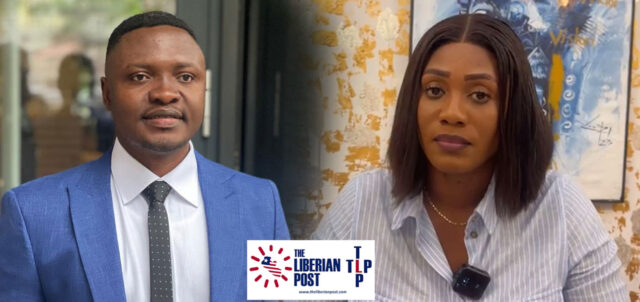
MONROVIA, Liberia – The valedictorian of the Louis Arthur Grimes School of Law at the University of Liberia, Ms. Izetta Jones Howe, has publicly refuted allegations of academic fraud made against her by activist Martin K. N. Kollie and announced a US$4 million defamation lawsuit in response.
Speaking at a press engagement amid growing social media controversy, Howe described the claims as false, malicious, and damaging to her hard-earned reputation. The allegations, circulated online by Kollie, questioned her academic record and suggested irregularities in her grades.
“I have built my reputation over the years, and I am not going to sit back and watch somebody who is looking for public relevance tarnish it,” Howe declared firmly.
Allegations and Immediate Rebuttal
The controversy erupted on February 20 when, according to Howe, she began receiving messages while presiding over her law school homecoming activities. Screenshots circulating online claimed she had failed multiple courses and falsified academic results.
Kollie allegedly asserted that she received three “C” grades and failed three courses, and implied that her academic standing was manipulated.
Howe dismissed the claims as baseless.
“Martin has not been able to provide proper evidence to substantiate his allegations,” she said.
She emphasized that she has never failed any course during her time at law school. She acknowledged repeating one course but clarified it was due to what she described as a grading oversight by a lecturer—not a failure.
“I have never failed any course since my journey in the law school,” Howe stated.
According to her explanation, she opted to retake the course voluntarily after disputing a grade she believed did not reflect her performance, ultimately earning an A+.
University Response
Amid the online storm, the University of Liberia issued a statement reaffirming Howe’s academic standing and confirming her status as valedictorian of the 105th graduating class of the Louis Arthur Grimes School of Law.
Howe told reporters that she was never summoned for investigation and that no university board meeting had reopened her academic review, contrary to claims circulated online.
“There has been no time where I was called for investigation,” she said, dismissing suggestions that her award was under reconsideration.
The university’s reaffirmation appears to have put institutional weight behind her defense, reinforcing that no official findings support Kollie’s accusations.

Political Undercurrents on Campus
Howe suggested that the controversy may be rooted in internal campus politics, alleging that certain individuals who felt entitled to leadership positions had long been hostile toward her.
“There are certain groups that feel really entitled… and once you don’t align with them, they come at you,” she explained.
While she stopped short of naming individuals, Howe alleged that some of her critics were affiliated with a particular student organization and had amplified the claims online.
She also asserted that Kollie failed to contact her for verification before publishing his claims.
“No, he never called me,” she said when asked whether the activist sought her side of the story before going public.
The Lawsuit
Howe confirmed that she has filed a lawsuit against Kollie seeking US$3.5 million in general damages and US$500,000 in punitive damages for defamation.
She described the allegations as constituting “defamation per se,” arguing that false claims of criminal fraud and academic falsification inherently damage one’s professional and personal standing.
“The Supreme Court of Liberia has long recognized the protection of individual reputation as a legally recognizable interest deserving of a judicial remedy,” Howe said while reading excerpts from her legal filing.
She further emphasized that while Article 15 of the 1986 Constitution guarantees freedom of speech, that protection does not extend to false and malicious statements that harm private individuals.
“Your freedom of speech has boundaries,” she asserted.
Addressing questions about Kollie’s physical absence from Liberia, Howe expressed confidence that legal mechanisms exist to pursue the case.
“The law has its way of reaching him, and he will definitely be reached,” she stated.
Broader Context
Martin K. N. Kollie is known for publicly raising allegations involving public officials and institutions, often through social media platforms. His posts regarding Howe formed part of a broader narrative questioning academic transparency at the University of Liberia.
However, no official report from the university has substantiated the claims against Howe. Instead, the administration has reaffirmed her valedictorian status.
The unfolding dispute now shifts from social media to the courts, where Howe says she intends to clear her name formally.
“I went to law school to defend what is right. If it comes to me now and I cannot defend myself, then I am not prepared to be a lawyer,” she said.
As graduation approaches, Howe remains poised to deliver the valedictory address of her class—while simultaneously preparing for a legal battle she says is necessary to protect her reputation.
The case is expected to test not only the boundaries between free speech and defamation in Liberia but also the growing influence of social media allegations on academic and professional standing.
Follow The Liberian Post on Facebook and X (formerly twitter)