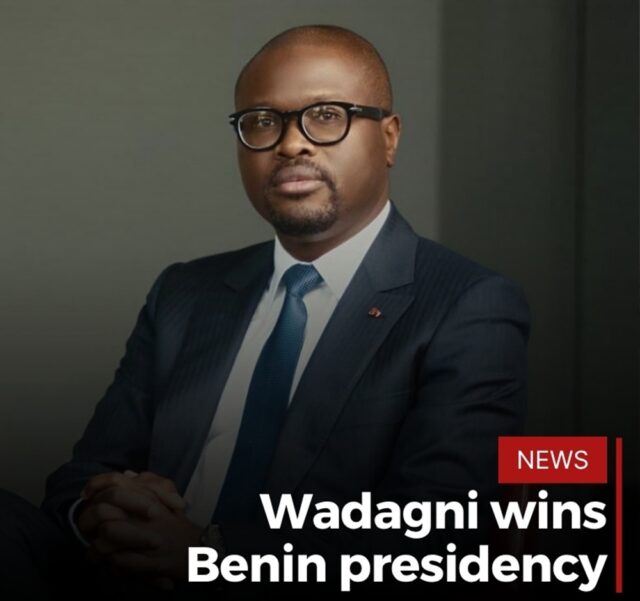
COTONOU, Benin — Benin’s Finance Minister, Romuald Wadagni, has secured a decisive victory in the country’s presidential election, winning more than 94 percent of the vote in a result that cements his transition from economic technocrat to national leader.
Provisional results released by the electoral commission show Wadagni garnered over 94 percent of ballots cast, with more than 90 percent of votes counted and a voter turnout of approximately 58 percent.
His closest rival, opposition candidate Paul Hounkpè, secured less than 6 percent of the vote and conceded defeat shortly after polling concluded, effectively confirming Wadagni’s overwhelming mandate.
Wadagni, 49, is widely regarded as the political successor to outgoing President Patrice Talon, under whom he served as Minister of Economy and Finance since 2016. During his tenure, he was credited with helping drive economic reforms and maintaining macroeconomic stability in one of West Africa’s more stable economies.
The election, held on April 12, marks a significant transition in Benin’s leadership, as President Talon prepares to step down after completing his constitutionally mandated two terms in office.

Despite the decisive outcome, the election has not been without controversy. Observers and opposition figures have raised concerns about the limited competitiveness of the race, pointing to strict candidacy requirements that prevented several opposition figures from contesting.
In addition, earlier parliamentary elections saw pro-government parties secure all seats, further consolidating the ruling coalition’s political dominance and raising questions about the inclusiveness of Benin’s democratic process.
Nevertheless, regional observers, including the Economic Community of West African States (ECOWAS), have praised the peaceful conduct of the election, noting that it was largely orderly despite political tensions.
Wadagni now faces a complex set of challenges as he prepares to assume office. These include addressing growing security threats in northern Benin linked to jihadist activity spilling over from the Sahel, as well as expanding access to basic services such as healthcare, clean water, and social protection.

Economic inclusion is also expected to be a key test for the incoming administration. While Benin has recorded steady economic growth in recent years, critics argue that the benefits have not been evenly distributed among the population.
In his campaign, Wadagni pledged continuity with Talon’s development agenda while also committing to strengthening social services and maintaining fiscal discipline.
Analysts say his landslide victory gives him a strong political mandate, but also places heightened expectations on his administration to deliver tangible improvements in living standards and governance.
As Benin enters a new political chapter, attention will now turn to how the president-elect balances economic reform, political inclusivity, and national security in a rapidly evolving regional landscape.
Follow The Liberian Post on Facebook and X (formerly twitter)