-Study Warns Counties Face US$179.4 Million Deficit by 2029 Unless Urgent Reforms Are Implemented
MONROVIA, Liberia – Naymote Partners for Democratic Development has issued a stark warning that Liberia’s ambitious decentralization agenda risks failing to achieve its intended goals unless government moves swiftly to address severe funding shortages, weak institutional structures, and planning bottlenecks hampering development at the county level.
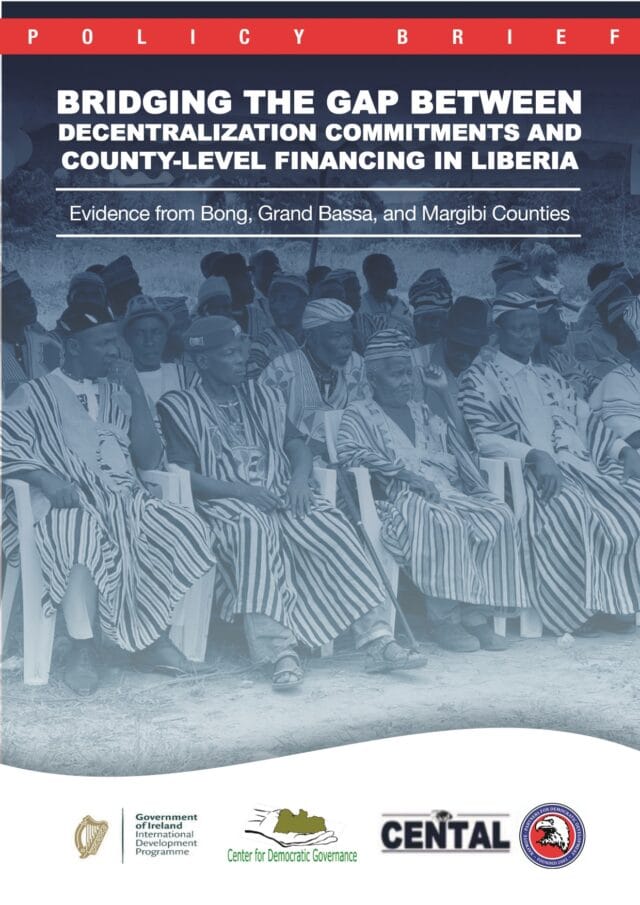
The warning comes in a newly released policy brief titled “Bridging the Gap Between Decentralization Commitments and County-Level Financing in Liberia: Evidence from Bong, Grand Bassa, and Margibi Counties,” which paints a troubling picture of the disconnect between national decentralization commitments and the financial realities confronting local governments.
According to the report, Liberia’s decentralization reform program—anchored in the Local Government Act, the National Policy on Decentralization and Local Governance, and the government’s ARREST Agenda for Inclusive Development—was intended to transfer authority, resources, and service delivery responsibilities from Monrovia to county administrations.
However, Naymote’s findings suggest that while the policy framework exists, the resources needed to make decentralization meaningful remain largely absent.
“The findings suggest that Liberia’s decentralization agenda remains structurally underfunded and institutionally constrained,” the report concludes.
Massive Development Financing Gap
The study, conducted between April 1 and April 30, 2026, examined fiscal devolution, budget appropriations, procurement plans, and governance structures in Bong, Grand Bassa, and Margibi counties.
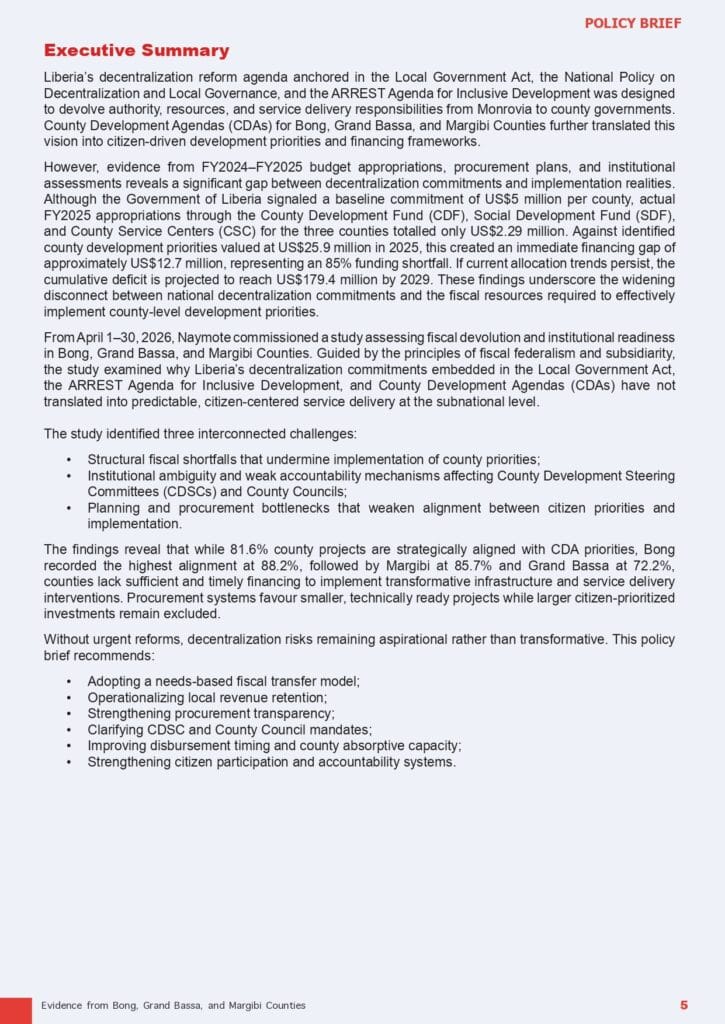
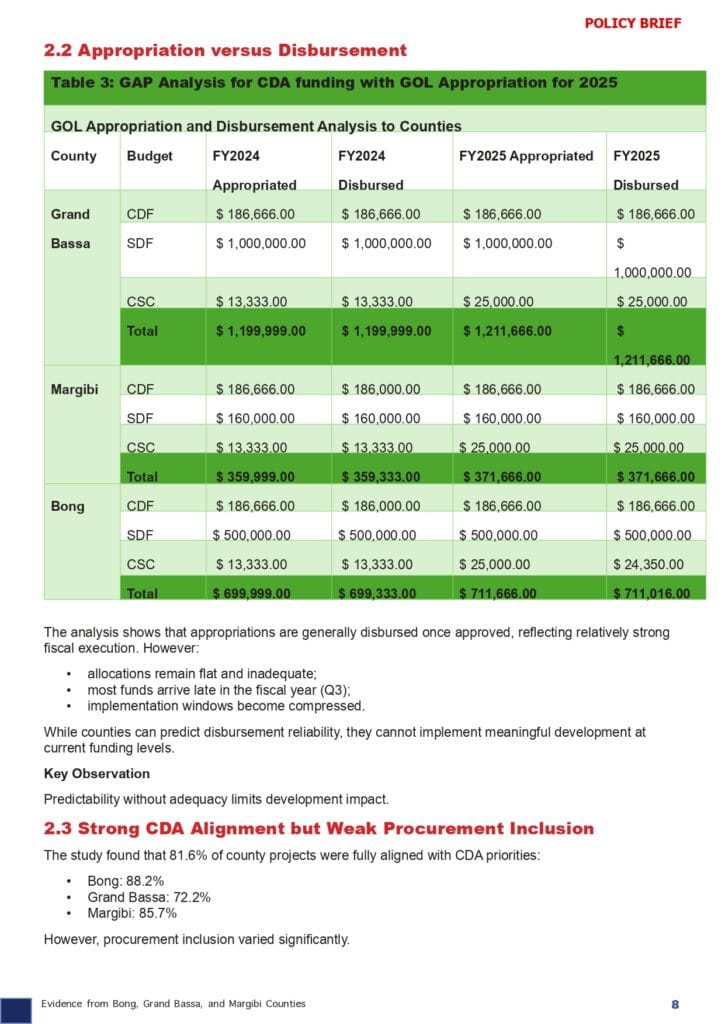
Researchers found that despite a government commitment to provide baseline support of approximately US$5 million per county annually, actual funding reaching the three counties through the County Development Fund (CDF), Social Development Fund (SDF), and County Service Centers (CSC) amounted to only US$2.29 million during Fiscal Year 2025.
Meanwhile, county development priorities identified through local planning processes were valued at approximately US$25.9 million.
The result is an immediate funding gap estimated at US$12.7 million, representing an alarming 85 percent shortfall between development needs and available resources.
Even more concerning, Naymote projects that if current allocation patterns continue unchanged, the cumulative deficit could balloon to approximately US$179.4 million by 2029.
The organization warned that such a trend threatens the very foundation of decentralization and could leave county governments unable to effectively deliver services or implement citizen-prioritized development projects.
Citizen Priorities Remain Unfulfilled
Despite financial challenges, the report found that counties are largely succeeding in identifying development projects that reflect the needs of their citizens.
An estimated 81.6 percent of projects reviewed were fully aligned with County Development Agenda (CDA) priorities.
Bong County recorded the highest alignment rate at 88.2 percent, followed by Margibi County at 85.7 percent and Grand Bassa County at 72.2 percent.
Yet researchers noted that alignment alone is not translating into implementation.
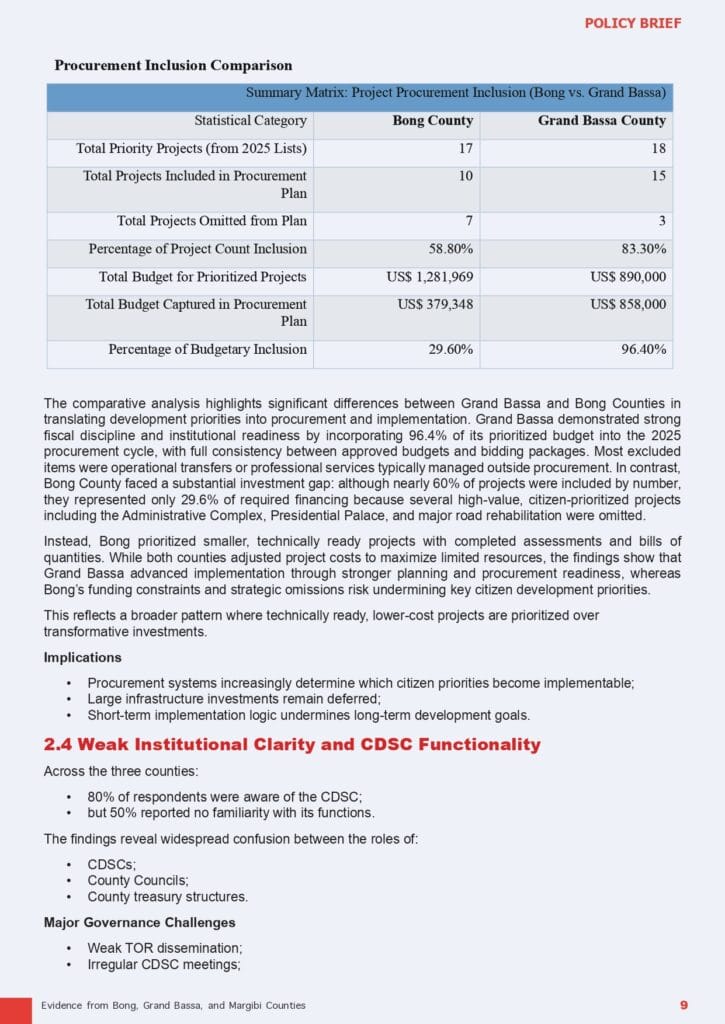
The report found that procurement systems increasingly determine which projects move forward rather than citizen priorities.
In Bong County, for example, only 10 of 17 prioritized projects were included in procurement plans, representing 58.8 percent inclusion. Grand Bassa performed better, incorporating 15 of 18 priority projects, or 83.3 percent.
Researchers observed that procurement systems often favor smaller, technically ready projects while larger infrastructure initiatives, including roads, administrative buildings, and transformative development investments, are deferred or omitted altogether.
“This reflects a broader pattern where technically ready, lower-cost projects are prioritized over transformative investments,” the report stated.
Weak Governance Structures Raise Concern
Beyond funding challenges, Naymote identified significant institutional weaknesses that continue to undermine local governance.
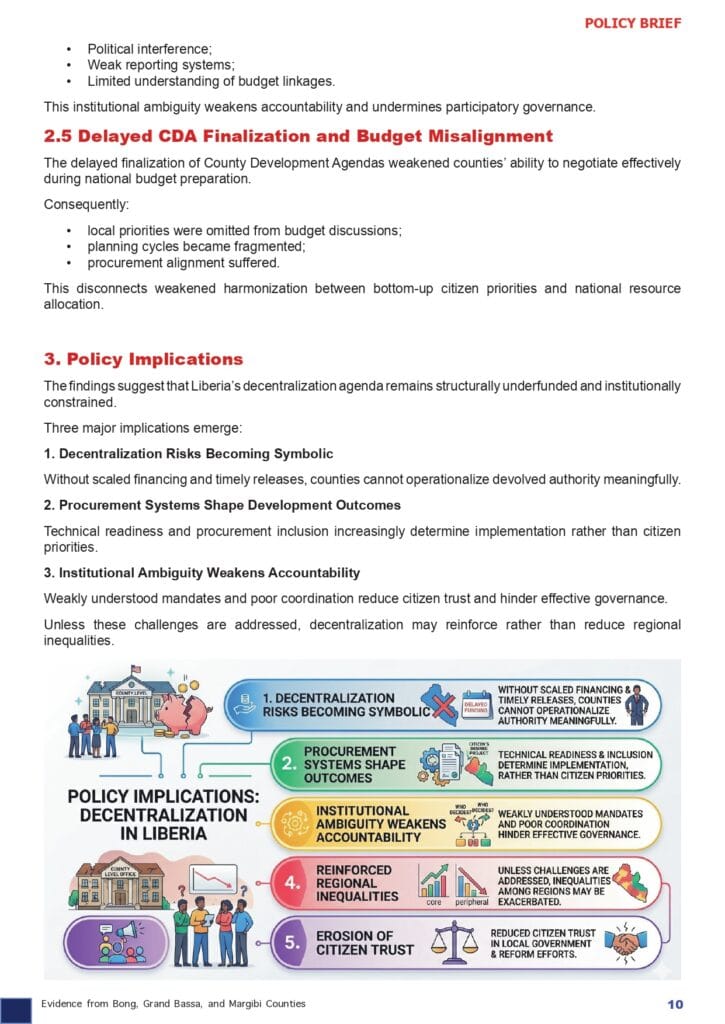
The report found widespread confusion among citizens regarding the responsibilities of County Development Steering Committees (CDSCs), County Councils, and county treasury structures.
Although approximately 80 percent of respondents were aware of County Development Steering Committees, half admitted they had little or no understanding of the committees’ actual functions.
The study also highlighted irregular meetings, weak dissemination of terms of reference, poor reporting systems, limited public awareness, and political interference as major governance challenges affecting county administration.
According to the report, these weaknesses undermine accountability mechanisms and weaken public confidence in the decentralization process.
“Institutional ambiguity weakens accountability and undermines participatory governance,” the study noted.
Delayed Planning Hurting Development
The report further identified delays in finalizing County Development Agendas as a major obstacle to effective county-level planning and implementation.
Researchers found that delayed planning cycles limit counties’ ability to participate meaningfully in national budget discussions and often result in local priorities being excluded from funding decisions.
The resulting disconnect between citizen-driven planning and national budget allocations weakens efforts to harmonize local development needs with national resource distribution.
Risk of Decentralization Becoming Symbolic
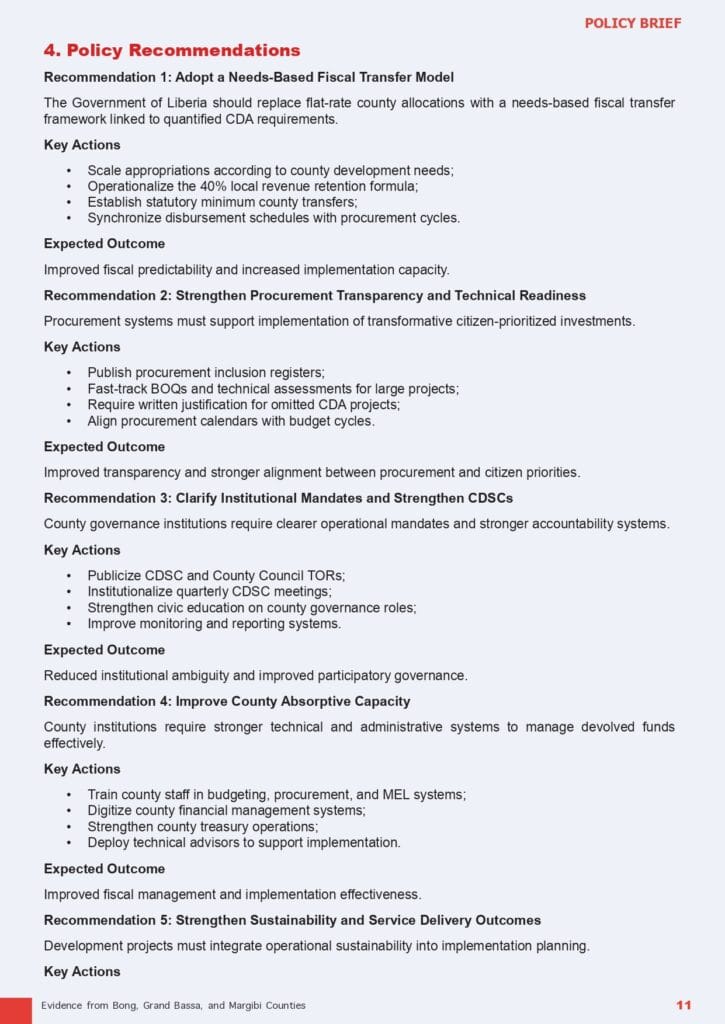
Among its most serious findings, Naymote warned that Liberia’s decentralization program risks becoming more symbolic than substantive if structural challenges are not addressed.
The report identifies several emerging risks, including the inability of counties to operationalize devolved authority, increasing regional inequalities, declining public trust in local governance institutions, and reduced accountability.
Without significant reforms, researchers argue, the promise of bringing government closer to the people could remain largely unfulfilled.
Recommendations for Reform
To reverse the trend, Naymote has proposed a series of policy interventions aimed at strengthening fiscal decentralization and improving county governance.
Among its recommendations, the organization is calling on government to adopt a needs-based fiscal transfer model that allocates resources according to county development requirements rather than flat-rate distributions.
The report also recommends implementing the 40 percent local revenue retention formula, establishing statutory minimum county transfers, improving procurement transparency, strengthening county treasury operations, and enhancing civic education programs on local governance.
Other recommendations include institutionalizing quarterly County Development Steering Committee meetings, improving financial management systems, deploying technical advisors to support county administrations, and synchronizing funding disbursements with procurement cycles.
Decentralization at a Critical Juncture
The findings arrive at a time when the Boakai administration has pledged to accelerate development through its ARREST Agenda and strengthen governance structures nationwide.
Decentralization has long been viewed as one of Liberia’s most important governance reforms, particularly in a country where political and economic power has historically been concentrated in Monrovia.
Advocates argue that effective decentralization can improve service delivery, increase citizen participation, reduce regional disparities, and strengthen local accountability.
However, Naymote’s latest assessment suggests that unless financing mechanisms and governance systems are significantly strengthened, the country’s decentralization ambitions may remain aspirational rather than transformational.
The organization says the future success of Liberia’s local governance reform agenda will depend on whether policymakers can bridge the growing gap between promises made in legislation and the resources necessary to deliver tangible development outcomes for citizens across the country.
Follow The Liberian Post on Facebook and X (formerly twitter)