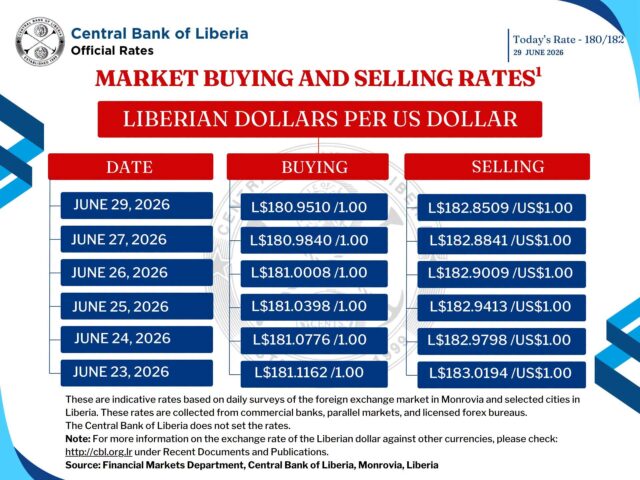
–CBL Survey Shows Market Buying Rate Falls to L$180.95 Per US$1, While Selling Rate Declines to L$182.85
MONROVIA – The Liberian dollar has continued its gradual appreciation against the United States dollar, with the latest foreign exchange market survey published by the Central Bank of Liberia (CBL) showing a steady decline in both buying and selling rates over the past week.
According to the CBL’s Official Market Buying and Selling Rates released on June 29, 2026, the indicative market buying rate stood at L$180.9510 per US$1, while the selling rate was L$182.8509 per US$1.
The figures represent a modest strengthening of the Liberian dollar compared with the previous trading days, continuing a trend that has seen the local currency gain ground in the foreign exchange market.
Steady Improvement Over the Week
The CBL data show that the buying rate has steadily declined from L$181.1162 per US$1 on June 23 to L$180.9510 per US$1 on June 29, reflecting an appreciation of the Liberian dollar.
Similarly, the market selling rate fell from L$183.0194 per US$1 on June 23 to L$182.8509 per US$1 by June 29.
The official daily rates released by the Central Bank indicate the following movements:
| Date | Buying Rate | Selling Rate |
| June 29 | L$180.9510 | L$182.8509 |
| June 27 | L$180.9840 | L$182.8841 |
| June 26 | L$181.0008 | L$182.9009 |
| June 25 | L$181.0398 | L$182.9413 |
| June 24 | L$181.0776 | L$182.9798 |
| June 23 | L$181.1162 | L$183.0194 |
The consistent decline in both rates suggests that pressure on the Liberian dollar has eased during the period under review.
Rates Reflect Market Conditions
The Central Bank emphasized that the published figures are indicative market rates derived from daily surveys of Liberia’s foreign exchange market rather than official exchange rates fixed by the monetary authority.
According to the Bank, the rates are compiled using information collected from commercial banks, licensed foreign exchange bureaus and participants in the parallel market operating in Monrovia and selected cities across Liberia.
The CBL also reiterated that it does not set the exchange rate, noting that the published figures are intended to provide the public with an accurate reflection of prevailing market conditions.
Significance for the Economy
Movements in the exchange rate are closely watched by businesses, importers, exporters and consumers because they influence the prices of imported goods, transportation costs, fuel, medicines and other essential commodities.
A stronger Liberian dollar can help moderate the cost of imports and ease inflationary pressures if the appreciation is sustained. Conversely, significant depreciation tends to increase the cost of imported goods and services, placing additional pressure on household incomes.
Economists, however, caution that exchange rate stability depends on several factors, including foreign exchange inflows, export earnings, remittances, monetary policy, fiscal discipline and overall market confidence.

CBL Pursues Exchange Rate Stability
Since assuming office, the leadership of the Central Bank of Liberia has repeatedly emphasized its commitment to maintaining macroeconomic stability, preserving confidence in the financial system and promoting a stable foreign exchange market.
The Bank has also continued to monitor market developments while working with fiscal authorities to support broader economic stability under the government’s development agenda.
Although the recent appreciation of the Liberian dollar is relatively modest, the latest figures indicate that the local currency has maintained a stable trajectory over the past week, providing a measure of reassurance to businesses and consumers monitoring developments in the foreign exchange market.
For breaking news, in-depth analysis, and exclusive reports from Liberia and around the world, follow The Liberian Post on Facebook (https://web.facebook.com/profile.php?id=61576017166570) and X, formerly Twitter (https://x.com/LiberianPost).