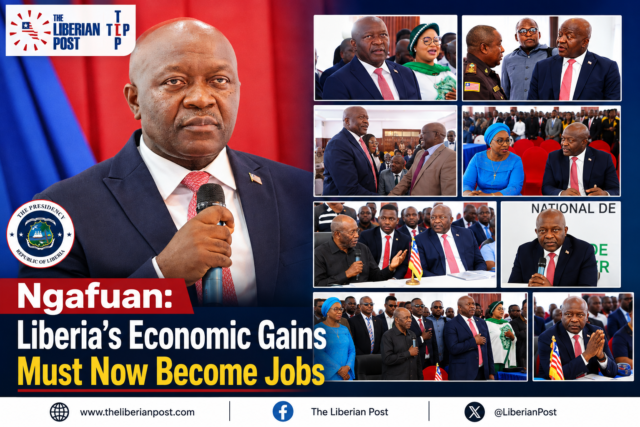
–Finance Minister Highlights 5.5% Growth, Falling Debt and Stronger Domestic Revenue as Government Confronts AAID Implementation Gaps
MONROVIA, Liberia — Finance and Development Planning Minister Augustine Kpehe Ngafuan has challenged government institutions to move beyond economic indicators and translate Liberia’s improving macroeconomic performance into jobs, better public services and measurable improvements in the lives of citizens.
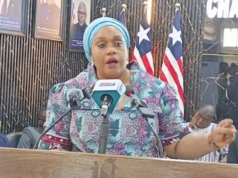
Speaking at the first National Steering Committee review of the ARREST Agenda for Inclusive Development (AAID), Minister Ngafuan said Liberia had recorded encouraging economic and fiscal gains during the first year of the national development agenda, but warned that macroeconomic stability alone would not constitute success.
“The ultimate measure of our progress is the extent to which these gains translate into improved services, greater economic opportunities in terms of job creation, and better living conditions for our citizens and residents.”
Ngafuan’s remarks came as government officials, development partners, private-sector representatives, civil society and members of the diplomatic community assessed implementation of the AAID and reviewed draft reports covering 2025 and the first two quarters of 2026.
The Finance Minister acknowledged progress across several sectors but also pointed directly to delays in project execution, reporting gaps, institutional capacity constraints and weak coordination as obstacles that must be addressed if the government’s development promises are to translate into results.
Growth Accelerates, Debt Ratio Falls
Ngafuan used the forum to highlight what he described as encouraging economic momentum under the first year of AAID implementation.
According to the figures presented, real GDP growth increased from 4 percent in 2024 to 5.1 percent in 2025 and is projected to reach 5.5 percent in 2026.
GDP per capita also rose from US$849 in 2024 to US$861 in 2025, with the 2026 projection reaching about US$961, moving Liberia closer to the AAID’s target of US$1,050 by 2029.
The Finance Minister also pointed to Liberia’s fiscal position as another area of improvement.
Public debt as a share of GDP declined from 56.1 percent in 2024 to 54 percent in 2025, with a further decline projected for 2026. Domestic revenue collections, meanwhile, increased from US$699 million in 2024 to US$848 million in 2025, reaching US$761.1 million by June 2026.
Ngafuan said the revenue trajectory places the government on course toward its US$1.3 billion domestic revenue target for 2026, providing a stronger fiscal foundation for implementing national development priorities.
But he stressed that these numbers must ultimately be judged by what they mean for ordinary Liberians.
“Scarce Resources” Must Produce Measurable Impact
For Ngafuan, the central challenge confronting the AAID is no longer simply identifying national priorities, but ensuring that available resources are efficiently converted into development outcomes.
He said the Ministry of Finance and Development Planning will continue working with ministries, agencies and other implementing institutions to strengthen planning, financing, monitoring and reporting, while ensuring that limited public resources are directed toward interventions capable of producing measurable impact.
“Our objective is straightforward: to ensure that government programs remain aligned with national priorities and that available resources are effectively translated into measurable development outcomes for our citizens and residents.”
The minister’s position was reinforced by the wider discussion at the meeting, where participants repeatedly emphasized that implementation, rather than policy formulation, would determine whether the AAID succeeds.
Civil Society: Development Must Be Felt Beyond Statistics
Representing the National Civil Society Council of Liberia, Lawrence Yealue urged government to ensure that development is measured not only through official statistics and donor reports but also through the experiences of ordinary Liberians.
Yealue called for greater attention to equitable service delivery, rural communities, marginalized groups, youth employment, gender inclusion and community ownership.
“Development is not just mere measurement of statistics or donor reports.” Yealue said it must also reflect dignity, fairness and the resilience of the Liberian people.
He further urged the government to treat civil society as a constructive partner rather than merely as a critic.
“Our advocacy is not merely opposition, it is patriotism. Our voice is not disruptive, it is constructive.”
Yealue said civil society was prepared to help ensure that AAID interventions become measurable, people-centered and transformative, while calling for greater accountability, transparency and respect for the rule of law.
Business Community Demands Action on Jobs, Local Content
The Liberia Chamber of Commerce also used the forum to press for stronger government-private sector collaboration, arguing that businesses must be placed at the center of efforts to create jobs and expand economic opportunity.
Representing the Chamber, Mr. Natty B. Davis said the private sector was not merely a beneficiary of national development but an “indispensable partner in delivery.” Businesses, he noted, create jobs, generate public revenue, stimulate innovation and expand trade.
The Chamber called for a formal public-private sector dialogue chaired by President Joseph Nyuma Boakai, arguing that such an engagement could identify constraints affecting enterprise development, investment, job creation, domestic production and competitiveness.
It also warned that delays in approving the proposed local content policy risked sending employment opportunities outside Liberia.
The Chamber said it is working to connect capable Liberian businesses with concessionaires, major investors and public projects, with the goal of turning local-content policy into actual contracts, skills transfer, stronger domestic value chains and decent jobs.
Development Partners Applaud Progress, Call for Stronger Coordination
French Ambassador Isabelle Le Guellec, speaking on behalf of development partners, said partners were impressed by Liberia’s first-year AAID implementation report and the government’s macroeconomic performance.
She pointed specifically to the need for stronger coordination between government and development partners, better information sharing and improved reporting and data-management systems.
The development partners also supported the proposed integrated national financing framework and urged Liberia to continue mobilizing domestic resources as international development assistance declines.
Le Guellec said the changing international financing environment should encourage Liberia to become more strategic about how it mobilizes and deploys resources.
Development partners, she said, were prepared to work with the government to realign priorities for 2026–2027 and accelerate AAID implementation.
Diplomatic Corps: Liberia Must Drive Its Own Development
Doyen of the Diplomatic Corps, Ambassador Beng’yela Augustine Gang, similarly stressed that Liberia must retain ownership of its development agenda.
Ambassador Gang noted that the success of the AAID should ultimately be judged by what happens to ordinary Liberians—including whether people find enough opportunity at home to remain in the country rather than leaving in search of better prospects abroad.
“The driver’s seat is occupied by Liberia itself.”
Augustine Gang also called for more regular consultations, clearer implementation timelines and individuals specifically assigned to drive development programs, warning that “programs don’t move themselves.”
A Financing Challenge as Aid Declines
The meeting also highlighted a fundamental challenge facing Liberia: the changing global development-financing environment.
Development partners acknowledged that international aid has declined sharply and is unlikely to return to previous levels, increasing pressure on Liberia to strengthen domestic resource mobilization and attract private investment.
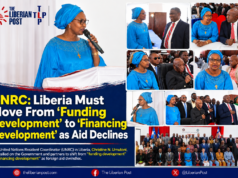
The UN Resident Coordinator, Christine Umutoni, gave only a limited part of the broader message: Liberia must increasingly shift from reliance on traditional funding toward a broader financing architecture involving domestic resources, private investment, innovative financing and strategic partnerships. She also welcomed the integrated national financing framework initiated by the Ministry of Finance.
That position dovetailed with Ngafuan’s emphasis on stronger domestic revenue and more disciplined use of public resources.
Ngafuan’s Message: Stability Is Not Enough
The Finance Minister’s central message was therefore not simply that Liberia’s economy is improving—it was that the improvement must now be converted into development that Liberians can see and feel.
While acknowledging encouraging gains, he cautioned that implementation remains uneven and that government cannot afford complacency.
The AAID review, he said, should therefore focus on understanding why interventions are delayed, closing reporting gaps, strengthening institutional capacity and finding practical solutions to bottlenecks.
The Ministry of Finance and Development Planning will work with implementing institutions to ensure that planning and financing are connected to monitoring, reporting and measurable results.
For Ngafuan, the next phase of the AAID is consequently about execution—making sure that economic growth, stronger revenues and improved fiscal indicators translate into roads, electricity, healthcare, education, jobs and expanded economic opportunities.
The message from the National Steering Committee was equally clear: Liberia has made progress, but the real test of the AAID will be whether that progress reaches communities and improves the daily lives of Liberians.
For breaking news, in-depth analysis, and exclusive reports from Liberia and around the world, follow The Liberian Post on Facebook (https://web.facebook.com/profile.php?id=61576017166570) and X, formerly Twitter (https://x.com/LiberianPost).