–Deputy Information Minister Accuses Senator of Undermining Drug Probe, Defends Boakai’s Record and Tells Konneh to Seek Allah’s Forgiveness; Senator Fires Back
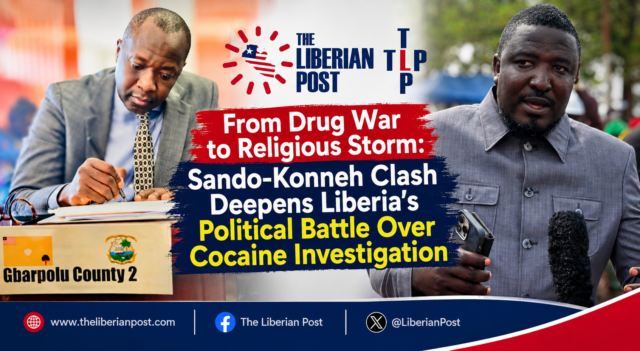
MONROVIA, Liberia — Liberia’s intensifying political debate over the government’s handling of the country’s unprecedented cocaine investigation has erupted into a wider controversy over accountability, political responsibility and the use of religion in public discourse after Deputy Information Minister for Public Affairs Daniel O. Sando launched a sweeping attack on Senator Amara Konneh.
Sando, appearing Monday evening on the state-backed The Class Reloaded, accused Konneh of making politically motivated insinuations about President Joseph Nyuma Boakai’s handling of the drug investigation, despite the Senate having been briefed on the matter on multiple occasions.
He also defended the government’s anti-drug campaign, argued that President Boakai has demonstrated decisive leadership, accused Konneh of bearing significant responsibility for the election of former President George Weah in 2017, criticized aspects of Konneh’s legislative record and, in the most controversial portion of his remarks, invoked the senator’s Muslim faith and urged him to seek Allah’s forgiveness.
The comments have since triggered a storm of responses on social media, with some Liberians defending Sando’s criticism of Konneh while others—including Senator Abraham Darius Dillon—condemned the decision to bring religion into the political dispute.
The controversy has transformed what was already a heated disagreement over Liberia’s drug crisis into a larger national argument about how government officials should respond when elected lawmakers publicly challenge an administration’s record.
SANDO: SENATE HAS BEEN BRIEFED ON DRUG INVESTIGATION
Sando’s central argument was that Senator Konneh and other lawmakers are creating doubts about an investigation in which, he said, the Senate has already received confidential briefings.
He said the Senate’s Committee on Defense, Security and Intelligence had been briefed on two separate occasions and continues to receive regular information on the investigation.
“Some senators who’s supposed to be in charge of the drug issue … keep coming on the radio and making insinuation that draws the integrity of the Liberian Senate into question,” Sando said.
He argued that Konneh’s suggestion that the President is being held hostage by people connected to the drug situation ignores the actions already taken by the administration.
According to Sando, individuals connected to the drug cases have been arrested, prosecuted, suspended or dismissed, demonstrating that the government is not shielding those accused of wrongdoing.
“Heads are rolling,” Sando said, arguing that the developments surrounding the investigation demonstrate that the administration is taking action rather than protecting individuals implicated in the drug trade.
Sando’s comments come as Liberia continues to investigate major cocaine seizures and alleged links between narcotics trafficking networks and individuals connected to government and security institutions.
‘THE PRESIDENT’S HANDLING … IS EXCELLENT SO FAR’
Far from conceding that the government has failed, Sando offered an emphatic defense of President Boakai’s record on the drug investigation.
He argued that the administration’s declaration of a zero-tolerance policy has encouraged stronger enforcement and resulted in drug seizures and prosecutions that, according to him, did not occur with similar force under previous administrations.
“I think the President’s handling of the drug situation is excellent so far,” Sando declared.
He said the increasing number of seizures should not necessarily be interpreted as evidence that Liberia is becoming more deeply involved in the drug trade.
Instead, he argued that the seizures demonstrate that traffickers are encountering a more aggressive enforcement environment.
“The reason why these drugs are being arrested is because the government said we got zero tolerance position. Nobody will use our country as a transit point to traffic drugs,” he said.
Sando contrasted the current situation with what he characterized as previous periods when large quantities of drugs were allegedly intercepted but those responsible were not held accountable.
He said that, under the current administration, approximately 20 people can already be identified as having been brought before the courts in connection with drug-related cases.
SANDO CHALLENGES KONNEH’S ‘CRITICAL VOICE’ CLAIM
Sando also directly challenged Konneh’s credibility as a leading critic of the Boakai administration.
He argued that Konneh’s public criticism is designed more to establish himself as a prominent opposition voice than to contribute constructively to the drug investigation.
“He’s simply talking for the sake of talking so that people can say, ‘Oh yeah, Amara and them are critical voice.’ But who consider Amara a critical voice in Liberia?” Sando asked.
He then turned to Konneh’s role in the political developments that brought George Weah to power.
Sando accused Konneh of being at the “epicenter” of what he described as a coordinated effort to manipulate the 2017 presidential election.
He alleged that political actors associated with the opposition at the time “connived, colluded and systematically rigged” the election and created the impression that Weah had won 14 of Liberia’s 15 counties.
Those are serious allegations and remain Sando’s characterization of the 2017 electoral process; they should not be construed as an established finding that Konneh rigged the election.
Sando argued that Konneh therefore carries responsibility for the political consequences of the Weah administration and cannot now present himself as though he had no connection to the decisions that brought that government to power.
‘GO TO THE MOSQUE’ REMARK IGNITES BACKLASH
The most controversial portion of Sando’s statement came when he referred directly to Konneh’s Muslim faith.
Sando acknowledged that Konneh is a Muslim before saying that, because of what he believes were Konneh’s past political actions, the senator should seek forgiveness from Allah.
“He needs to take a time to go to the mosque on Friday to seek the face of Allah in supplication. Let him be forgiven,” Sando said.
He connected the statement to his argument that the political decisions that helped bring Weah to power contributed to suffering in Liberia, pointing to people who died because of inadequate healthcare and students who could not attend school.
That religious reference quickly became the most controversial part of the entire exchange, drawing condemnation from several Liberians who otherwise might have agreed with Sando’s political criticism of Konneh.
KONNEH: ‘I AM A PROUD LIBERIAN MUSLIM’
Konneh responded forcefully on Facebook, defending both his political record and his faith.
He said he is a practicing Muslim who prays five times daily, fasts and gives charity, while also emphasizing his respect for Christianity and Christian devotion at the Senate.
“I am a proud Liberian Muslim who prays five times a day, fasts, and donates charity to the poor,” Konneh wrote.
He said he did not need a government official to instruct him to attend mosque or practice his religion.
But Konneh quickly returned to the issue that sparked the confrontation: Liberia’s cocaine crisis.
He rejected the suggestion that his criticism of the administration is motivated simply by a desire for political attention.
“I speak out against this cocaine scheme because I love my country and worked hard to bring in this UP government with the promise to rid our nation of drugs,” he said.
Konneh acknowledged that the government has made efforts against narcotics but argued that the administration is still struggling to fulfill the promise on which he says he helped bring the Unity Party to power.
“Silence would be complicity. I am doing my job. You do your job, too, so we can make Liberia a drug-free country and a better country than it was two and a half years ago. Everybody wins!”
Konneh’s response also referred to President Boakai as an “aging President,” a description that subsequently became another point of criticism among some government supporters.
DILLON TELLS SANDO TO ‘MAKE AMENDS’
Montserrado County Senator Abraham Darius Dillon became one of the most prominent figures to challenge Sando’s remarks.
Dillon said he was not positioning himself as a perfect moral authority but drew on his more than two decades in public service to advise the Deputy Information Minister.
He specifically objected to Sando’s reference to Konneh’s religion.
“Your recent comments directed at Sen. Amara Konneh essentially referencing his religion and religious belief was inappropriate and out of order, from my viewpoint,” Dillon said.
Dillon argued that political disagreements should be addressed through substantive arguments rather than religious references.
He urged Sando to reach out to Konneh and make amends, while warning him against becoming too comfortable with political applause.
“Do not follow some of these political clapping and cheers … they may be temporary and can shift!!!”
Dillon’s intervention is significant because, despite his history as a fierce opposition politician, he is also a political actor who has worked with the current administration.
His position therefore illustrates how the controversy has crossed party and ideological lines.
LIBERIANS SPLIT OVER THE EXCHANGE
The reaction on social media has been sharply divided.
John O. F. Kangbah questioned Konneh’s decision to describe President Boakai as an “aging President,” arguing that if the senator’s concern is the government’s handling of the drug crisis, he should directly state his criticism and allow Liberians to judge the government’s record.
“There is no need to disguise your message. Be clear, be direct, and let the Liberian people decide,” Kangbah wrote.
Rixck W. Barsi-Giah, meanwhile, attacked Konneh for describing Sando as an “unskilled sycophant,” arguing that Konneh himself has been closely associated with the Unity Party-led government.
Other commentators, however, strongly defended Konneh.
Siafa Siakason Sherif argued that Konneh’s role in Liberia’s electoral politics should not be used as a basis for attacking his religious identity.
Sherif described Konneh as a proud and devout Muslim and argued that the senator is exercising his constitutional role by questioning the government’s handling of the drug crisis.
Nassamuaidi Yaya Bility similarly said political disagreements should be answered politically rather than through religious references.
“Minister Daniel Sando made a political statement against the Senator. Therefore, it should be addressed politically, with substance, not with religious sentiments intended to fuel confusion among our people,” Bility wrote.
He added:
“We are one people despite our choices in life.”
SANDO ALSO CHALLENGES KONNEH’S SENATE RECORD
The Deputy Information Minister’s attack went beyond the cocaine investigation and Konneh’s political history.
Sando questioned Konneh’s performance in the Senate, particularly in relation to the Public Accounts Committee.
He criticized what he described as public hearings into audit reports that date back several years and questioned what he said was the committee’s progress during Konneh’s time in the Legislature.
“What has he been doing for the last two years six months in the Senate?” Sando asked.
He also challenged the broader tendency of political actors to focus on the failures of the current administration without acknowledging the country’s long history of institutional and developmental challenges.
Sando said Liberia needs to move forward rather than continuously revisiting political history.
THE DRUG INVESTIGATION REMAINS THE REAL BATTLEGROUND
Despite the religious and political controversy, the underlying issue remains Liberia’s growing narcotics crisis.
The government has described the investigation as an effort to dismantle a broader trafficking network rather than simply prosecute individuals caught transporting cocaine.
Officials have said the alleged network may have operated for years and that investigators are pursuing financiers, organizers, couriers, facilitators, insiders and foreign actors.
The administration has also repeatedly emphasized that prosecutions must be built on evidence capable of surviving judicial scrutiny.
That principle is particularly relevant to the Sando-Konneh confrontation.
Konneh says his criticism is part of his constitutional responsibility and reflects concern that the government has not gone far enough.
Sando says the criticism ignores the arrests, prosecutions and institutional actions already taken and unfairly undermines a government that has adopted a zero-tolerance policy.
The disagreement is therefore fundamentally about whether the government’s actions so far amount to sufficient evidence of success—or whether the scale of the drug problem demands even greater accountability and transparency.
SANDO URGES JURORS TO PUT LIBERIA FIRST
In another significant portion of his remarks, Sando turned to the pending cocaine prosecutions and called on Liberians who may be selected as jurors to approach the cases as matters of national importance rather than partisan politics.
He said the cases should be viewed beyond the political divide between the Unity Party and the Coalition for Democratic Change.
“It is not about the CDC or the United Party. It’s about Liberia,” Sando said.
He urged prospective jurors to consider the impact of illicit drugs on Liberian communities and young people when evaluating the evidence presented in court.
At the same time, his comments underscore the importance of allowing jurors to make their decisions based solely on the evidence and instructions provided through the judicial process.
THE BIGGER QUESTION: HOW SHOULD GOVERNMENT ANSWER CRITICS?
The controversy ultimately raises a question larger than Sando and Konneh.
Government officials have a legitimate responsibility to defend their administration against criticism. Legislators likewise have a constitutional responsibility to scrutinize government actions, particularly where national security, public health and the expenditure of public resources are concerned.
But the quality of democratic governance depends heavily on how those disagreements are conducted.
Sando’s strongest defense of the administration is based on concrete claims: Senate briefings, arrests, prosecutions, suspensions, dismissals and drug seizures.
Konneh’s strongest criticism is similarly substantive: he says the government has promised to eradicate the drug problem and must be held accountable for fulfilling that promise.
Those are arguments Liberians can debate.
The religious exchange, however, risks shifting public attention away from those substantive questions.
LIBERIA NEEDS THE EVIDENCE TO SPEAK
The country’s cocaine crisis is too serious to be reduced to Facebook battles.
Liberians need to know who imported the drugs, who financed them, who facilitated their movement, who provided protection, whether state officials were involved, why security failures occurred and whether the government can successfully prosecute those responsible.
Those questions cannot be answered through political insults or religious references.
They require intelligence, evidence, transparent investigations, credible prosecutions and functioning courts.
For Sando, the challenge now is to continue making the government’s strongest case through facts and demonstrable results.
For Konneh, the challenge is equally clear: if he believes the government is failing, he should continue to identify specific failures and demand specific remedies.
And for both sides, the public deserves a political debate in which the evidence is stronger than the rhetoric.
Liberia’s drug war cannot afford to become another partisan contest.
The government says its zero-tolerance policy is working.
The senator says the government is falling short.
The courts will ultimately test the criminal allegations.
The evidence will determine the prosecutions.
And the Liberian people will ultimately judge whether the government kept its promise to confront the drug crisis.
That is the debate Liberia needs—not a battle over who should pray where.
For breaking news, in-depth analysis, and exclusive reports from Liberia and around the world, follow The Liberian Post on Facebook (https://web.facebook.com/profile.php?id=61576017166570) and X, formerly Twitter (https://x.com/LiberianPost).