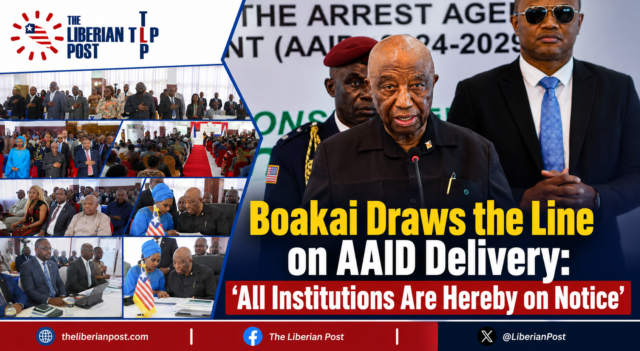
-President Demands Performance, Accountability and Results as Government Reviews First Year of Liberia’s Development Agenda
MONROVIA, Liberia — President Joseph Nyuma Boakai has issued his strongest call yet for performance-driven implementation of Liberia’s ARREST Agenda for Inclusive Development (AAID), warning ministers, government agencies and other implementing institutions that delays, weak reporting and poor performance will no longer be tolerated.
Addressing the inaugural National Steering Committee review of the AAID, President Boakai said Liberia had made measurable progress since the development agenda was launched in January 2025, but insisted that the government must now move with greater urgency to turn policies, plans and investments into tangible improvements in the lives of citizens.
“All institutions are hereby on notice to implement full range of our sector interventions without further delay.”
The President’s message came as senior government officials, development partners, diplomats, the private sector and civil society gathered to assess the first year of AAID implementation and examine draft reports covering the first and second quarters of 2026.
For President Boakai, the meeting was not another ceremonial review of government programs. It was a performance checkpoint intended to determine what is working, what is failing, where bottlenecks exist and who must be held responsible for correcting them.
‘We Must Move Beyond Plans’
President Boakai said his administration’s central promise when it launched the AAID on January 15, 2025, was to move beyond the cycle of ambitious plans and political rhetoric that has characterized many previous development initiatives.
“Our promise to the Liberian people was to move beyond plans.”
He said Liberians have heard repeated commitments to better roads, improved water supply, stronger livelihoods and better public services, but stressed that the success of the AAID must ultimately be measured by whether those promises become reality.
The President acknowledged that substantial progress had been made in aligning national platforms with development priorities and improving coordination and resource mobilization. But he was equally candid about shortcomings, pointing to implementation gaps, delays and institutional weaknesses that continue to undermine delivery.
That, he said, requires immediate corrective action.
“Progress must be tracked. Results must be reported transparently. And where implementation is lacking, corrective action must be taken.”
Performance, Not Connections, Will Determine Promotion
In one of the strongest portions of his address, President Boakai warned against using personal relationships, family connections or political influence as a basis for rewarding public officials.
He said his administration must build a culture in which public servants earn advancement through measurable performance rather than access to political leaders.
“You get a job, you earn a promotion. And the promotion, if you have leadership, is based on your performance.”
The President went further, warning that officials who consistently fail to deliver could be reassigned.
“In instances when we see that people are not measuring… we have to ask you to move elsewhere.”
His remarks effectively placed performance management at the center of the AAID’s second year, signaling that ministries and agencies will increasingly be judged by outputs and outcomes rather than explanations for non-performance.
Boakai: ‘We Cannot Continue to Complain’
The President also challenged government institutions to identify and eliminate the administrative and institutional bottlenecks slowing down the implementation of national priorities.
He said the government must concentrate its limited resources on interventions capable of producing the greatest impact, particularly in job creation, education, healthcare, telecommunications, water security and infrastructure.
“We cannot continue to complain.” President Boakai said, insisting that government must instead concentrate its efforts on interventions that produce the greatest positive impact for Liberians.
He pointed to the impact of roads and clinics as examples of investments whose value should ultimately be measured by how they change people’s lives.
A new road, he argued, can transform access and economic activity, while a functioning clinic should be judged by its ability to save lives, empower communities and use public resources efficiently.
Every Public Dollar Must Work for Liberia
President Boakai also delivered a pointed message to public corporations and state-owned entities, warning against treating government resources as personal assets.
He said resources controlled by public corporations ultimately belong to the Liberian people and must be deployed for national development.
“All of those resources are for the development of this country.”
With public resources limited and citizens’ expectations rising, the President said every dollar must be managed with the highest level of integrity.
“We have a duty to ensure that the public resources are used wisely and strategically in the ways that deliver real and measurable improvement in the lives of our citizens.”
He also challenged officials to examine whether government investments are producing the intended results and whether donor resources and other development opportunities are being fully utilized.
Private Sector Must Get a Bigger Seat at the Table
The President’s call for results was echoed by the business community, which urged the administration to deepen public-private cooperation as a central component of the AAID.
Representing the Liberia Chamber of Commerce, Natty B. Davis said businesses create jobs, generate government revenue, stimulate innovation and expand trade, but warned that the private sector needs an environment in which Liberian-owned enterprises—particularly micro, small and medium-sized businesses and women- and youth-led enterprises—can grow and compete.
The Chamber called on President Boakai to convene the first formal public-private sector dialogue under his chairmanship, saying such a forum could address constraints affecting investment, enterprise development, job creation, domestic production and competitiveness.
The Chamber also delivered a strong warning over the proposed local-content policy.
“Any delay in reaching Cabinet’s resolution of the proposed local content policy is tantamount to directly exporting employment opportunities out of Liberia.”
The group said its goal is to convert local-content policy from an aspiration into actual contracts for Liberian businesses, skills and technology transfer, stronger domestic value chains and decent jobs.
President Boakai responded positively to the private sector’s call, with the government indicating that it would work with the Ministry of Finance and Development Planning to advance the proposed dialogue.
Civil Society Calls for People-Centered Results
National Civil Society Council Chairman Lawrence Yealue also pressed the government to ensure that AAID implementation is assessed from the perspective of ordinary Liberians rather than solely through official statistics and donor reports.
Yehulu described civil society as a critical bridge between government and citizens and called for greater participation by civil society, the media and academia in national development monitoring.
“Development is not just mere measurement of statistics or donor reports.”
He urged government to prioritize equitable service delivery, especially in rural and marginalized communities, strengthen transparency and public trust, and place greater emphasis on youth empowerment and job creation.
Yealue also called for stronger verification of government performance data, warning that implementation reviews must go beyond simply accepting reports submitted by institutions.
His intervention closely reinforced President Boakai’s demand for measurable, transparent and accountable performance.
Diplomats: ‘The Driver’s Seat Is Occupied by Liberia’
The diplomatic community likewise emphasized that Liberia must take ownership of its development trajectory.
Ambassador Beng’yela Augustine Gang, Doyen of the Diplomatic Corps, said the AAID’s inclusiveness should ultimately be measured by what ordinary Liberians experience—including whether citizens see enough opportunity at home to stay rather than leave the country in search of better prospects.
“The driver’s seat is occupied by Liberia itself.”
Ambassador Gang called for more regular consultations, clear implementation timelines and designated individuals responsible for driving specific programs.
His blunt observation was that “programs don’t move themselves”—people assigned to execute them do.
The point resonated with President Boakai’s broader argument that institutional performance, rather than political connections or excuses, must determine whether government succeeds.
Development Partners Back Results-Based Approach
Development partners also welcomed the government’s implementation review and acknowledged encouraging progress, while urging stronger coordination and more effective use of declining international assistance.
France’s Ambassador to Liberia, Isabelle Le Guellec, speaking on behalf of development partners, said partners were impressed by Liberia’s first-year AAID report and the draft 2026 reports, describing the results as evidence of a “result-oriented mindset” and government determination to advance the country’s 2030 development vision.
The partners also stressed that declining international development assistance makes domestic resource mobilization, private-sector development and a stronger investment climate increasingly important.
The UN Resident Coordinator, Christine Umutoni, similarly endorsed the government’s partnership approach but emphasized that Liberia’s next phase must focus on implementation, results and accountability, rather than simply maintaining development plans.
‘Timely Reporting Is Not Negotiable’
President Boakai reserved another stern warning for ministries, agencies and partners that fail to submit timely and accurate reports.
He said reliable reporting is essential to measuring progress, identifying gaps and making timely decisions.
“Timely reporting is not negotiable.”
Under the President’s directive, implementing institutions are expected to submit reports on time and in the format agreed upon with the Ministry of Finance and Development Planning. Repeated delays, inconsistencies and incomplete submissions, he said, will no longer be acceptable.
The government also plans to strengthen its data systems and develop integrated platforms capable of supporting real-time monitoring and reporting.
From Peace to Prosperity
The President’s message ultimately extended beyond government bureaucracy to a broader call for national ownership of Liberia’s development.
He thanked development partners for their continued support but urged them to align their programs and resources more closely with Liberia’s national priorities.
He also called on the private sector to invest, innovate and industrialize, while urging civil society to serve as a constructive bridge between the government and citizens.
The broader message from the meeting was reinforced by the UN Resident Coordinator, who said Liberia’s future cannot depend indefinitely on traditional aid and must increasingly be driven by stronger institutions, investment, domestic resources and opportunities for its people.
For President Boakai, however, the immediate challenge is more direct: make the AAID work.
His address made clear that the second year of implementation will be judged not by the number of plans produced or meetings convened, but by whether government institutions deliver the roads, clinics, schools, jobs, water systems, infrastructure and economic opportunities that Liberians expect.
And his warning to the machinery of government was unmistakable:
“All institutions are hereby on notice.”
For breaking news, in-depth analysis, and exclusive reports from Liberia and around the world, follow The Liberian Post on Facebook (https://web.facebook.com/profile.php?id=61576017166570) and X, formerly Twitter (https://x.com/LiberianPost).