–First 20 Third-Country Nationals Arrive Under Agreement Covering Up to 1,200 People; Residents in Unification Town Question Why Liberia Agreed to Take Them
HARBEL, Margibi County — The first 20 third-country nationals deported from the United States arrived in Liberia on Thursday under the controversial agreement that could see up to 1,200 people transferred to the country over the next year, but their arrival was met with tight security, restricted media access and visible public unease in communities along their route.
The group arrived at Roberts International Airport shortly after 1 p.m. local time, marking the first implementation of an agreement under which Liberia has agreed to receive people removed from the United States who are neither Liberian nor American nationals.
The arrival was confirmed by international news agencies, which reported that the first group of 20 landed at Roberts International Airport on Thursday. The broader arrangement covers up to 1,200 people over 12 months.
But rather than offering journalists an opportunity to observe or speak with the new arrivals, Liberian authorities kept the media at a distance as officials from the Liberia Refugee Repatriation and Resettlement Commission (LRRRC) and the Liberia Immigration Service (LIS) handled the reception and screening process.
Journalists were positioned away from the area where the arrivals were being received.
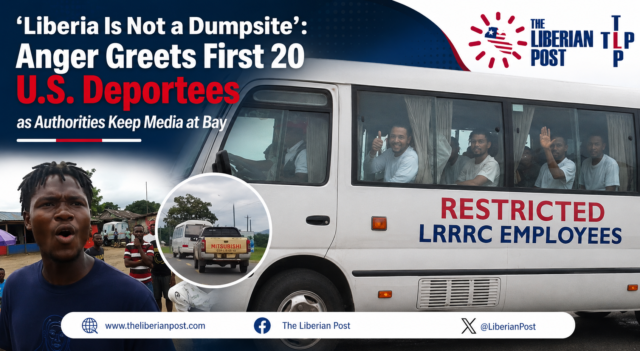
After what appeared to be the completion of the screening process, the bus carrying the 20 people was taken through a separate exit gate more than half a mile from where journalists had been posted, effectively bypassing the media.
The maneuver became apparent after movements around the airport alerted journalists that the bus had changed its expected route.
This reporter and another journalist immediately boarded a motorcycle taxi and rushed toward the alternate exit, arriving just in time to see the bus as it left the airport area.
There was no opportunity to interview the passengers.
Some of the arrivals appeared cheerful, while others appeared more subdued. At least two acknowledged journalists and raised their hands in a V-shaped peace sign as the bus passed.
The brief encounter provided the first public glimpse of the people at the center of one of Liberia’s most controversial migration arrangements in years.
‘Liberia Is Not a Dumpsite’
The first strong public reaction encountered outside the airport came in Unification Town, locally known as Smell No Taste, the Margibi County community through which the convoy passed after leaving Roberts International Airport.
There, a group of young men expressed anger and concern over Liberia’s decision to receive the deportees.
Among them was Lee Lerato Lee, who told The Liberian Post that he did not believe Liberia was in a position to accommodate additional foreign nationals when many Liberians themselves are struggling to find jobs and basic services.
“I don’t feel good at all, because this country, we, the youth in this country, nothing good is happening for us at all right now.”
Lee said unemployment and poor living conditions were already major challenges facing Liberians.
“No job to do. Then they are adding another group to us?” he asked.
His strongest objection was directed at the United States’ decision to send people removed from American territory to Liberia.
“It should not be in Liberia, this third-world country, where nothing, nothing is here. No good housing units, no job, absolutely nothing. And you bring these people to live among us?”
Asked whether reported U.S. support for the program could make the arrangement beneficial to Liberia, Lee rejected the argument.
“Liberia is not a dumpsite, that you will just take people from anywhere and just throw them here in Liberia.”
His comments capture a concern likely to become increasingly prominent as the government begins receiving more people under the agreement: whether Liberia’s humanitarian obligations should outweigh its own economic and social pressures.
‘Why Liberia?’
Lee questioned why the United States could not return the deportees to their countries of origin.
“They have their countries. Send them back to their countries. But not Liberia.”
The government has said the people being transferred to Liberia are third-country nationals who, for various reasons, cannot simply be returned to their countries of origin.
Information Minister Jerolinmek Matthew Piah told Reuters that most of the people expected under the broader arrangement are from Latin American countries, including Venezuela, Cuba and Colombia, although the government has described the overall group as including nationals from African and Western Hemisphere countries.
The government has also said the arrivals are being received as guests, rather than prisoners, and that they will have freedom of movement and the option to seek asylum in Liberia.
But those assurances have not resolved the fundamental question being raised by residents such as Lee:
Why should Liberia assume responsibility for people who have no prior connection to the country?
‘We Are Suffering’
Lee also rejected the government’s argument that the arrangement represents a partnership between Liberia and the United States.
“No. As for me, it’s not a good partnership because we are suffering.”
He linked his opposition to Liberia’s long and complicated relationship with the United States, arguing that Washington has historically exercised enormous influence over Liberia.
“They told us that they are the ones who colonized this country, and they left this country Liberians with nothing. They don’t even value Liberia.”
Historically, Liberia’s founding was closely connected to the settlement of formerly enslaved and free Black people from the United States, creating an unusually deep relationship between the two countries.
That history makes the current deportation arrangement especially sensitive for some Liberians, who view the deal not simply as a migration agreement but through the lens of Liberia’s longstanding relationship with Washington.
‘Come and Take Your People’
Lee’s final message was directed squarely at Americans.
“My final message to the Americans is that they should come and take their people and carry them back to their countries because America is the best place for them to live, not in Liberia.”
He added:
“Here in Liberia, we are already suffering in Liberia, and then you want to come and add suffering on us again?”
Lee’s comments do not represent the position of all residents of Unification Town or Liberia.
But they provide an early indication of the kind of grassroots resistance that could emerge if communities become concerned that the third-country deportation arrangement will impose additional economic, social or security pressures on Liberia.
A Highly Controlled Arrival
Thursday’s restricted media access also raises questions about the government’s approach to public transparency surrounding the program.
The government had announced that the first group would arrive at Roberts International Airport and that reception preparations had been completed.
It also said the arrivals would not be detained and would be free to move within Liberia.
Yet journalists were not permitted near the reception area to observe the process or speak directly with the people being received.
That lack of access leaves important questions unanswered, including the identities and nationalities of the first 20 arrivals, the individual circumstances of their removal from the United States, and the precise screening process undertaken by Liberian authorities before they were accepted.
As of Thursday, The Liberian Post had not independently verified a public list containing the names of the 20 arrivals.
Up to 1,200, Not 1,200 Guaranteed
The government has agreed to receive up to 1,200 third-country nationals over a 12-month period—meaning 1,200 is a maximum figure under the arrangement, not a guaranteed number of people who must be transferred to Liberia. Reuters and AP both describe the agreement in those terms.
The arrangement was finalized through an exchange of diplomatic notes between Liberia and the United States in September 2025.
Liberia is among a growing number of countries participating in U.S. third-country deportation arrangements under the Trump administration’s intensified immigration enforcement program.
Information Minister Piah has said the people transferred under the arrangement will be received as guests and may seek asylum in Liberia or leave the country if they wish.
Reuters reported that the United States is providing Liberia with US$5 million for migration-management activities as part of the broader arrangement.
Who Are the First 20?
That question is now one of the most immediate outstanding issues.
Although the first 20 people arrived Thursday, no authoritative public list of their names has been identified.
Reuters reported before the arrival that Liberia had not provided details on the nationalities of the initial group, while Piah subsequently told Reuters that most of the broader group would come from Latin American countries, including Venezuela, Cuba and Colombia.
Without an official manifest, it would be irresponsible to publish names circulating through unofficial channels as established fact.
But the government should be pressed to answer basic public-interest questions:
Who are the 20?
What countries are they nationals of?
Why were they removed from the United States?
Were any of them convicted of crimes, or were their cases primarily immigration-related?
What independent screening did Liberia conduct?
Where are they being housed?
Who is paying for their accommodation, food and medical care?
How long are they expected to remain in Liberia?
And what happens if they choose to leave Liberia?
These questions become even more important if the program ultimately reaches its ceiling of 1,200 people.
The Government’s Humanitarian Argument
The Boakai administration has presented the arrangement in humanitarian and historical terms.
Information Minister Piah has argued that Liberia’s history as a refuge for freed people and supporters of African liberation gives the country a special responsibility to provide sanctuary.
Government officials have also stressed that the arrivals are not being brought to Liberia as prisoners and that those who want to make Liberia their home can apply for asylum.
Justice Minister Cllr. N. Oswald Tweh has said the individuals were vetted before arrival, while the LRRRC and Liberia Immigration Service are responsible for receiving and processing them. AP reported that Tweh said most of the deportees had committed migration-related violations and offenses.
The government’s position is therefore that Liberia is not becoming a detention center for the United States, but rather a temporary host under a controlled migration arrangement.
But Public Acceptance Is Another Matter
Thursday’s scenes suggest that official assurances may not automatically translate into public acceptance.
The first reaction encountered outside the airport was not one of celebration.
It was frustration.
Lee’s complaint was fundamentally about scarcity: scarce jobs, inadequate housing and limited economic opportunities.
His argument was that Liberia should first address the needs of Liberians before assuming responsibility for people sent from another country.
Whether that view will become widespread remains to be seen.
But the arrival of the first 20 has moved the debate from the realm of government statements and diplomatic agreements into the streets and communities of Liberia.
The question is no longer theoretical.
The people have arrived.
And Liberia must now determine how the agreement will work in practice—and whether the country’s already-strained communities are prepared to accept up to 1,200 additional people whom they did not expect to become their neighbors.
A New Test for the Boakai Administration
The third-country deportation arrangement is now one of the most politically sensitive decisions facing the Boakai administration.
The government must balance its diplomatic relationship with Washington against domestic concerns over sovereignty, transparency, security, employment, housing and public services.
It must also demonstrate that the people being received are properly screened and that Liberia retains meaningful authority over who enters the country and under what conditions.
For residents like Lee, however, the central issue is much simpler.
“Liberia is not a dumpsite.”
That sentiment may not represent Liberia as a whole.
But after Thursday’s arrival, it is a sentiment the government can no longer afford to ignore.
The first 20 have arrived. The real test of Liberia’s controversial agreement with the United States has now begun.
For breaking news, in-depth analysis, and exclusive reports from Liberia and around the world, follow The Liberian Post on Facebook (https://web.facebook.com/profile.php?id=61576017166570) and X, formerly Twitter (https://x.com/LiberianPost).