–Former Vice President Faces Seven Charges as Government Names Three Alleged Foreign Network Organizers; Ex-NSA Deputy Director Gerald Smith Questioned
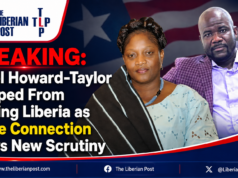
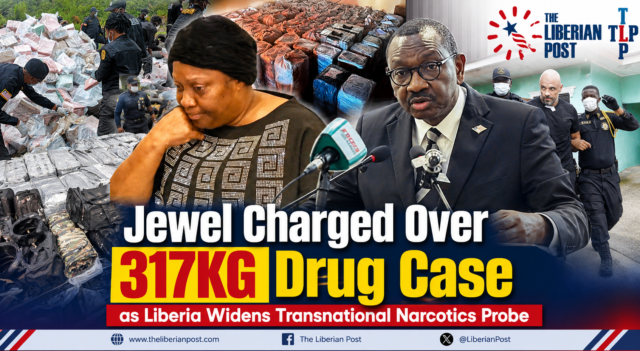
MONROVIA, Liberia — Liberia’s escalating campaign against transnational narcotics trafficking has reached a dramatic new stage, with former Vice President Jewel Howard-Taylor formally charged with seven criminal offenses in connection with an alleged international narcotics trafficking network operating within and beyond Liberia.
The charges represent one of the most consequential developments yet in an investigation that has expanded from major drug seizures into a broader effort to identify the alleged leadership, financiers, facilitators, transporters, operational coordinators and institutional protectors behind the trafficking network.
In a formal statement issued Wednesday, August 19, Attorney General and Minister of Justice Cllr. N. Oswald Tweh said Howard-Taylor was stopped from departing Liberia at Roberts International Airport (RIA) and subsequently taken to the headquarters of the Liberia National Police.
Following investigative procedures and a review of evidence presented by the Joint National Security Investigative Team, Tweh said, Howard-Taylor was formally charged.
The government simultaneously announced charges in absentia against three foreign nationals it identified as alleged members and organizers of the same network, while Gerald Smith, former Deputy Director of the National Security Agency for Administration, has been called in for questioning.
The developments represent a major escalation in Liberia’s ongoing fight against a drug-trafficking problem that authorities increasingly describe as a threat not only to public safety but also to national security and state institutions.
Seven Charges Against Jewel Howard-Taylor
According to the Justice Minister’s formal statement, Howard-Taylor faces three charges under Liberia’s Controlled Drug and Substance Act of 2023.
They are:
- Violation of Section 14.83: Unlicensed Importation of a Controlled Drug or Substance;
- Violation of Section 14.85: Unlicensed Sale, Trading, Administration, Dispensation, Delivery, Distribution, Dispatch in Transit and Transportation of a Controlled Drug or Substance; and
- Violation of Section 14.93: Illicit Trafficking of a Controlled Drug or Substance.
The former Vice President is also charged under Chapter 10 of the Penal Law of Liberia with:
- Violation of Section 10.2: Criminal Solicitation;
- Violation of Section 10.3: Criminal Facilitation; and
- Violation of Section 10.4: Criminal Conspiracy.
The seventh charge is under the Anti-Money Laundering and Terrorist Financing Law, specifically:
- Violation of Section 15.2: Money Laundering.
The breadth of the charges means the government’s allegations extend beyond the physical movement of narcotics to include alleged solicitation, facilitation, conspiracy and financial activity associated with the alleged trafficking operation.
However, the formal charges remain allegations that must be established in court.
Government Links Howard-Taylor to the 317KG Investigation
The formal statement identifies Howard-Taylor as being charged in connection with an ongoing investigation into an alleged transnational narcotics trafficking network.
During the Justice Minister’s subsequent interaction with journalists, however, Tweh provided an important clarification about the particular narcotics investigation involving the former Vice President.
He said Howard-Taylor’s alleged connection is to the 317-kilogram narcotics case, rather than the separate US$19 million cocaine seizure at Roberts International Airport.
That distinction is important because Liberia’s current anti-drug campaign has involved more than one major narcotics investigation.
The government’s formal statement does not itself identify the specific drug seizure by weight or monetary value. The 317-kilogram connection comes from the Justice Minister’s explanation during the press briefing.
That means the formal legal position currently before the public is that Howard-Taylor has been charged as part of the investigation into an alleged transnational narcotics network; the government’s more specific identification of the 317-kilogram case was made separately during the briefing.
Three Foreign Nationals Charged in Absentia
The government also announced that three foreign nationals have been charged in absentia as alleged members and organizers of the same transnational narcotics network.
The formal statement identifies them as:
Nikolai Ivancic, a Croatian national.
Mihovil Vrlovac, a Croatian national and
Tara Zaderieko, a Ukrainian national.
The Ministry of Justice said it will pursue “all lawful domestic and international measures” necessary to locate, apprehend and bring the three defendants before the courts of Liberia.
Their designation as alleged members and organizers remains an allegation, and the government’s formal statement does not provide further details about their specific alleged roles in the network.
Former NSA Deputy Director Gerald Smith Called for Questioning
The investigation is also reaching into Liberia’s security establishment.
The Justice Minister announced that Gerald Smith, former Deputy Director of the National Security Agency for Administration, has been called in for questioning in connection with the same investigation.
The development is significant because it indicates that investigators are examining possible connections involving not only private individuals and alleged foreign narcotics operators, but also people who have held senior positions within Liberia’s security architecture.
The government has not publicly disclosed the precise allegations or evidentiary basis for Smith’s questioning.
Being called for questioning should therefore not be interpreted as a criminal charge or finding of wrongdoing.
Government Says It Is Going After the Entire Network
Tweh said the latest actions represent a “decisive stage” in the government’s effort to expose and dismantle the alleged network.
The Justice Minister said investigators intend to identify and pursue the network’s:
- leadership;
- financiers;
- facilitators;
- transporters;
- operational coordinators;
- institutional protectors; and
- every person who knowingly assisted its activities.
The government is therefore presenting the investigation as something considerably broader than a conventional drug-trafficking prosecution.
Its stated objective is to uncover the infrastructure that allegedly allows international narcotics organizations to operate inside Liberia.
“Our objective is not merely to seize narcotics or arrest low-level operatives,” Tweh said. “Our objective is to dismantle the entire criminal infrastructure—its leadership, financing, logistics, protection arrangements, and international connections.”
He said investigators would follow the evidence across institutions, political boundaries and national borders.
‘No Office Is Too High’
The Justice Minister also delivered one of the government’s strongest warnings yet to anyone allegedly connected to the narcotics trade.
“No office is too high, no political connection is too powerful, no nationality provides immunity, and no individual is beyond the reach of the law.”
The statement is particularly significant given Howard-Taylor’s former position as Liberia’s Vice President.
It also comes amid growing public discussion about whether powerful individuals, including former government officials, may have provided protection or access to drug-trafficking organizations.
Tweh said the government would not provide selective justice, political protection or compromise with organized criminality.
He said every person against whom credible and admissible evidence is established will be investigated and prosecuted without fear, favor or political consideration.
Coleman Had Earlier Warned of Senior State Connections
The government’s latest announcement follows warnings from Liberia’s security leadership that the narcotics investigation had begun reaching into the upper levels of the state.
Liberia National Police Inspector General Gregory O. W. Coleman had previously said investigators had uncovered information linking individuals at the very top of government, past and present, to the broader cocaine investigation.
Coleman’s warning came shortly before the latest developments involving Howard-Taylor and Gerald Smith.
The Inspector General did not publicly identify the officials he was referring to.
That statement therefore established the existence of an investigative trail involving senior state actors without establishing the identity or culpability of any particular individual.
Samuel Gaye: ‘No Sacred Cows’
The latest development also gives renewed context to a July 31 statement by Samuel Gaye, the chief of President Joseph Nyuma Boakai’s security detail.
Gaye wrote that authorities were closing in on state and non-state actors who allegedly provided sanctuary to, facilitated and protected drug-trafficking organizations operating in Liberia from 2021 onward.
He wrote:
“The DTOs did not set up shop on our soil without the acquiescence of some significant former state actors. No sacred cows. Stay tuned.”
Gaye did not name Howard-Taylor in that statement.
Nor did he identify the “significant former state actors” to whom he referred.
His statement should therefore be treated as part of the broader chronology of the government’s narcotics investigation—not as evidence that he was specifically referring to Howard-Taylor.
The significance of the statement is that it demonstrates that, before the former Vice President was formally charged, senior security officials were already publicly signaling that investigators believed drug-trafficking organizations could not have operated in Liberia without assistance or acquiescence from individuals with significant state connections.
The ‘Former State Actors’ Question
Coleman’s earlier warning and Gaye’s July 31 statement now take on greater significance following the formal charging of a former Vice President.
But the distinction between investigative suspicion and established evidence remains critical.
Neither Coleman nor Gaye publicly named Howard-Taylor.
The government’s formal statement also does not say that she is one of the former state actors referenced by Gaye.
What is now established is that Howard-Taylor has been formally charged in an alleged transnational narcotics investigation.
Whether the evidence underlying those charges overlaps with the alleged state protection or acquiescence described by Coleman and Gaye will ultimately have to be demonstrated through the government’s evidence and court proceedings.
Why Howard-Taylor Was Stopped at RIA
Howard-Taylor’s detention at Roberts International Airport immediately raised questions about why authorities prevented her departure rather than simply inviting her for questioning.
Justice Minister Tweh explained during the press briefing that investigators had already reached a point where they believed they had sufficient evidence to proceed toward indictment.
According to his explanation, authorities were therefore preparing to take the case forward when they learned that Howard-Taylor was attempting to leave Liberia.
She was stopped and subsequently taken to Liberia National Police headquarters.
The government’s position is that the action was part of the investigative process and was based on evidence available to investigators.
Howard-Taylor’s legal team is expected to have the opportunity to challenge the government’s actions through the judicial process.
The Investigation Has an International Dimension
Liberia is not conducting the narcotics investigation entirely on its own.
Police Inspector General Coleman previously disclosed that U.S. law enforcement agencies are assisting Liberian authorities.
The agencies identified include the:
- U.S. Drug Enforcement Administration (DEA);
- Federal Bureau of Investigation (FBI); and
- U.S. Department of Homeland Security.
The involvement of those agencies underscores the government’s characterization of the investigation as transnational.
It also potentially gives Liberian investigators access to international intelligence, financial information, communications records and other evidence relevant to trafficking networks operating across national borders.
The Broader Cocaine Crisis
Howard-Taylor’s prosecution comes against the backdrop of two major cocaine investigations that have shaken Liberia in 2026.
The first involved the seizure of approximately 237.6 kilograms of cocaine at Roberts International Airport, with authorities placing its value at more than US$19 million.
The second involved the seizure of a much larger quantity of suspected cocaine in the VOA Community/Paynesville area, which authorities have valued at approximately US$317 million.
The two investigations have generated arrests, institutional scrutiny and questions about how international narcotics organizations were able to use Liberia as a potential transit point.
The government has increasingly moved the focus away from the drugs themselves toward the alleged networks responsible for financing, transporting, storing and protecting the shipments.
It is within that broader context that the Howard-Taylor charges have emerged.
Government Says No One Will Be Protected
The Justice Ministry’s formal statement makes the government’s position explicit.
Tweh said there will be:
“No selective justice, political protection, sacred cows, or compromise with organized criminality.”
He said investigators will follow the evidence across institutions, political boundaries and national borders.
That commitment will now face its most significant test.
Howard-Taylor is not merely another defendant in the government’s expanding narcotics investigation.
She is a former Vice President, a former senior political figure and a prominent member of Liberia’s political establishment.
The prosecution will therefore attract intense public and political scrutiny, making the evidence supporting the charges particularly important.
Charges Are Allegations, Government Emphasizes
The Justice Ministry has expressly cautioned the public against treating the charges as findings of guilt.
The formal statement says:
“Criminal charges are accusations and do not constitute judgments of guilt.”
The government further emphasized that all defendants remain presumed innocent unless and until proven guilty before a court of competent jurisdiction.
They are entitled to legal representation, due process and all constitutional and statutory protections guaranteed under Liberian law.
That caveat applies equally to Howard-Taylor, the three foreign nationals charged in absentia and any other person who may subsequently become a defendant in the investigation.
Government Warns Against Speculation
Because the investigation remains active, the Justice Ministry said it will not release information that could:
- compromise ongoing operations;
- endanger cooperating persons; or
- prejudice judicial proceedings.
The government also urged political actors, members of the public and media institutions to avoid speculation, witness intimidation and publication of unverified information capable of interfering with the investigation or undermining the administration of justice.
That warning is especially relevant as the case enters a politically sensitive phase.
The formal charges now provide a foundation for reporting, but the government’s evidence must still be tested through the judicial process.
A Major Test for Liberia’s Anti-Drug Campaign
The Howard-Taylor case represents a major escalation in President Boakai’s administration’s campaign against transnational narcotics trafficking.
The investigation has moved from drug seizures to questions about who financed the operations, who facilitated them, who transported the narcotics, who provided protection, who coordinated the activities and whether individuals with access to state institutions assisted the alleged network.
Coleman’s earlier warning about senior state actors, Gaye’s July 31 declaration that authorities were closing in on former state actors, and now the formal charging of a former Vice President have given the investigation a new political dimension.
But the central issue remains evidence.
The government must now establish the allegations against Howard-Taylor in court.
The prosecution must likewise demonstrate the specific roles allegedly played by Nikolai Ivancic, Mihovil Vrlovac and Tara Zaderieko, while investigators must clarify what information they are seeking from former NSA Deputy Director Gerald Smith.
For Liberia, the stakes are enormous.
If the government’s allegations are proven, the case could expose a sophisticated narcotics network with connections extending into Liberia’s political and institutional structures.
If the allegations are not sustained, the government will face equally serious questions about the basis for the prosecution.
For now, however, the government is unequivocal.
“Let there be no misunderstanding,” Tweh said. “Liberia will not be surrendered to drug traffickers or those who enable them.”
He said the government intends to “uproot this network, sever its financial and institutional support, pursue its members wherever they may be found, and bring every culpable actor before the law.”
The next major test will come in court, where the government’s allegations—and the evidence behind them—will face judicial scrutiny.
This is a developing story. The Liberian Post will continue to follow the investigation and report further developments as they are officially confirmed and become legally appropriate for publication.
For breaking news, in-depth analysis, and exclusive reports from Liberia and around the world, follow The Liberian Post on Facebook (https://web.facebook.com/profile.php?id=61576017166570) and X, formerly Twitter (https://x.com/LiberianPost).