–Former President Accuses Boakai of Trampling Constitutional Rights, While Critics Question Why He Has Not Rushed Home to Stand With His Former Vice President
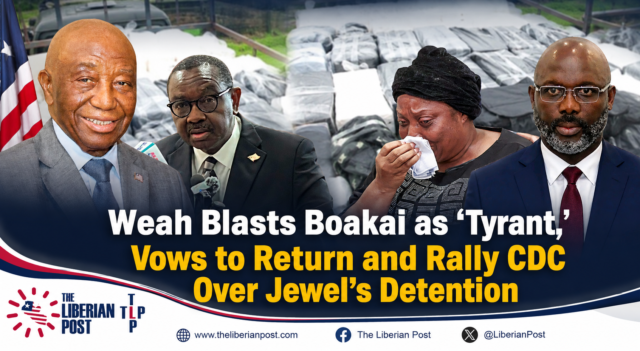
MONROVIA, Liberia — Former President George Manneh Weah has launched one of his strongest attacks yet on President Joseph Nyuma Boakai, accusing his successor of seeking to rule Liberia as a “tyrant” and vowing to return home to mobilize the Coalition for Democratic Change (CDC) against what he describes as an assault on the country’s democracy.
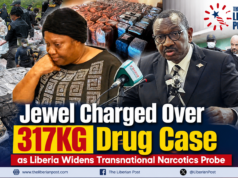
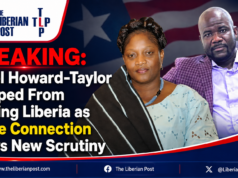
Weah’s forceful reaction came late Wednesday evening after his former Vice President, Jewel Cianeh Howard-Taylor, was stopped from leaving Liberia, taken to the headquarters of the Liberia National Police and subsequently formally charged in connection with an ongoing investigation into an alleged transnational narcotics trafficking network.
In a statement issued in his capacity as former President of Liberia and Political Leader of the CDC, Weah described Howard-Taylor as the latest victim of what he called “rising authoritarian tendencies” under the Boakai administration.
“Despite a peaceful democratic transition, President Boakai seeks to rule as a tyrant. This we must all resist.”
The statement immediately injected a new and potentially explosive political dimension into a case that the government has framed primarily as a major national-security and narcotics investigation.
But while Weah mounted a vigorous defense of Howard-Taylor, his statement also triggered a separate debate among some of his critics: Why has the former President not immediately returned to Liberia to stand beside the woman who served as his Vice President for six years?
Weah’s answer is contained in the final portion of his statement.
“Following my engagements, I shall return to Liberia to rally the CDC along with all well-meaning Liberians to resist this tyrannical attempt to trample upon our burgeoning democracy, using all political and legal means guaranteed to us under our constitution.”
That promise to return—but only “following my engagements”—has become a focal point of criticism as Howard-Taylor remains at the center of the government’s expanding narcotics investigation.
Weah Calls Jewel the Latest Victim of ‘Authoritarian Tendencies’
Weah opened his statement by portraying Howard-Taylor’s detention as evidence of what he described as a broader deterioration in Liberia’s democratic governance.
“What we all witnessed today has further revealed the extent of our democratic decline in the last few years, marked by the continuous use of extrajudicial powers by President Joseph Boakai to trample upon the constitutional rights of Liberians who hold opposing views.”
He specifically characterized Howard-Taylor as the latest target of what he called “rising authoritarian tendencies which have historically plunged societies, including ours, into chaos.”
The former President said he supports lawful efforts to combat Liberia’s narcotics problem but accused the government of attempting to exploit the crisis for political purposes.
“While we support all legal and judicious efforts to rid Liberia of the current drug epidemic, we condemn attempts to use this crisis to score political points.”
Weah’s position therefore draws a distinction between his support for fighting the drug trade and his opposition to the manner in which the Boakai administration is conducting the investigation.
‘Unlawfully Prevented From Traveling’
The former President said Howard-Taylor was “unlawfully prevented from traveling” without prior notice, which he described as a violation of her constitutional right to freedom of movement.
He further accused authorities of subsequently harassing and detaining her.
Weah said he had spoken with Howard-Taylor and that she had “strenuously, categorically denied” the politically motivated allegations being made against her by the Boakai administration.
He did not provide details of his conversation with the former Vice President or disclose the specific allegations she denied.
The government’s position is substantially different.
Attorney General and Justice Minister Cllr. N. Oswald Tweh has said Howard-Taylor was formally charged after investigators reviewed evidence presented by the Joint National Security Investigative Team.
The government says she faces seven charges, including alleged unlicensed importation of controlled drugs or substances, illicit trafficking, criminal solicitation, criminal facilitation, criminal conspiracy and money laundering.
Weah Accuses Government of Protecting Its Own Officials
The former President’s criticism goes beyond Howard-Taylor’s detention.
He accused the Boakai administration of failing to pursue the narcotics investigation with the seriousness and urgency required, while allegedly attempting to create links between the drug investigation and his former administration.
“Rather than treating the investigation with the degree of diligence and urgency it deserves, the government has instead sought to fabricate and concoct connections to the CDC administration, while giving a slap on the wrist to its own government and security officials—many of whom still roam the streets despite being named and accused as true perpetrators.”
Weah did not identify in the statement the government or security officials he believes should face arrest or prosecution.
The accusation nevertheless places the former President squarely against the government’s narrative that the narcotics investigation is being pursued across political and institutional lines.
Justice Minister Tweh has repeatedly insisted that the government will pursue anyone against whom credible and admissible evidence is established.
‘No Office Is Too High’
In announcing Howard-Taylor’s charges, Tweh delivered a message that appears directly relevant to the political battle now emerging around the case.
“No office is too high, no political connection is too powerful, no nationality provides immunity, and no individual is beyond the reach of the law.”
The government has also charged three foreign nationals in absentia—Nikolai Ivancic, Mihovil Vrlovac, and Tara Zaderieko—as alleged members and organizers of the same transnational narcotics network.
Meanwhile, former Deputy Director of the National Security Agency for Administration Gerald Smith has been called in for questioning.
The government says its objective is to dismantle the alleged criminal infrastructure rather than simply arrest individuals found in possession of narcotics.
Weah Says He Is Taking the Fight Beyond Liberia
Weah also disclosed that his response to the Howard-Taylor case has extended beyond Liberia.
He said his team has continued engagements with regional and continental leaders, whom he said he has sought to inform about what he described as the systematic undermining of Liberia’s rule of law and democracy.
“We have continued engagements with several regional and continental leaders to again iterate and underscore to them, how the rule of law and democracy in Liberia is being systematically undermined, and how grave a danger such action poses to our peace and security.”
The former President did not identify the regional or continental leaders with whom he has engaged, nor did he disclose whether any of those engagements had resulted in a formal response.
But the disclosure signals that Weah intends to internationalize his political objections to the Boakai administration’s handling of the Howard-Taylor case.
‘Boakai Seeks to Rule as a Tyrant’
The sharpest line in Weah’s statement was reserved for President Boakai himself.
“Despite a peaceful democratic transition, President Boakai seeks to rule as a tyrant. This we must all resist.”
The accusation represents a significant escalation in the political rhetoric between the former President and his successor.
Weah peacefully transferred power to Boakai in January 2024 after serving one six-year term, following the 2023 presidential election.
By invoking that transition, Weah appears to be contrasting what he considers his administration’s acceptance of democratic succession with what he now portrays as Boakai’s departure from constitutional norms.
The Boakai administration has rejected suggestions that the narcotics investigation is politically motivated and maintains that its actions are based on evidence and the law.
But Why Isn’t Weah Already Home?
While Weah’s statement was welcomed by supporters of Howard-Taylor and the CDC, it also generated a second, more personal criticism.
Some of the former President’s critics questioned why he has not immediately returned to Liberia following Howard-Taylor’s detention.
Their argument is straightforward: Howard-Taylor stood beside Weah for six years, served as his Vice President from 2018 to 2024, remained politically aligned with him after leaving office and has continued to speak favorably about him and his administration.
For those critics, her detention should have prompted an immediate and highly visible response from the former President.
Some have questioned why Weah, who is currently outside Liberia, has not interrupted his engagements and returned immediately to stand beside his former Vice President.
Some critics have even argued that, given the seriousness of the development, Weah could have arranged immediate private air travel and been back in Monrovia within hours.
Those are political criticisms, however, and do not establish what travel options were actually available to Weah or what his current engagements entail.
The former President’s own statement provides only one explanation: he intends to return after completing his current engagements.
A Political Loyalty Test for Weah
The criticism has exposed what may become an uncomfortable political question for Weah: How does a former President demonstrate loyalty to the people who stood with him when they themselves come under pressure?
Howard-Taylor was not a peripheral figure in the Weah administration.
She was his running mate in the 2017 presidential election and served as the country’s second-highest constitutional officer throughout his presidency.
For six years, the two shared the political burden of governing Liberia.
Even after their administration left office, Howard-Taylor remained politically associated with Weah and has continued to defend him publicly.
That history is why some critics believe the former President should have made her case an immediate personal priority.
Their criticism essentially boils down to a perception that Weah is most forceful when his own political position is directly threatened, but less urgent when an ally faces personal consequences.
The criticism is politically charged and should not be presented as an established fact about Weah’s motives.
Indeed, his statement directly contradicts any suggestion that he is indifferent to Howard-Taylor.
He publicly defended her, accused the government of violating her rights and pledged to mobilize the CDC in response.
The controversy is therefore not about whether Weah has defended Howard-Taylor.
It is about how—and how quickly—he is choosing to do so.
A Six-Year Partnership Now Under the Spotlight
Howard-Taylor’s political relationship with Weah dates back to the 2017 presidential election, when she joined his ticket as the CDC’s vice-presidential candidate.
The Weah-Howard-Taylor ticket defeated then-Vice President Joseph Nyuma Boakai and Senator Emmanuel Nuquay in the 2017 runoff.
Howard-Taylor subsequently served as Vice President from 2018 until January 2024.
Throughout that period, she remained one of the most recognizable figures within the administration and the CDC political establishment.
Her political association with Weah did not end when their administration left office.
She has remained part of Liberia’s political conversation and has continued to speak positively about the former President.
Her current legal predicament therefore represents the most serious challenge yet faced by one of Weah’s closest political allies since the CDC left power.
Weah Promises to Rally the CDC
Despite the criticism surrounding his absence, Weah’s statement leaves little doubt about his intention to turn the Howard-Taylor case into a major political confrontation.
“Following my engagements, I shall return to Liberia to rally the CDC along with all well-meaning Liberians to resist this tyrannical attempt to trample upon our burgeoning democracy, using all political and legal means guaranteed to us under our constitution.”
The language is significant.
Weah is promising not merely to issue another statement, but to return physically to Liberia and mobilize his political movement.
He is also signaling that the CDC intends to use both political and legal avenues to challenge the government’s actions.
That could mean a significant escalation in the already tense relationship between the opposition and the Boakai administration.
Government Says the Investigation Is About Drugs, Not Politics
For its part, the government insists that the Howard-Taylor case is part of a much larger national-security investigation.
The Justice Ministry says investigators are seeking to identify and dismantle the alleged network’s:
- leadership;
- financiers;
- facilitators;
- transporters;
- operational coordinators;
- institutional protectors; and
- individuals who knowingly assisted its activities.
The government has emphasized that Howard-Taylor’s charges are accusations and not judgments of guilt.
The Justice Ministry’s formal statement explicitly says all defendants are presumed innocent unless and until proven guilty before a court of competent jurisdiction.
That distinction will become increasingly important as the case moves into the judicial process.
The Battle Now Moves to Politics—and the Courts
The Howard-Taylor case has quickly evolved beyond a narcotics investigation.
It is now simultaneously a criminal case, a constitutional dispute, a national-security controversy and a major political confrontation between Liberia’s former ruling coalition and the current administration.
For Boakai, the case is an opportunity to demonstrate that Liberia’s powerful and politically connected figures are not beyond the reach of the law.
For Weah and the CDC, it is an opportunity to argue that the government is using a legitimate national-security crisis to pursue political opponents.
For Howard-Taylor, the immediate challenge is legal: she must confront seven serious criminal charges and defend herself through the judicial process.
And for the Liberian public, the stakes are even larger. The country needs answers to two fundamental questions:
Can Liberia dismantle an alleged transnational narcotics network without allowing politics to contaminate the investigation?
And equally important:
Can the government prosecute politically powerful individuals while maintaining strict adherence to due process and constitutional rights?
The Question Weah Has Left Hanging
Weah has answered the political question decisively. He says Boakai is acting like a tyrant. He says Howard-Taylor’s rights have been violated.
He says the government is attempting to fabricate links to his administration.
He says regional and continental leaders are being engaged. And he says he will return to Liberia and rally the CDC.
But one question remains unanswered—and it is now being asked loudly by his critics:
Why wait?
Howard-Taylor served beside Weah for six years.
She campaigned with him. She governed with him. She defended his administration. And she continues to speak favorably about him.
Now she is facing seven criminal charges in one of Liberia’s most politically explosive investigations in years.
Weah says he will return “following my engagements.”
Whether his eventual return is seen as timely leadership or as a response that came too late may become almost as politically consequential as the statement itself.
For now, one thing is clear: the Howard-Taylor case has transformed Liberia’s narcotics investigation into an explosive political showdown, and Weah has chosen to put himself—and the CDC—squarely in the fight.
This is a developing legal and political story. The Liberian Post will continue to follow the Howard-Taylor case, the government’s narcotics investigation and former President Weah’s response.
For breaking news, in-depth analysis, and exclusive reports from Liberia and around the world, follow The Liberian Post on Facebook (https://web.facebook.com/profile.php?id=61576017166570) and X, formerly Twitter (https://x.com/LiberianPost).