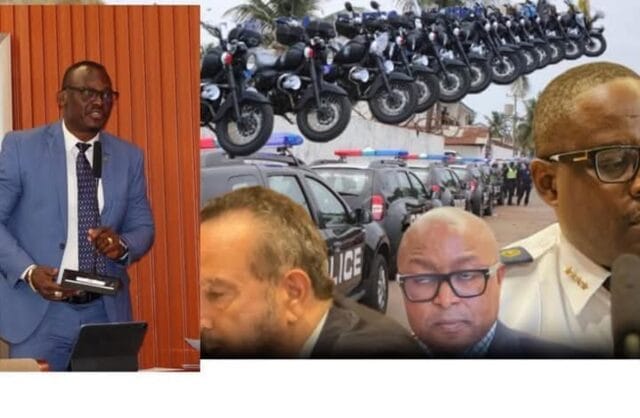
MONROVIA – The Liberian Senate has launched a formal investigation into the outsourcing of core traffic management services to the Liberia Traffic Management Incorporated (LTMI), a private and foreign-controlled entity.
The Senate’s decision was triggered by a communication from Lofa County Senator Momo T. Cyrus, who prayed the wisdom of Plenary to summon the Minister of Justice and the Inspector General of the Liberia National Police.
In his communication, Senator Cyrus raised serious national security concerns over the nature of the agreement granting LTMI significant authority over key functions such as vehicle registration, licensing, and enforcement.
While acknowledging the importance of improving traffic efficiency and road safety, the Senator emphasized that such outsourcing arrangements must not compromise national sovereignty or security.
He, at the same time called for the appearance of the Minister of Justice and the Police Inspector General to appear before the Senate to:
- Present the legal framework under which the LTMI outsourcing deal was executed,
- Explain the oversight mechanisms in place to prevent abuse or unauthorized data access,
- Clarify the operational boundaries between LTMI, the Liberia National Police Traffic Division, and the Ministry of Transport,
- And reassure the Senate that no statutory mandate or national interest has been undermined.
He underscored the Legislature’s responsibility to ensure that all public-private partnerships particularly those involving critical national functions are transparent, constitutional, and non-threatening to the sovereignty of the Republic.
Following deliberations, the Senate Plenary voted to forward the communication to the Committees on Judiciary, Transport, Security, and Concessions for thorough review and report findings and recommendations to Plenary in due time.
US$40 Million Concession for Liberia Traffic Management Raises Concerns
It can be recalled the Government of Liberia entered into a ‘controversial’ concession agreement with Liberia Traffic Management, outsourcing seven key traffic-related functions for a total of US$40 million.
This agreement, which has sparked concerns regarding transparency and fiscal responsibility, involves essential public services that were previously managed by the Ministry of Transport. The outsourced functions include:
- Traffic ticketing
- Roadworthiness vehicle inspection
- Driver’s license issuance
- Vehicle registration
- City parking
- Vehicle towing and impoundment
- Driver testing and certification
Financial Implications, A Discrepancy in Revenue Generation
Historically, the Ministry of Transport generated approximately US$12 million annually from just two of the functions being outsourced: Vehicle Registration and Driver’s Licenses.
Despite receiving only US$3 million a year from the national budget to cover operational costs, the Ministry managed to generate a net revenue of US$48 million over four years, which raised questions about the financial prudence of the current concession model.
Under the new concession agreement, the revenue-sharing formula has shifted significantly, with 70% of revenue directed to the private operator and 30% allocated to the Government of Liberia.
This ratio starkly contrasts with previous partnerships, which allowed a more favorable 55% to the government and 45% to the private entity involved.
Concerns About Revenue Distribution,
Recent reports indicate troubling patterns in the revenue distribution from the concession, with 35% retained by Liberia Traffic Management, 15% allegedly allocated to the Inspector General of Police, 5% allegedly to the Minister of Justice, and 15% allegedly to individuals within President Boakai’s family circle. This newspaper has not yet seen pieces of evidence to support these allegations.
However, this distribution raises serious questions about oversight and whether the agreement serves the public interest.
Adding to the confusion, discrepancies have emerged regarding the concession’s legitimacy, as conflicting statements indicate it was signed under the administrations of both President Weah and former President Ellen Johnson Sirleaf.
This raises further questions about the legal grounding of the concession, particularly since the Ministry of Transport—established in 1987—has not been legally dissolved or repealed.
A Calls for Revaluation and Accountability
The formation of a concession review committee by former President George Weah has yet to result in a review of the LTMI concession, which critics argue is essential given the potential misalignment with national interests and the substantial financial implications involved.
Liberians are questioning why the committee would shy away from scrutinizing an agreement that reportedly allows the Liberia National Police to delegate core Ministry of Transport’s functions to a private entity.
Doubts persist about the projected US$40 million investment from Liberia Traffic Management Incorporated and who will monitor this investment over the concession’s 25-year term. With growing concerns about transparency and fiscal responsibility, many advocate for a revaluation of the concession to ensure that public revenue is maximized and accountability is upheld.
In conclusion, while the potential for increased efficiency exists in outsourcing, the current concession agreement raises critical questions about the fiscal and operational impacts on the Government of Liberia, necessitating urgent scrutiny and potential revision to better serve the country’s interests