In the theater of Liberian politics, a new act has begun, starring a familiar face in a new role. Senator Amara Konneh of Gbarpolu County, a man whose career has been inextricably linked to the national coffers for over a decade, has recently taken to the public stage on Facebook not as a lawmaker dedicated to legislative solutions, but as a self-styled critic, a detached commentator lamenting the very economic ailments he helped cultivate. His recent diatribes against the nascent administration of President Joseph Nyuma Boakai are not the courageous truth-telling of a statesman, but the perilous posturing of a political pretender. It is the hollow sound of a man pointing at a fire while his own hands smell of gasoline and brimstone.
Elected in 2023, Senator Konneh was given a clear mandate by the people of Gbarpolu County—one of Liberia’s most impoverished regions—to work within the Legislature to forge laws that would alleviate the crushing economic hardship facing ordinary Liberians. The people did not elect a pundit; they elected a problem-solver. Yet, the Senator has chosen the path of least resistance, opting for the comfort of the critic’s chair rather than the arduous work of legislative reform. He speaks of the government’s challenges as if he were an outsider, an observer looking in, conveniently forgetting that he is a powerful, well-compensated insider.
I seek to unmask his performance. I will peel back the layers of his rhetoric to reveal a history of economic mismanagement, a pattern of self-preservation, and a profound hypocrisy that undermines his every word. By examining his record as a cabinet minister and his actions as a senator, I will expose the central contradiction of Amara Konneh: a man who consistently dips his finger in the national soup pot to lick it, while loudly complaining to everyone else about how salty it is. If the soup is truly unpalatable, one must ask: why does he keep feeding from it so voraciously?
Unveiling the Senator’s Selective Outrage and Hypocrisy
The core of Senator Konneh’s recent commentary is a thinly veiled threat about a “silent majority” who, dissatisfied with the current government, will supposedly deliver their verdict at the ballot box in 2029. This is a classic case of political projection. Senator Konneh, in his attempt to cast blame upon the Executive, seems oblivious to the fact that the wrath of a suffering populace does not discriminate. When the people rise, they do not just look at the Mansion; they look at the Capitol Building, where he sits, drawing a handsome salary from their collective suffering.
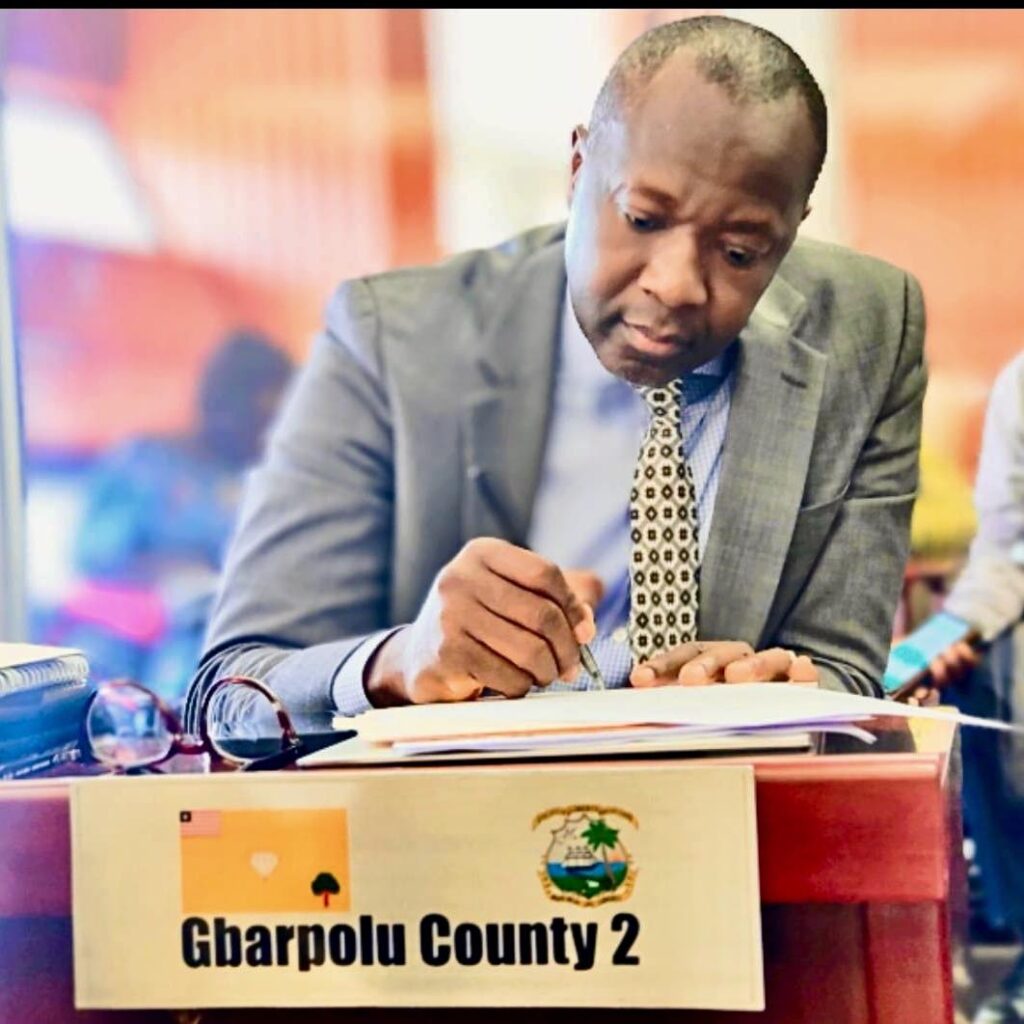
It is such reading of the Liberian populace that should guide the day-to-day working of Senator Konneh. Interestingly, Senator Konneh is behaving like Pontius Pilate. Pilate, a governor who wished to maintain his power and appease the crowd, publicly washed his hands off the decision to crucify Jesus, whom he himself declared he found no fault in. He sacrificed an innocent man to secure his own position, all while feigning non-involvement. Senator Konneh is the Pontius Pilate of modern Liberian politics, and the Liberian people—whose resources are being sacrificed—are his Jesus.
His hypocrisy is most glaringly demonstrated on the issue of legislative compensation. For years, the Liberian public has cried out for a radical cut in the exorbitant salaries and benefits afforded to lawmakers. This is not a trivial matter; it is a moral imperative in a nation where civil servants struggle to make ends meet and poverty is rampant. Brave voices in the Legislature, like Senator Abraham Darius Dillon, have championed this cause, standing in solidarity with the people they represent. Where is Senator Amara Konneh? He is silent. He has refused to join the chorus demanding shared sacrifice. He has chosen to protect his personal income, derived from the very national budget he now criticizes as inadequate.
He wants to keep his job, with all its privileges and comforts, so badly that he is willing to cast the Executive branch to the ‘wolves’ of public opinion. He finds “no fault” in the system when it benefits him directly but is quick to condemn its outcomes when it serves his political narrative. He pretends he is not part of the institutional machinery that perpetuates economic disparity, yet he is one of its primary beneficiaries. He sits in the Senate, a co-equal branch of government responsible for appropriations and oversight, and acts as if he has no power to influence the nation’s economic direction. This is not just negligence; it is a calculated act of political theater designed to absolve himself of responsibility. The Liberian people are not fooled by this hand-washing ceremony. They see that his hands are not clean; they are stained by the very system he pretends to decry.
The Architect of Economic Stagnation: A Legacy of Missed Opportunities
Before becoming a senator for one of Liberia’s poorest counties, Amara Konneh was the chief architect of the Liberian economy for years, serving as Minister of Planning and later as the powerful Minister of Finance and Development Planning under the Ellen Johnson Sirleaf regime. This is not ancient history; it is the direct prequel to our current economic reality. His tenure was not a golden age of prosperity, but a period marked by missed opportunities, flawed policies, and a foundation of debt that plagues us to this day.
During his time as Finance Minister, Liberia was awash with unprecedented resources, including the management of a staggering US$16 Billion UNMIL economy. This was a once-in-a-generation opportunity to fundamentally restructure and expand Liberia’s economic base. It was a moment that called for bold, novel, and radical ideas to create sustainable jobs and foster inclusive growth. Instead, what did Minister Konneh deliver? Stagnation. The concession agreements signed under his watch were notorious for favoring Monrovia-based elites, deepening the urban-rural divide and leaving the counties, like his own Gbarpolu, in the dust.
A critical failure was his refusal to tackle Liberia’s debilitating dual-currency regime. While our neighbors in the subregion de-dollarized their economies and strengthened their local currencies, Liberia remained an outlier. This policy inaction has left the Liberian dollar perpetually weak and the economy vulnerable to external shocks. The results are clear: our neighbors, who have a single currency regime, now boast stronger, more resilient economies. Senator Konneh had the authority and the opportunity to set Liberia on a similar path, but he failed to act.
So profound were his administrative shortcomings that he earned the moniker “Mr. Budget Shortfall.” Year after year, his ministry produced wildly optimistic budgetary projections that never aligned with actual revenue collection. This chronic gap between projection and reality created immense uncertainty, starved essential government programs of funding, and resulted in painfully slow economic growth. His primary solution was not to innovate or expand the revenue base, but to engage in continuous debt sourcing. His legacy is one of mortgaging Liberia’s future, accumulating massive debts from the World Bank, IMF, and other lenders, with little to show for it in terms of tangible, widespread development. This is the man who now lectures the new government on economic transformation. It is an absurdity of the highest order!
Having presided over years of economic policy that failed to deliver for the average Liberian, Senator Konneh now has the audacity to point an accusing finger at the Joseph Boakai Administration for the very challenges he helped entrench. He criticizes the Executive for not doing enough to expand the economy and create jobs, a task at which he spectacularly failed despite having far more resources and time at his disposal. He represents Gbarpolu County, a place of immense poverty and neglect, yet he has lived comfortably at the expense of the state for his entire public career. The question for the people of Gbarpolu is simple: what has he done for you?
The Specter of 2029: A Desperate Gambit and a Dangerous Narrative
His recent commentary, warning of a “silent majority” poised to protest at the ballot box in 2029, is the height of political arrogance. He frames this as a threat exclusively to the Executive branch, as if he, a sitting senator, is immune to the people’s judgment. Does he believe the “political wrath” of a frustrated electorate will magically spare the Legislature? Does he think the people of Gbarpolu County will forget that while he pens critiques from his comfortable position, their roads remain unpaved, their clinics unequipped, and their children without opportunity? When you point one finger at others, Senator, the other four are pointing right back at you.
His criticism is a performance of distraction. It is an attempt to create a narrative where he is the wise elder, the concerned patriot, while the new government is inept. But Liberians have long memories. They remember “Mr. Budget Shortfall.” They remember the debt. They remember the concession deals that enriched the few. And they see him now, a member of the Legislature, failing to champion the one reform that would signal true solidarity with the people: a cut in his own salary.
Furthermore, his attempt to legitimize recent protests by invoking a “silent majority” conveniently ignores the complex and, at times, unsavory motivations of some participants. On Thursday, July 17, 2025, we saw some protestors openly complaining that the government’s strong stance against the proliferation of narcotic drugs is harming their “business.” For Senator Konneh to align himself with such sentiments, even implicitly, by championing their cause without nuance is deeply troubling. Is this the “silent majority” he speaks of? Those whose livelihoods depend on the poison that is destroying our youth? If fear of protest is the only motivator for governance, then every elected official, including Senator Konneh, has reason to be afraid.
Let me conclude that the argument that the “silent majority” might be tempted to bring back the regime of former President George Weah is a scare tactic devoid of logic. To suggest this is to insult the intelligence of the Liberian people. Are we to believe they have forgotten the chaos of the Weah years? The disastrous salary harmonization that crippled civil servants, the explosion of the drug pandemic, the rampant corruption, the mysterious deaths of auditors, and the desecration of our academic institutions were not myths. They were the lived reality that led to the change Liberians voted for in 2023. The people did not vote for a return to that chaos; they voted for a rescue mission.
The rescue of a nation is not a simple task, and it is not the sole responsibility of the Executive branch. It requires all hands on deck, especially from the legislative branch, which holds the power of the purse and the law. Senator Amara Konneh was not elected to be a high-paid critic. He was elected to legislate, to oversee, to represent, and to solve problems. His current path of perilous posturing is a betrayal of that mandate.
Instead of writing commentaries filled with veiled threats and hollow critiques, I challenge Senator Konneh to act. Propose a bill for a radical, immediate cut in legislative salaries and benefits, starting with your own. Use your extensive experience, for better or worse, to draft concrete, innovative policies to de-dollarize our economy. Champion oversight hearings that hold all parts of the government, including the past administrations in which you served—accountable for their economic decisions. Go back to Gbarpolu County and work, demonstrably, for the people who elected you.
Until then, your words will remain what they are: the self-serving diatribe of a political pretender, desperately trying to rewrite his own history and deflect blame for a system from which he has handsomely profited. The Liberian people deserve more than a Pontius Pilate who washes his hands in public. They deserve leaders with the courage to get their hands dirty in the genuine, arduous work of nation-building.
Daniel Henery Smith, PhD
Class of 2014: Edward J. Bloustein School of Planning and Public Policy
Class of 2024: Rutgers Graduate School of Education (GSE)
Class of 2010: University of Liberia
ULSU President Emeritus (2009-2010)
Founding Executive Director Emeritus (2016-2018): UL Teaching & Learning Center (TLC)