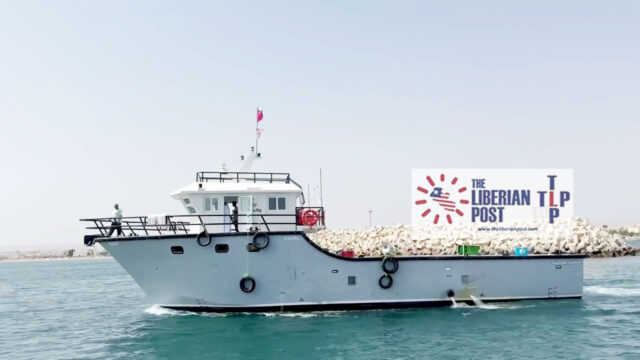
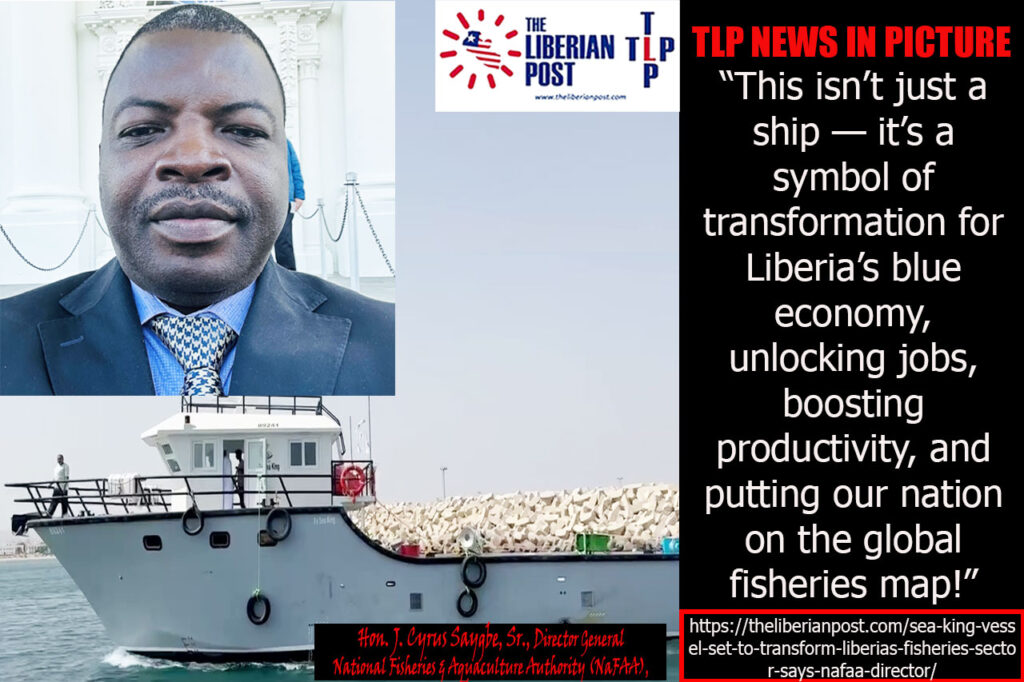
MONROVIA — Liberia is poised to enter a new era in its marine economy as the country’s first government-owned semi-industrial fiberglass fishing vessel, dubbed “The Sea King,” prepares to arrive on Liberian shores, according to the National Fisheries & Aquaculture Authority (NaFAA). Director-General J. Cyrus Saygbe Sr. says the vessel, constructed in Oman and financed through the World Bank under the Liberia Sustainable Management of Fisheries Project (LSMFP), represents a major leap for the sector.
“History is sailing home!” Saygbe declared in a public statement he posted on his Facebook, calling the vessel “not just a ship — it’s a symbol of transformation for Liberia’s blue economy, unlocking jobs, boosting productivity, and putting our nation on the global fisheries map.”
What is the LSMFP?
The Liberia Sustainable Management of Fisheries Project (LSMFP) was approved by the World Bank in 2021 and became effective in December of that year. The project aims to improve fisheries management, promote value addition, support aquaculture, strengthen governance, and enhance livelihoods for fishing communities across Liberia. It is central to the government’s broader economic-development goals.
Some of the LSMFP’s achievements to date include:
- Establishing improved landing sites for artisanal and industrial fishermen at Mesurado Pier in Monrovia.
- Supporting production of fiberglass fishing boats—non-wooden, more durable, and environmentally friendly vessels.
- Distribution of AIS transponders to fisherfolk to enhance safety and tracking.
What “Sea King” Brings
According to NaFAA:
- The vessel is being made available under a Public-Private Partnership (PPP) model, preferably with a Liberian partner, to ensure professional management and operational sustainability.
- It is expected to increase productivity, create skilled jobs, and augment the artisanal fishing industry by offering opportunities for training and value-addition.
- The design and construction through LSMFP reflect environmental consciousness, like using fiberglass to reduce reliance on wooden boats that contribute to deforestation.
Challenges and Considerations
While the announcement has been welcomed, there are key considerations:
- Regulation & Oversight: Semi-industrial fishing operations can potentially clash with inshore, artisanal fishers. Ensuring clear demarcation of fishing zones, licensing, observer systems, and stock assessments will be essential for sustainability.
- Transparency: Given Liberia’s commitment under projects like LSMFP and recent moves to join global transparency initiatives (e.g., FiTI), stakeholders will expect openness in the PPP contract, ownership, and revenue distributions.
- Technical & Financial Capacity: Operating a government-owned semi-industrial vessel requires maintenance, fuel, crew training, and robust logistical support—areas that have been challenging in the past for Liberia.
Why This Matters
- The fisheries sector is a crucial source of food, income, and employment for coastal communities. LSMFP estimates that over 11,000 fishers, using more than 3,300 canoes, directly serve approximately 56,000 people.
- It aligns with Liberia’s efforts to reduce dependence on imported fish, increase value addition within the country, and address food security challenges.
- Environmentally, the shift toward more sustainable vessel materials and technologies helps meet climate goals and avoid over-exploitation of marine resources.
What Comes Next
- NaFAA will formally tender the PPP contract for managing Sea King, selecting a partner under performance-based terms.
- Preparations are underway for crew recruitment, operating guidelines, safety protocols, and integration with LSMFP’s broader framework for governance and value-addition.
Local fisherfolk, civil society, and coastal communities will watch closely how benefits are shared, zones are enforced, and bending toward sustainability is maintained.