MONROVIA – At the heart of Monrovia, the University of Liberia (UL) is a bustling hub of learning where thousands of young Liberians converge daily in pursuit of knowledge and opportunity. But for too long, one simple yet critical problem has cast a shadow over their studies: the lack of chairs.
In overcrowded lecture halls, students often sit on windowsills, lean against walls, or squeeze three into benches made for two. Some even stand for hours, notebooks in hand, determined not to miss a lecture.
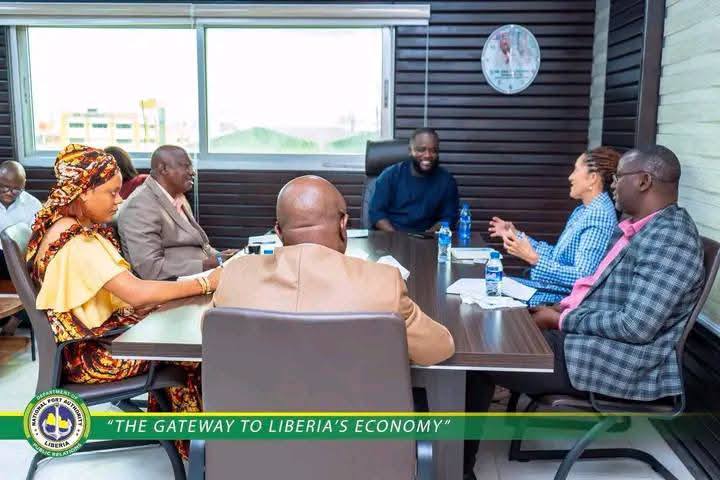
On Monday, relief — and a sense of recognition — came when the National Port Authority (NPA) announced an initial contribution of US$25,000 to help ease the chair shortage at UL. The pledge was made during a high-level meeting at the NPA headquarters between Managing Director Sekou A. M. Dukuly and UL President Dr. Layli Maparyan.
“This is not just about furniture; it’s about dignity in education,” Dukuly declared. “No student should have to struggle for a place to sit while trying to learn. The Port Authority is taking the first step, but we are also committed to galvanizing our partners and the business community to do more.”
Students Speak: “Sometimes, I Don’t Even Take Notes”
For students, the gesture represents more than financial support — it touches the reality of their daily struggles.
“I’ve had to stand through an entire economics lecture because there weren’t enough chairs,” said Josephine, a second-year economics major. “Sometimes, I don’t even take notes because I’m too tired from standing. Knowing that chairs are finally coming feels like someone out there is listening.”
Another student, Emmanuel, a senior in political science, described the situation as “humiliating.” “When visitors come to campus and see us standing in class, it feels like we are not respected. The NPA’s intervention makes me feel hopeful that conditions can improve.”
UL President Welcomes “Partnership for Progress”
UL President Dr. Maparyan expressed deep gratitude to the NPA, noting that the gesture reflects a national commitment to higher education.
“This contribution provides immediate relief, but it also sends a powerful message — that Liberia’s institutions see education as central to our nation’s progress,” she said. “We are not alone in this struggle, and partnerships like these help light the path forward.”
Dr. Maparyan also welcomed discussions on future collaboration, including the possibility of UL designing training programs to strengthen NPA’s human resource capacity — a model she described as “a win-win for academia and industry.”
Beyond Chairs: A Legacy of Challenges
The chair shortage at UL is not new. Over the years, the institution has grappled with surging student enrollment, aging infrastructure, and insufficient resources. With more than 20,000 students, the university’s facilities have not kept pace with demand, leaving both students and faculty frustrated.
“When students don’t have seats, teaching becomes almost impossible,” said a senior lecturer in the College of Business and Public Administration. “You’re trying to deliver a lecture, but half the class is distracted because they’re standing. It’s discouraging. This intervention may seem small, but it addresses a very real issue.”
NPA’s Vision: Education as National Development
For Dukuly and his team, the initiative is part of a broader vision to link Liberia’s institutions in common purpose. Senior NPA officials — including Deputy Managing Director for Operations Emmanuel Horton, Executive Director for Governmental & International Affairs Sekou B. Kolleh, and Human Resource Director Madam Vashti Sirleaf — joined Monday’s meeting, underscoring the Authority’s collective commitment.
“This is transformational leadership at work,” Dr. Maparyan told the gathering. “When one institution extends a hand of partnership to another, the whole nation benefits.”
A Symbol of Hope
For many at UL, the NPA’s US$25,000 donation is more than money — it is a statement. It acknowledges the struggles students face and affirms their right to basic learning conditions.
As Emmanuel, the political science student, put it: “It’s not just about sitting in class. It’s about being able to learn with dignity. That’s what this means for us.”
For the University of Liberia, where each chair represents a student’s chance to focus, engage, and succeed, the intervention may well be remembered as a small but meaningful step toward transforming the country’s educational landscape. And for the students still waiting for a place to sit, it is a promise that their voices are being heard — and that a seat for the future may soon be theirs.