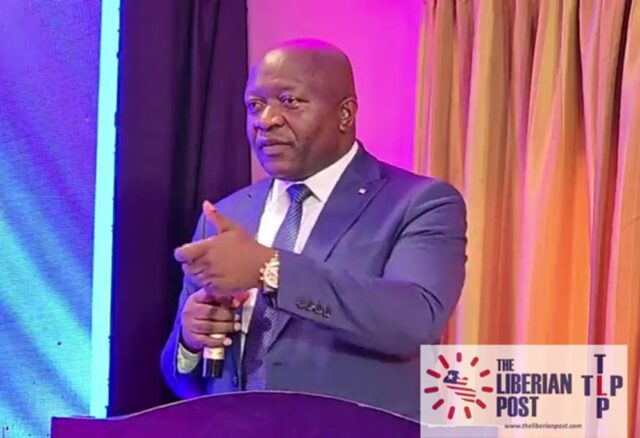
MONROVIA, Liberia — Finance and Development Planning Minister Augustine Kpehe Ngafuan on Thursday keynoted the launch of Payaza in Liberia, casting the pan‑African payments firm’s entry as part of President Joseph Nyuma Boakai Administration’s push to digitize the economy, cut transaction times and expand opportunities for young people and small businesses.
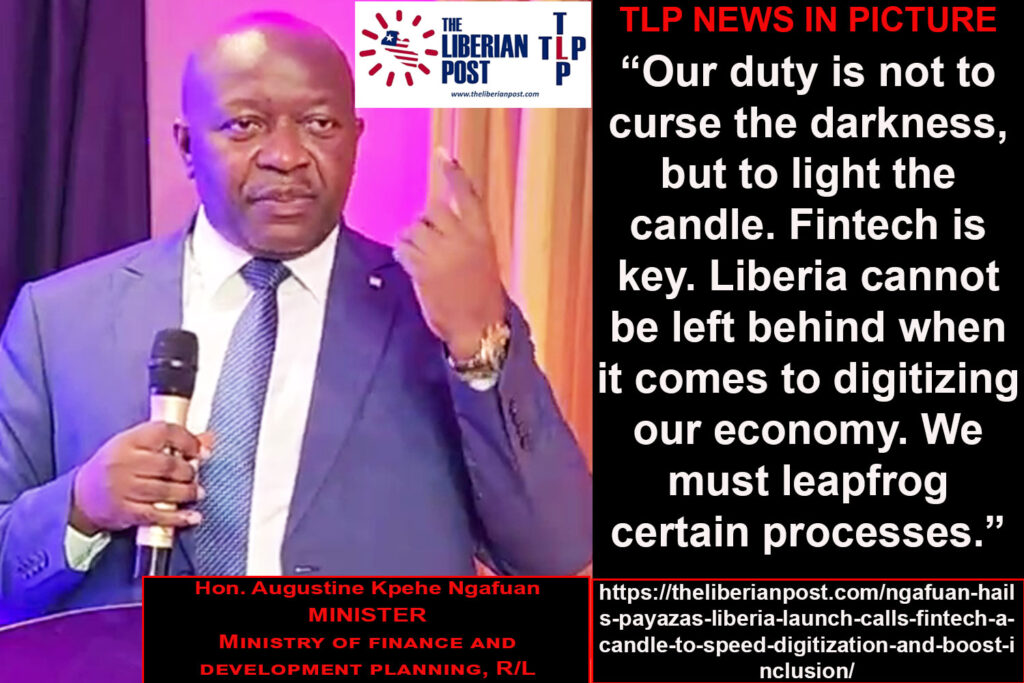
“Our duty is not to curse the darkness, but to light the candle,” Ngafuan told dignitaries gathered for the event, where the Central Bank of Liberia was represented on behalf of Governor Henry Saamoi, alongside senior government advisers, legislators and banking executives. “Fintech is key. Liberia cannot be left behind when it comes to digitizing our economy. We must leapfrog certain processes.”
Ngafuan praised Payaza’s commitment to hiring locally and targeting youth, saying the company’s arrival “is not just good for you, it’s also good for us,” and framed faster, more reliable payments as a competitiveness issue. “Efficiency is key,” he said. “If you can do in a few seconds what ordinarily you are doing in one week, think about what that does for your profitability, your turnover and everything.”
The Minister linked the launch to a broader government agenda to modernize payments and public services, citing President Boakai’s recent unveiling of the Pan‑African Payment and Settlement System (PAPSS) in Monrovia. He said PAPSS is already helping traders—especially market women—move money safely without carrying large amounts of cash across borders. “The more we make our system seamless, as Payaza is trying to do, we become more robust,” he said.
Ngafuan also signaled that interoperability between Liberia’s two major mobile‑money networks—Lonestar and Orange—is advancing under Central Bank guidance. “From what the Central Bank is doing, sooner than later, that should be possible. People can move between networks and transact,” he said after speaking with CBL officials at the event.
About Payaza
Payaza describes itself as a pan‑African payments company that enables businesses and consumers to send, receive and manage money via cards, bank transfers and mobile money. Its offerings typically include merchant collections, payment links and invoices, disbursements and bulk payouts, wallets/virtual accounts, and developer APIs and dashboards for integration. Company representatives at Thursday’s event said the firm’s regional leadership covers Liberia, Sierra Leone and Ghana, and Ngafuan noted the company also operates in Uganda. Specific Liberia launch details—such as licensing status, local bank/MNO integrations, pricing and go‑live timelines—were not disclosed during the remarks.
The Minister’s speech mixed policy signals with a broader defense of the administration’s economic record, pointing to ongoing electrification in hard‑to‑reach areas, road improvements and a forthcoming public works push dubbed “Operation Octopus,” which Public Works officials plan to launch Oct. 15 as the dry season begins. He said the government is racing to submit the national budget by Oct. 31, pegging the current year at $880 million and suggesting next year could top $1 billion. “We are knocking on heaven’s door,” he said.
Addressing wages and living standards, Ngafuan reiterated that the least‑paid civil servants now earn $150 gross per month, while estimating the average pay “may be around maybe $350 to $500.” He said more than 28,000 public employees received pay increases this year and that the government is underwriting insurance for police officers. He argued Liberia’s minimum wage compares favorably in the region, while acknowledging more progress is needed.
Ngafuan also said the government has maintained fiscal targets despite donor headwinds. Claiming the United States Agency for International Development canceled most projects this year except five—amounting to “more than $300 million”—he insisted the administration is “still hitting targets” due to tighter revenue collection and what he called the “visionary leadership of President Boakai.” Those assertions could not be independently verified at the event.
Thanking private‑sector partners, bankers and think‑tank leaders in attendance—including Senior Presidential Adviser, Dr. Augustine Konneh; lawmakers such as Special Envoy Hon. Daniel Kolubah; and executives from UBA and GTBank—Ngafuan urged Payaza to “plant deep roots” in Liberia. “You have come to help us to leapfrog,” he said. “It shouldn’t just be a shallow root. It should be a deep root that will help our economy in terms of employment, empowerment of businesses and services, [and] efficiency.”
Why it matters
- Faster, interoperable digital payments can reduce cash‑handling risks, shrink settlement times and lower costs for small businesses.
- New entrants like Payaza could spur competition among banks and mobile‑money operators, provided they secure licenses and integrate with domestic payment rails under Central Bank’s oversight.
- The government is tying fintech growth to its wider economic program—roads, power and public‑sector modernization—arguing that efficiency gains translate into higher productivity and revenues.
What’s next
- The Central Bank has not yet publicly detailed timelines for full mobile‑money interoperability.
- Payaza is expected to outline Liberia‑specific products, partners and compliance milestones in the coming weeks.
- Public Works plans to launch “Operation Octopus” on Oct. 15 to accelerate road works, which the administration says will complement logistics and digital‑commerce growth.