MONROVIA – Grand Gedeh County Senator Zoe Emmanuel Pennue has lauded President Joseph Nyuma Boakai’s administration for transformative gains in road infrastructure, transportation, and public services—remarks that political observers say could mark a historic shift for the Unity Party in Southeastern Liberia, a region long considered politically non-partisan.
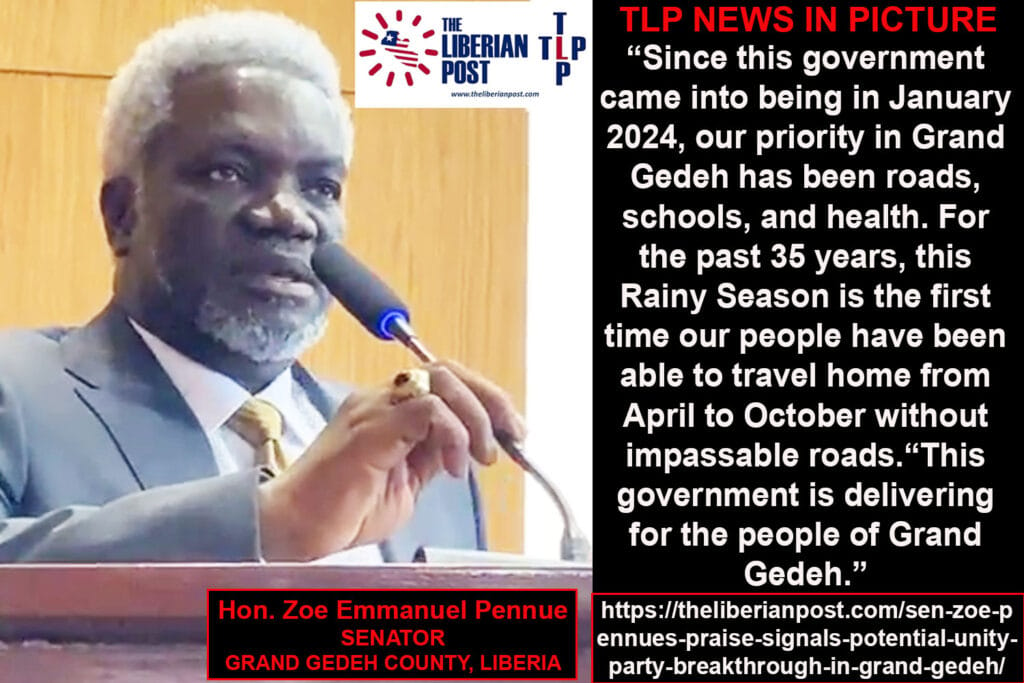
Speaking on the Senate floor Thursday, Pennue detailed the dramatic improvements that his constituents have experienced under the Boakai-led government. “Since this government came into being in January 2024, our priority in Grand Gedeh has been roads, schools, and health. For the past 35 years, this Rainy Season is the first time our people have been able to travel home from April to October without impassable roads,” he said, highlighting the tangible impact on daily life.
Pennue noted that fuel and transport costs have fallen sharply: gasoline prices in Zwedru have dropped from 2,500–3,000 Liberian dollars per gallon to around 750–800 Liberian dollars, while transport fares to Monrovia have decreased from 19,000–20,000 to 6,000–7,000 Liberian dollars. The senator also pointed to food security improvements, with rice prices declining from 4,000–5,000 to 3,200 Liberian dollars per bag.
“These developments are not just statistics—they reflect real change in the lives of our people,” Pennue said, linking road rehabilitation and infrastructure development directly to economic access, education, and healthcare improvements. He added that the county’s health system is regaining capacity, and local schools, including the community college set to become a university, are receiving record-level funding.
Observers say Pennue’s repeated commendations signal growing political capital for the Boakai administration in Southeastern Liberia, where the Unity Party has historically struggled. Since Liberia’s return to democratic governance in 2005, the Unity Party has failed to secure a single election in Grand Gedeh and surrounding counties. Analysts now suggest that visible improvements in infrastructure and public service delivery could begin shifting public perception—and potentially electoral outcomes—in favor of the ruling party.
“This government is delivering for the people of Grand Gedeh,” Pennue concluded, offering what many political analysts interpret as a subtle endorsement of Boakai’s leadership ahead of future elections.

Political watchers note that Pennue’s praise—coming just a month after similar commendations in September 2025—underscores the administration’s potential to penetrate previously resistant regions, leveraging developmental gains into political support. For a county long viewed as non-partisan, the Boakai administration’s track record on roads, transportation, and service delivery may be its most potent tool for winning hearts and votes in the Southeast.
As Southeastern Liberia experiences tangible improvements, the question remains whether these gains will translate into a strategic advantage for the Unity Party—potentially rewriting decades of regional political patterns.