-Public Works Cites Budget and Procurement Rules While Bility’s Party Accuses Government of Stifling Community‑Driven Projects
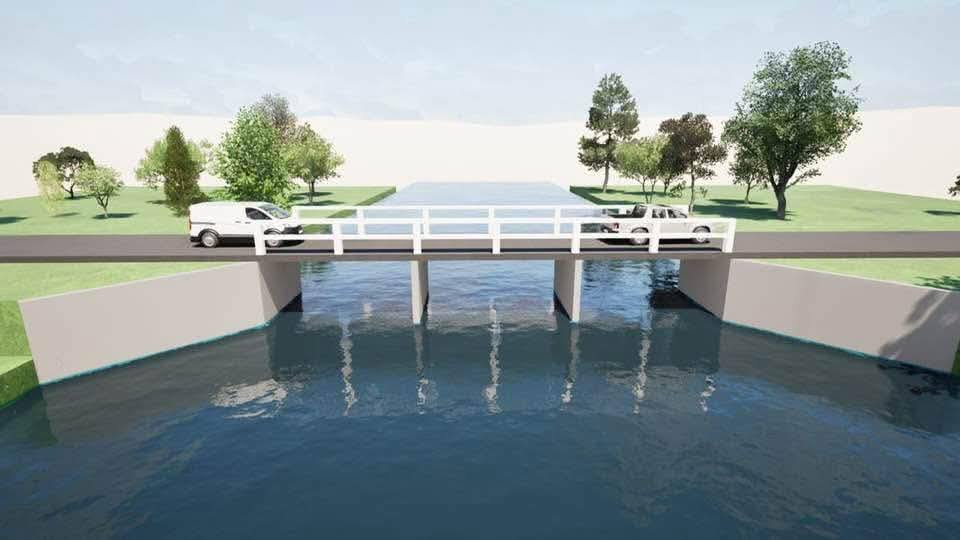
MONROVIA, Liberia — The Citizens Movement for Change (CMC) has accused the Government of Liberia of resisting a citizen‑led plan to build a 38‑meter bridge in Bong County, but the Ministry of Public Works says the crossing is already programmed in the FY2025 national budget and will proceed through competitive procurement.
In a Nov. 5 press statement, CMC said it was “deeply disappointed” by what it described as government resistance to a community‑driven development effort in Bong. The opposition party argued the bridge would replace unsafe river crossings, improve access to markets, schools and health services, and “improve the daily lives” of nearby communities.
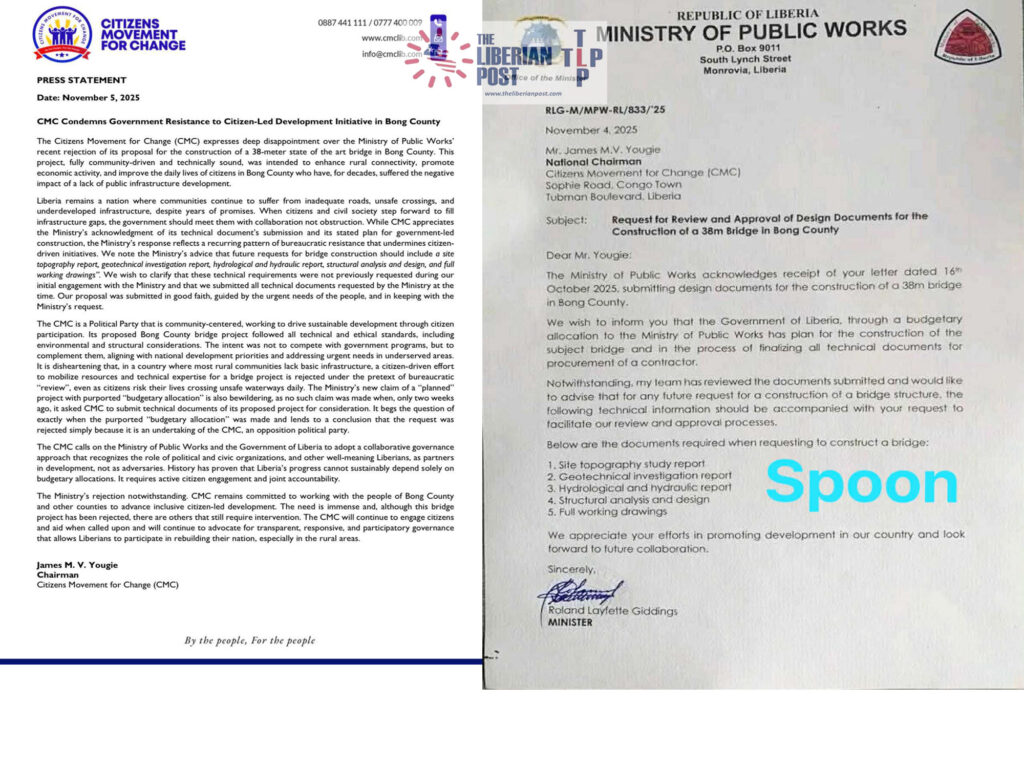
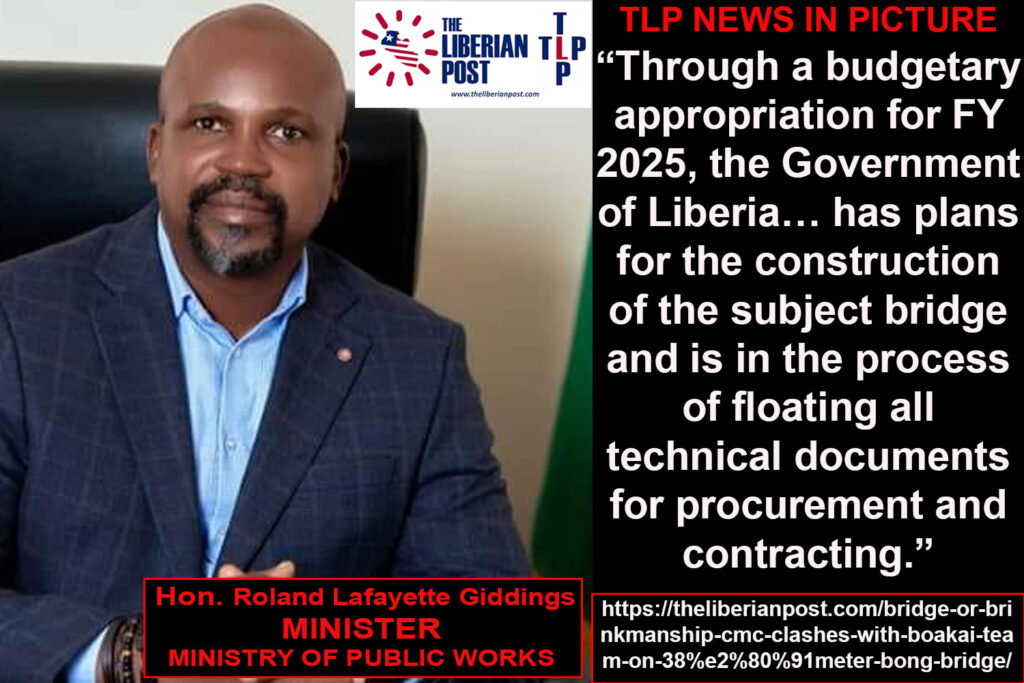
Public Works replied in a Nov. 4 letter acknowledging receipt of CMC’s Oct. 16 submission of bridge designs and stressing that the project is in the 2025 budget pipeline. “Through a budgetary appropriation for FY 2025, the Government of Liberia… has plans for the construction of the subject bridge and is in the process of floating all technical documents for procurement and contracting,” Minister Roland Lafayette Giddings wrote. The letter outlines standard requirements for bridge works—hydrological and geotechnical studies, structural designs and drawings, bills of quantities, and environmental and social safeguards—and says the ministry “appreciate[s] your efforts” and looks forward to collaboration.
What Each Side Is Saying
- CMC: The party says bureaucratic hurdles are slowing a timely, locally backed solution to a dangerous crossing and reflect a broader pattern of government resistance to citizen‑initiated projects—particularly in rural areas.
- Public Works: The ministry says the bridge will be built under the state’s legal procurement framework using budgeted funds, with all surveys, designs and safeguards completed before award, in line with law and safety standards.
Why It Matters
Liberia’s rural connectivity gaps routinely isolate communities during the Rainy season, curbing farm‑to‑market access and public services. The dispute in Bong spotlights a recurring tension: how to welcome citizen initiative while preserving value‑for‑money, engineering integrity and public accountability through formal procurement.
Who Is CMC—and Musa Bility’s Role
CMC is one of Liberia’s newest opposition parties, founded by businessman Musa Hassan Bility. Bility is a former chairman of the Liberty Party and a prominent figure in the Collaborating Political Parties (CPP) framework. He previously served as president of the Liberia Football Association and, in 2019, received a 10‑year FIFA ban over ethics violations—a decision widely reported at the time. Bility has remained active in business and politics and launched CMC as a vehicle for citizen‑centered reforms and opposition advocacy.
What’s Next
- Procurement timeline: Public Works says bid documents for the Bong bridge are being prepared for competitive tender under FY2025. The ministry has urged collaboration and adherence to technical and safeguard requirements.
- Community coordination: CMC is pressing for clearer guidance and faster approvals so citizen‑supported projects can align with national standards without being sidelined.
- Transparency: Local stakeholders are urging both sides to publish timelines, technical steps and funding milestones so communities know when—and how—the bridge will be delivered.
Bottom Line
CMC’s criticism and the ministry’s response converge on one point: the bridge must be built. The test will be whether formal procurement moves swiftly enough—and transparently enough—to deliver a safe crossing that meets engineering standards while honoring the community’s push for faster, responsive development.