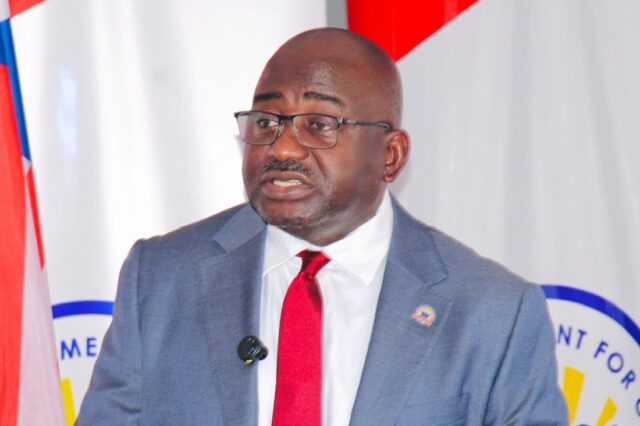
MONROVIA, Liberia — Opposition leader Musa Hassan Bility used a flurry of “we will” promises to torch the government’s draft US$1.2 billion FY2026 budget and to sketch what he calls a “People’s Budget” under a future Citizens Movement for Change (CMC) administration.
In a press conference, Bility labeled the draft “an eating‑show budget” built on “fantasies,” zeroing in on the conditional US$200 million ArcelorMittal signature bonus and a US$10 million contingency line from asset recovery to argue the revenue plan is inflated and unreliable. He contrasted those criticisms with no fewer than 11 explicit “we will” commitments, ranging from salary caps for top officials to sharp increases for education, agriculture, health care, infrastructure and support for small businesses.
Key Criticisms of the FY2026 draft
- One‑offs and contingencies: Bility said nearly 17% of the draft revenue—US$200 million—is a one‑time windfall (the Mittal bonus) that will evaporate in 2027. He called the US$10 million contingency from asset recovery “speculative,” arguing it “pushes [the budget] beyond the US$1 billion mark” without proven collection capacity.
- Spending mix: He cited a 25% rise for the Legislature (to almost US$52 million), a 45% jump for national security (to US$151 million), and a higher wage bill—up about US$14 million—while agriculture, which employs over 60% of Liberians, receives “barely 1%” (about US$13.6 million). “One percent for farmers and 27% for bureaucrats,” he said.
- SOE opacity: Bility said 17 of 18 state‑owned enterprises listed in the annex failed to submit financial plans, a breach of Liberia’s PFM law that “undermines the integrity of the national budget process.”
CMC’s “People’s Budget” Promises
Bility framed his alternative as “Development with Dignity,” “Liberia‑First Economics,” and “Replacing, not repairing” old systems. Among the commitments:
- Education: “We will” raise education to 15% of the first budget, 20% of the second; link schooling to entrepreneurship/TVET.
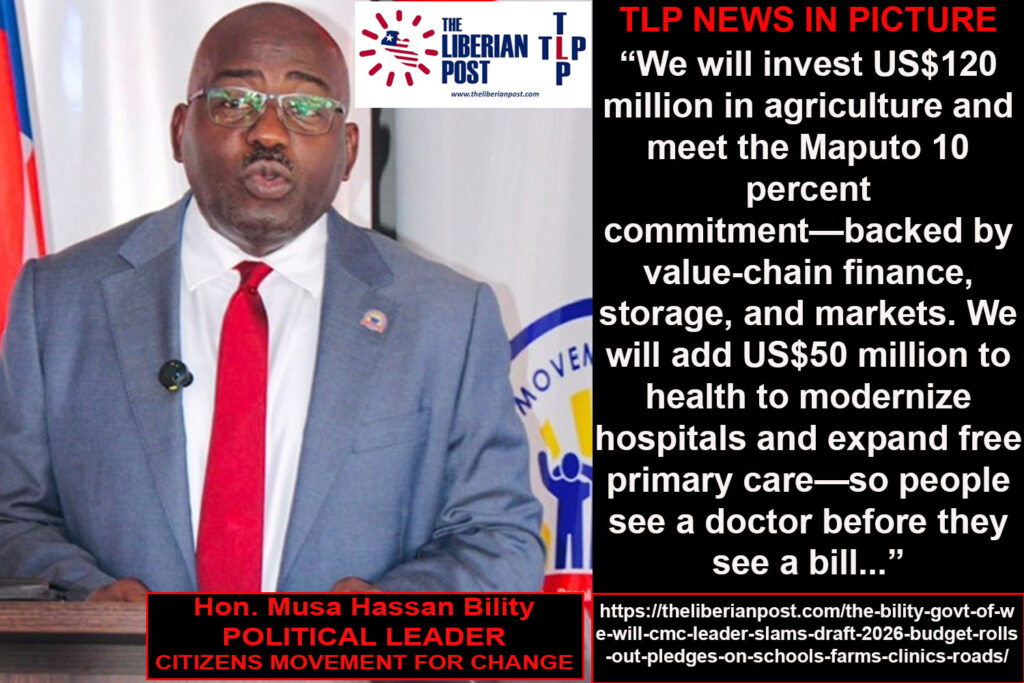
- Agriculture: “We will” fund the sector at US$120 million to meet the Maputo 10% pledge and back agribusiness/value chains; he floated using windfalls to capitalize an agricultural investment bank.
- Health: “We will” add US$50 million above the draft’s US$101 million to modernize hospitals and expand free primary care.
- Infrastructure: “We will” lift capital for roads/bridges from US$133 million to US$220 million, prioritizing rural/feeder roads and PPPs; “we will invest in technology” to improve government monitoring and delivery.
- SMEs: “We will” double support to US$32 million via direct finance and credit guarantees.
Governance, Savings, and Revenue Measures
- Integrity and austerity: “We will” empower watchdogs to cut fraud/waste; “we will” cap top public pay at US$5,000/month and cut senior officials’ salaries by 40%.
- Transparency: “We will” require verified asset declarations before office or Senate confirmation; “we will” enact whistleblower protections; “we will” publish procurement awards and routinely review contracts.
- Efficiency and revenue: “We will” reintroduce bulk purchasing for government; “we will” audit large taxpayers going back five years; “we will” reduce the overall wage bill by streamlining bureaucracy; “we will” redirect savings to essential services.
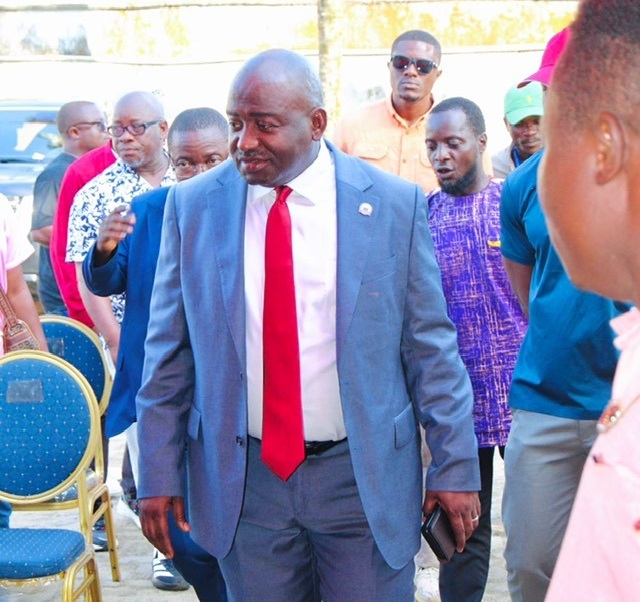
How many “we will” pledges? In the excerpted statement shared with this paper, Bility made at least 11 “we will” commitments. (The total count may be higher in the full text.)
Context: FY2026 draft, FIFA ban, and road‑fund baggage The Boakai administration’s draft FY2026 budget—Liberia’s first ever to cross US$1 billion—projects 94% domestic financing and triples the Public Sector Investment Program, channeling a US$100 million boost into roads and energy if the Mittal deal is ratified. Finance Minister Augustine Kpehe Ngafuan and LRA Commissioner General James Dorbor Jallah say the numbers are ambitious but achievable; critics call the windfall‑dependent top‑line fragile.
Bility, a businessman and former Liberia Football Association president, was handed a 10‑year FIFA ban in 2019 over ethics violations—allegations he has denied. He also previously chaired Liberia’s road‑fund board during years when audits and public debates raised questions about governance and the use of road‑fund collections. Supporters say those experiences ground his infrastructure critique; detractors argue they undercut his credibility to cast stones.
What to Watch
- Legislative scrutiny: Lawmakers will test the realism of the signature bonus and contingency lines, the capital pipeline’s readiness, and the draft’s wage‑bill and Legislature/security increases.
- CMC arithmetic: Bility’s “People’s Budget” hinges on savings (salary cuts, bulk purchases), stronger oversight, and back‑tax audits to finance steep hikes for classrooms, clinics, farms and roads without choking growth.
- Voter reception: “We will” promises are powerful, but they will be judged against the politics of pay cuts, the grit of tax compliance, and whether real roads, clinics and schools result.
Bility’s Bottom Line
“This is betrayal disguised as policy,” he said of the draft. “We will” do it differently, he pledges—more for students and farmers, more for clinics and roads, less for bureaucracy. Whether voters buy the “Bility government of ‘We Will’” will be tested as the budget fights move from the press room to the Legislature—and, eventually, to the ballot box.