-Citing Fixed Five‑Year Tenure and Due‑Process Rights
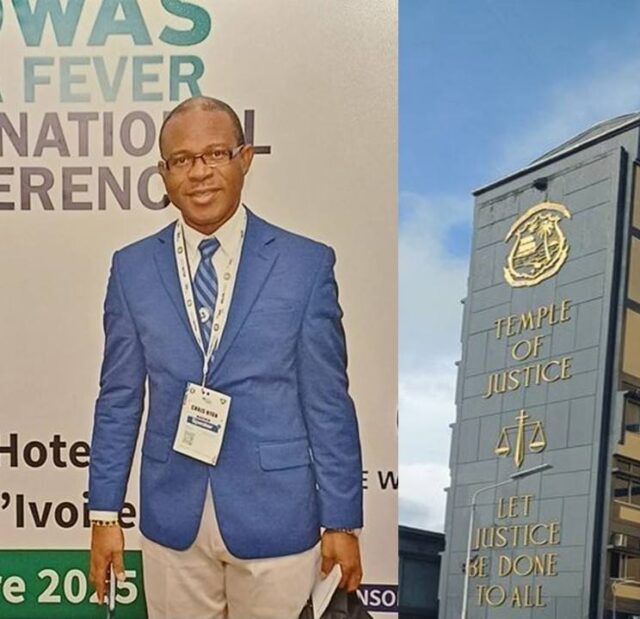
MONROVIA, Liberia — National Public Health Institute of Liberia (NPHIL) Director General Dr. Dougbeh Christopher Nyan has asked the Supreme Court to stop what he calls an unlawful attempt by the Executive Branch to remove him from office before the expiration of his statutory five‑year term.
In a petition for a writ of prohibition filed on October 23, 2025, before Chambers Justice Jamessetta Howard‑Wolokollie, Dr. Nyan names as respondents “the Executive Branch of the Liberian Government, represented by the Minister of Justice & Attorney General, the Solicitor General, and all persons acting under the authority of the Minister.”
He asserted “Respondent has unilaterally sought to remove Petitioner from his tenure position in contravention of the NPHIL Act and without due process.”

Key claims in the petition
- Fixed term and removal for cause: Citing Sections 4.3 and 4.4 of the National Public Health Institute Act of 2016, the petition says the NPHIL Director General is appointed by the President upon recommendation of the Board of Directors to a fixed five‑year term and “may only be removed for cause, including corruption, conversion, incapacity, conflict of interest, or other misconduct, and only after due process.”
- No accusation, no inquiry: “Petitioner was duly appointed and commissioned to serve his five‑year statutory tenure and has not been accused, charged, or investigated for any act constituting a statutory cause for removal,” the filing states.
- Attempted removal by executive directive: Dr. Nyan alleges that on or about September 12, 2025, communications “issued under the authority of the Minister of Justice/Attorney General” were circulated instructing officials to resist his performance and to recognize no acts “of the Director General,” which he characterizes as an executive attempt to oust him without Board action or due process.
- Tenure not expired: The petition says his tenure commenced in September 2021 and runs through September 17, 2026, and that any premature removal “is illegal, arbitrary, and unconstitutional.”
Relief requested Dr. Nyan asks the Court to:
- Order the respondents and “all its agents, assigns and confederates” to cease enforcing his removal, and to conduct a conference to determine the legality of the respondents’ action;
- Declare any removal “illegal, unconstitutional, and void ab initio” as violative of the NPHIL Act of 2016, the Administrative Procedure Law, the Judiciary Law, and Article 20(a) of the 1986 Constitution (due process);
- Reinstate him “with all rights, privileges and benefits,” and issue a status quo ante order pending final disposition of the petition.

The petition is signed by Senior Counselors for the petitioner and filed on October 23, 2025.
What the NPHIL law says
The NPHIL Act was enacted in 2016 in the wake of the Ebola epidemic to institutionalize national public‑health functions. The law provides for a Board of Directors and a Director General appointed by the President upon Board recommendation. It fixes a five‑year tenure for the Director General and specifies removal “for cause” with due process—a protection designed to insulate core public‑health leadership from routine political turnover.
Dr. Nyan’s tenure and public‑health record
Appointed in August 2024, Dr. Nyan’s petition lists institutional achievements during his term, including laboratory upgrades, regional recognition, and technical partnerships. It notes that under his leadership NPHIL was designated by Africa CDC as an “Africa Regional Center of Excellence for National Public Health Institute Development,” and claims no investigation or charge has been brought against him that would trigger a removal‑for‑cause process.
What prohibition does

A writ of prohibition is an extraordinary remedy the Supreme Court may issue through its Justice in Chambers to prevent a branch or official from taking an action alleged to be outside the law or without jurisdiction. If an “alternative writ” or a stay is issued, the status quo is generally maintained while the Court hears arguments on the merits.
Government response
The Ministry of Justice had not issued a public response to the filing by press time. The petition asserts that any removal directed by executive instruction violates the NPHIL Act’s tenure and Board‑governance scheme; the government is expected to argue its legal basis for any personnel action when the matter is set down for conference.
Why this matters
The case tests Liberia’s framework for protecting the leadership of statutory public‑health institutions from summary removal—a governance lesson drawn from Ebola and reinforced during COVID‑19. It also touches the broader constitutional themes of due process and the limits of executive discretion where the Legislature has created tenure protections.
Next steps
Justice Howard‑Wolokollie may call a conference of the parties and decide whether to issue an alternative writ and a stay. If the Court finds the petition has merit, it could restrain any removal action pending a final ruling. If it finds the Executive acted within law, the petition could be denied.
NPHIL’s role
NPHIL leads Liberia’s disease surveillance, laboratory networks, and public‑health emergency preparedness in coordination with the Ministry of Health and the National Public Health Institute’s regional partners, including Africa CDC and WHO. Stability and clarity at the top of NPHIL are seen by health experts as central to sustaining gains in early warning and response.
Editor’s note: Allegations and claims summarized above are drawn from the petition filed with the Supreme Court. The respondents will have the opportunity to respond in court. All parties are presumed to be acting within their asserted legal rights until the Court rules.