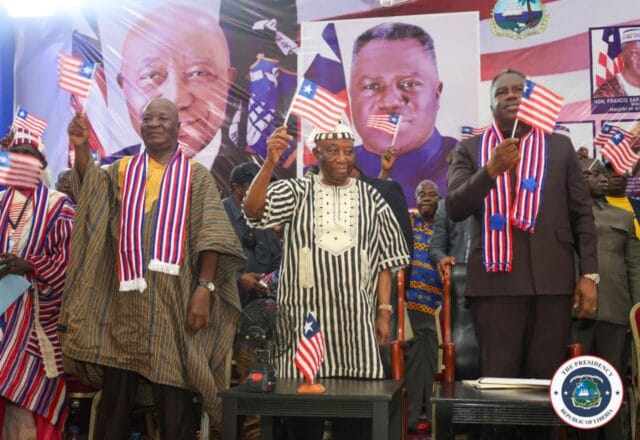
GBARNGA, Bong County – President Joseph Nyuma Boakai, Sr. has issued one of his clearest calls yet for national unity and shared responsibility, urging Liberians in the Kpelle language to “Kwa pa ku kalay ku noi toh” — “Let’s come together and build our land” — as he opened the first‑ever National Assembly of Chiefs and Tribal Governors in Gbarnga, Bong County.
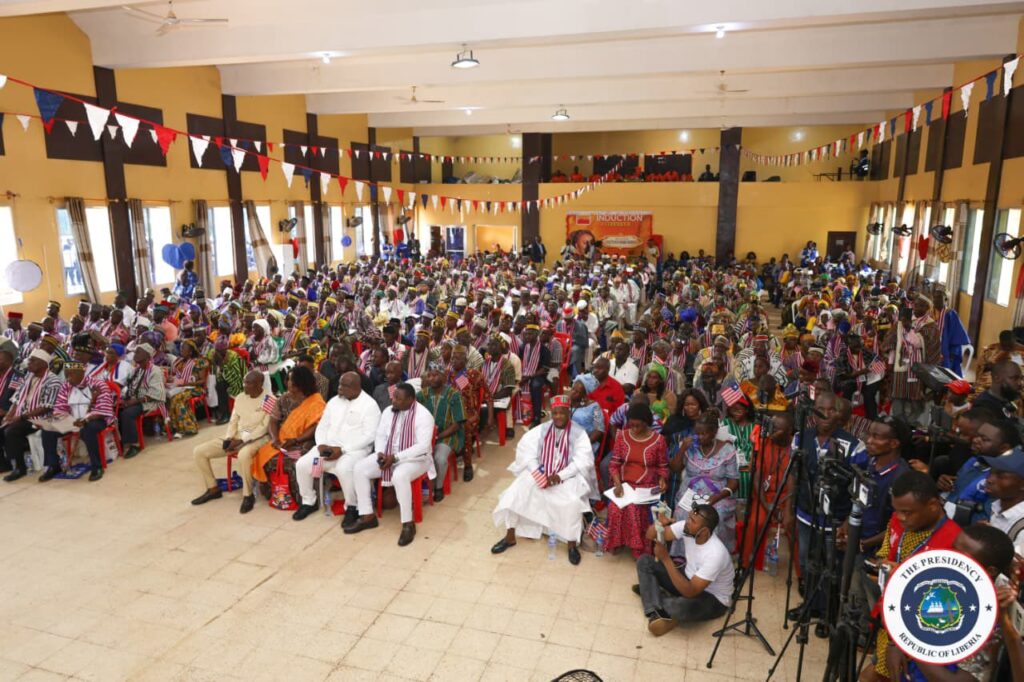
The two‑day assembly, held Friday and Saturday, November 21–22, in the heart of Kpelle country, brought together paramount and clan chiefs, tribal governors, superintendents and local officials from across all 15 counties. Kpelle, Liberia’s most widely spoken indigenous language, was deliberately chosen as the rallying cry, symbolizing a call to unity that cuts across ethnic, regional and political lines.
“We have one of the best countries,” President Boakai told the packed hall. “And we should all work to make it what it should be.”
Chiefs as Partners, Not Spectators
In an address that blended tradition, development and democratic reform, Boakai paid visible tribute to the assembled leaders:
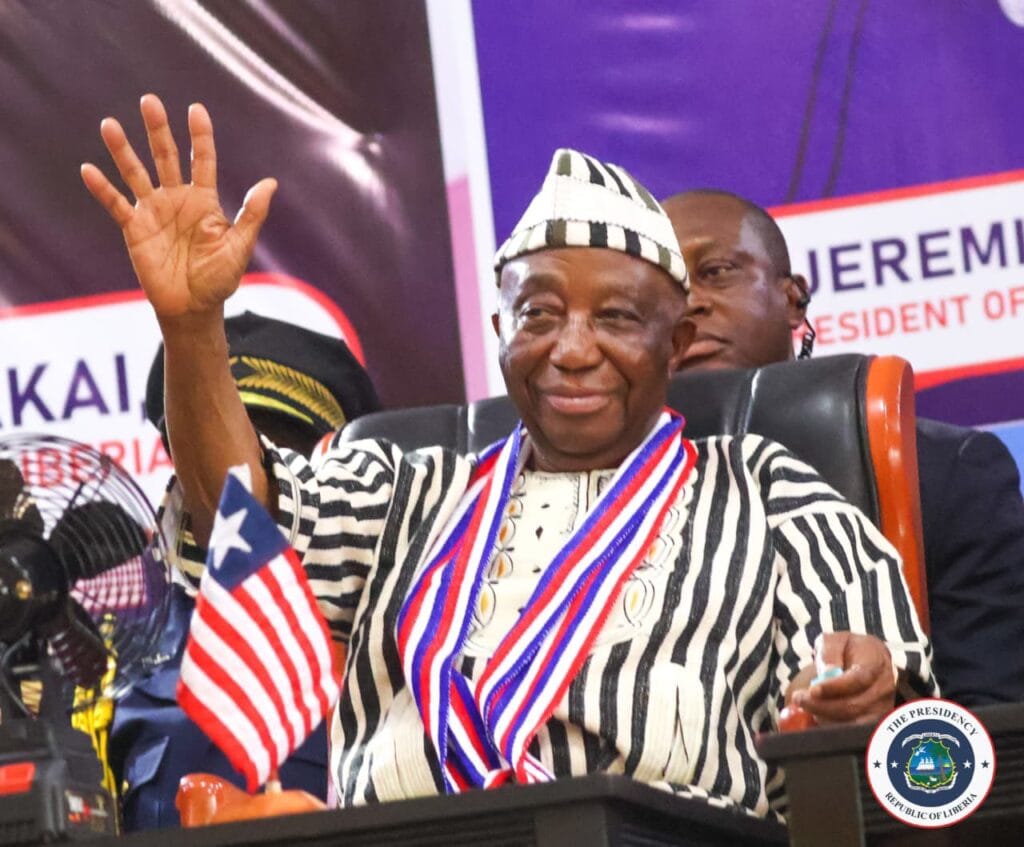
“To be very frank with you, I’ve never seen our chiefs looking so good,” he said to loud applause. “You know our tradition is, when you see the chief, you should know. [They] look like chiefs, look like leaders. I want to congratulate you for looking so good.”
But beneath the light moment was a serious message: chiefs, elders and governors are not bystanders, he insisted, but frontline partners in rebuilding Liberia.
“You are not observers. You are part of this government,” Boakai declared. “You take the role you play to build this country.”
He urged local leaders to take ownership of projects in their communities—especially roads and infrastructure—once contractors leave.
“Sometimes when people go to build roads in your counties, you don’t wear this ‘they probably wear that government thing,’” he said. “It is your thing because when they leave, it’s there; it’s for you. So, you make sure that the people don’t take the materials away; they don’t steal anything. Make sure you protect them because they are for you.”
Gbarnga: Symbolic Capital of Unity
Choosing Gbarnga—the capital of Bong County and the cultural heartland of the Kpelle people—as the venue for this first national assembly was no accident. The Kpelle language, variants of which are spoken or understood in communities across Liberia, made the President’s call instantly accessible to thousands beyond the walls of the conference hall.
By anchoring the event in central Liberia rather than Monrovia, Boakai also underscored his administration’s pledge to break with the hyper‑centralized political culture that has long defined the Liberian state.
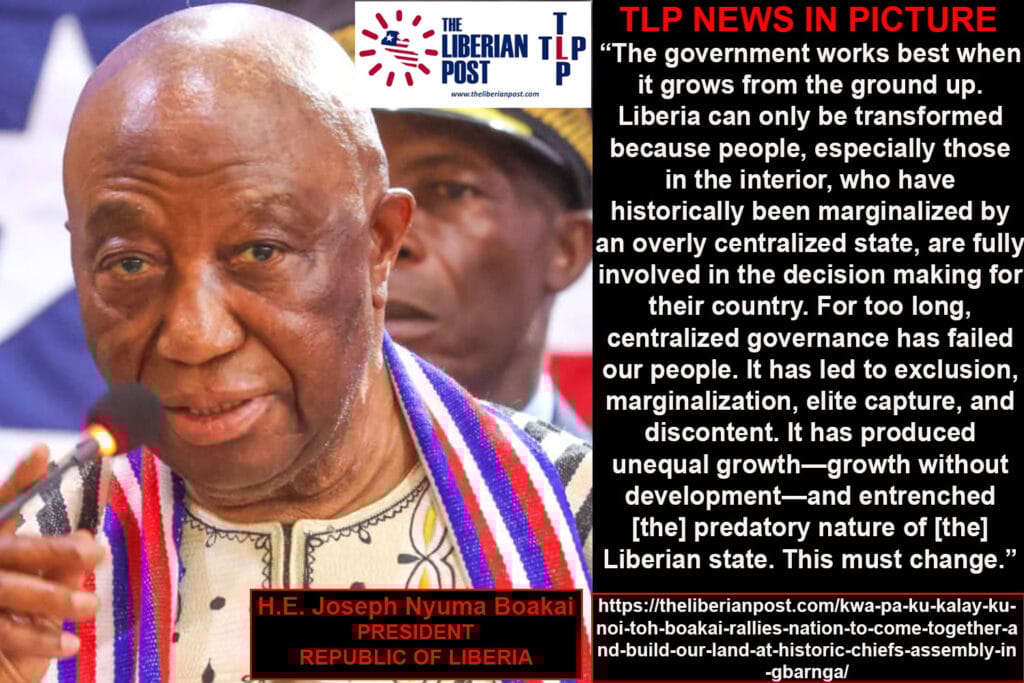
“The government works best when it grows from the ground up,” he said. “Liberia can only be transformed because people, especially those in the interior, who have historically been marginalized by an overly centralized state, are fully involved in the decision‑making for their country.”
He thanked the Minister of Internal Affairs for organizing what he said he expects to become an annual platform between national leaders and local authorities — “one that promotes peace, security, decentralization, and inclusive development.”
From Centralized Rule to Shared Power
Boakai used the assembly to deliver one of his sharpest critiques yet of the old model of governance.
“For too long, centralized governance has failed our people,” the President argued. “It has led to exclusion, marginalization, elite capture, and discontent. It has produced unequal growth—growth without development—and entrenched [the] predatory nature of [the] Liberian state. This must change.”
He insisted that decentralization is not a slogan, but “the key to Liberia’s development.”
“When government is too centralized, the majority of people are left on the periphery of national life,” he said. “When decisions affecting the well‑being of our rural communities are made far away from these communities, development cannot be meaningful, inclusive, and sustainable. True democracy thrives when people participate fully in shaping the decisions that govern their lives.”
Boakai reminded the gathering that in his Legislative Agenda, presented on January 29, 2025, he submitted a bill to create a Ministry of Local Government to fully implement the Local Government Act of 2018—a document he described as “the foundation of our decentralization effort.”
“I again urge the Legislature to pass the bill,” he said. “This approval could transform Liberia more than nearly any other reform currently before us.”
“Our Tradition Is in Place”
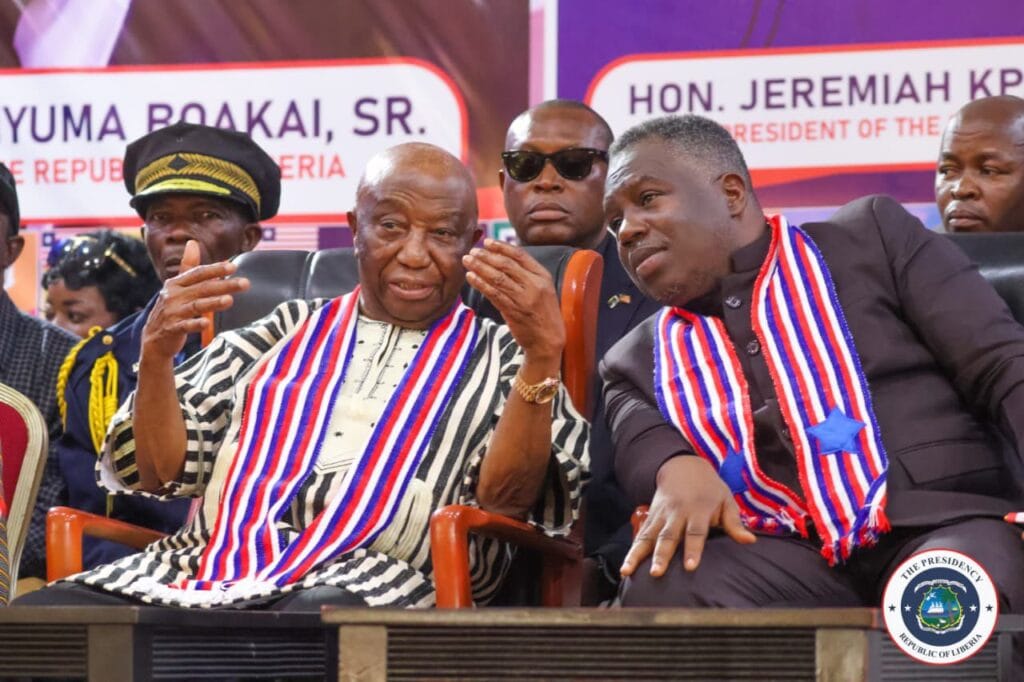
In words that resonated strongly with his audience of chiefs and elders, Boakai pushed back against the notion that Liberia’s indigenous systems are backward or irrelevant.
Recalling the Ebola crisis, he noted that international actors only then began to appreciate the informal surveillance and social control systems that villages already had in place.
“There was a time that people didn’t believe that our people had any system in place,” he said. “But then they learned that our people have what they call the triage. There are no strangers that come to the village that the chief there doesn’t know where they came from… Our tradition is in place. It has helped us to come this far.”
“We had a system, and that’s what you represent,” he told the chiefs. “Everybody works to improve, but that doesn’t mean that we didn’t have a system.”
In tying modern governance reforms to traditional structures rather than against them, Boakai sought to nationalize the decentralization agenda as a patriotic project, not a technocratic one.
Roads, Agriculture, Dignity
The President linked the call to “come together and build our land” directly to his ARREST Agenda—Agriculture, Roads, Rule of Law, Education, Sanitation and Tourism—arguing that basic infrastructure is the most powerful anti‑poverty tool available.
“All these things—we’re talking about poverty, poverty,” he said. “You build good roads, good water, electricity, you will see how people’s lives will begin to improve.”
He pointed to plans already underway:
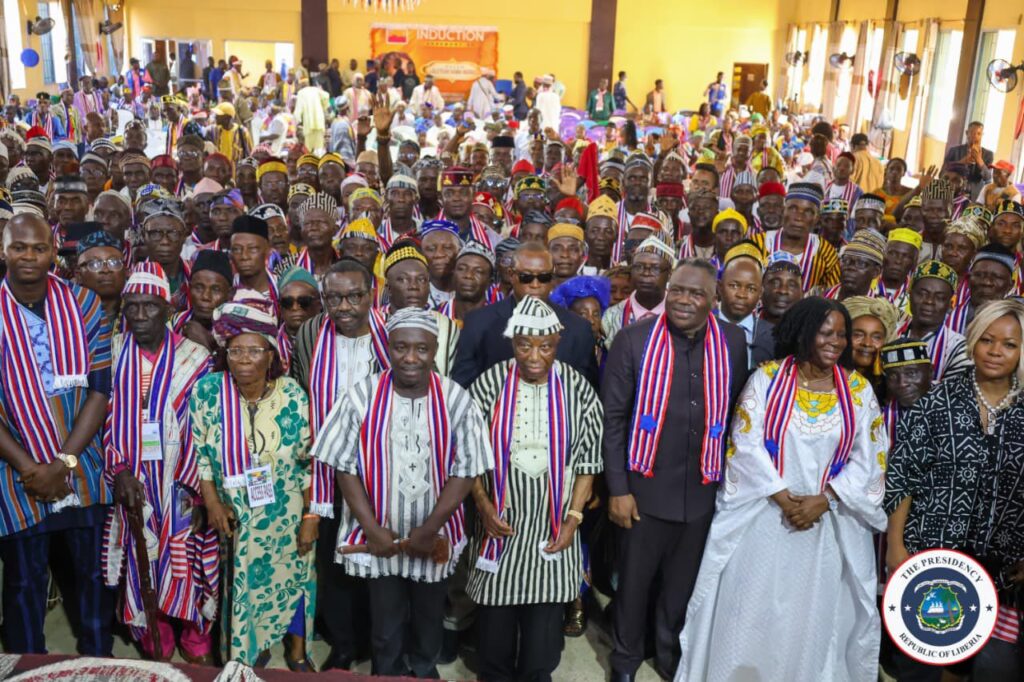
- “Yellow machines” and bridges, referenced by Vice President Jeremiah Kpan Koung, to open up production areas;
- Expanding electricity and water systems — “because we believe that Liberians deserve dignity”;
- A reimagined education system: “We’re not just going to build schools like the way they used to build them. We want to build schools that produce young people for the future of the world, not just Liberians.”
Boakai also highlighted a major fiscal milestone:
“For many, many years our budget [was] 700 million or this and that,” he said. “The first time we’ve gone to US$1.2 billion of budget, never before. It means that our capacity is built enough to be able to build our country, to serve our people.”
Making Bong a National Hub
In a nod to Bong County’s strategic importance, the President reiterated a pledge he had previously made to turn Gbarnga into a national conference center and sports development hub.
“I told the people of Bong County, I think because of the central location of Bong County, we said we’ll make Bong a conference center,” he said, noting that it would be “a cheap place to stay” for national events.
“And not only that, I even told them we’re going to put a football academy here where young people will be trained, because you can come from all the counties and do that.”
The promise—made on Kpelle land, in a Kpelle‑majority city—carried a symbolic weight: Bong would no longer just be the country’s geographic center, but a meeting point for national dialogue, talent and unity.
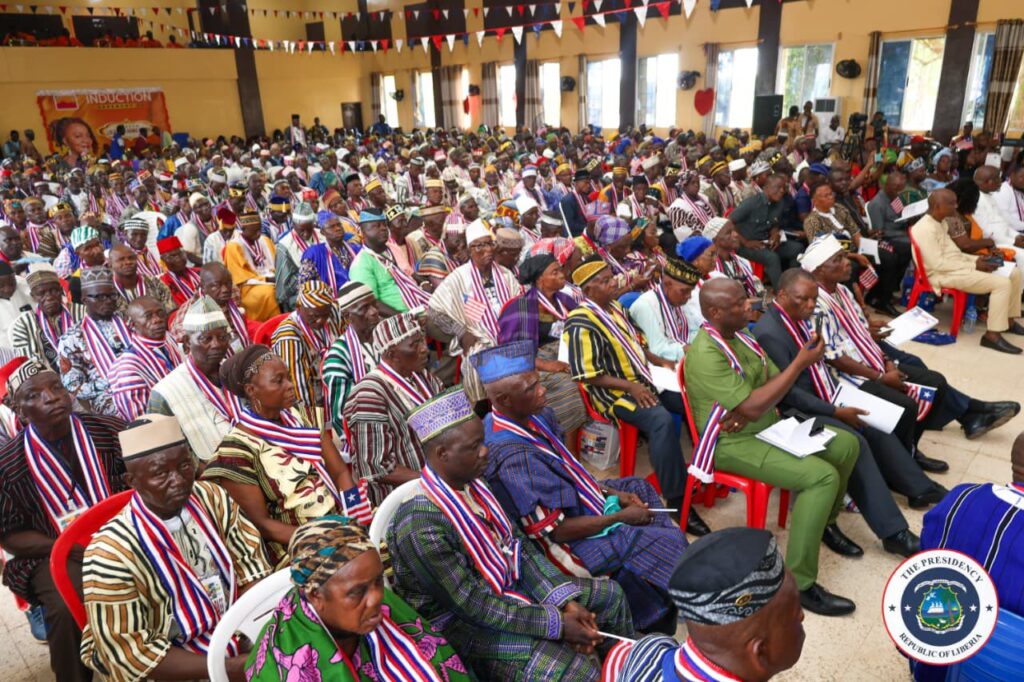
“Nothing Is Going to Stop Liberia From Moving Up”
Throughout his address, Boakai returned to a theme of unshakable national optimism, grounded not in denial of Liberia’s problems but in belief in Liberian capacity.
“We have one of the best countries and we should all work to make it what it should be,” he told the assembly.
“All these plans are in the way… We are committed to it and there’s nothing that’s going to stop Liberia from moving up. Nothing. God himself has approved that.”
By framing the chiefs and governors as co‑architects of that upward movement—and by rooting his appeal in the widely understood Kpelle phrase “Kwa pa ku kalay ku noitoh”— Boakai used the Gbarnga gathering to send a message far beyond Bong County:
Liberia’s renewal, he argued, will not be designed in air‑conditioned offices in Monrovia alone, but built from the ground up, by communities, chiefs and citizens who see the country as their own project.
In a nation often fractured by history, ethnicity and politics, the President’s bet is that a simple command in the nation’s most widely spoken local tongue — “Let’s come together and build our land”—can become not just a slogan, but a shared marching order.